
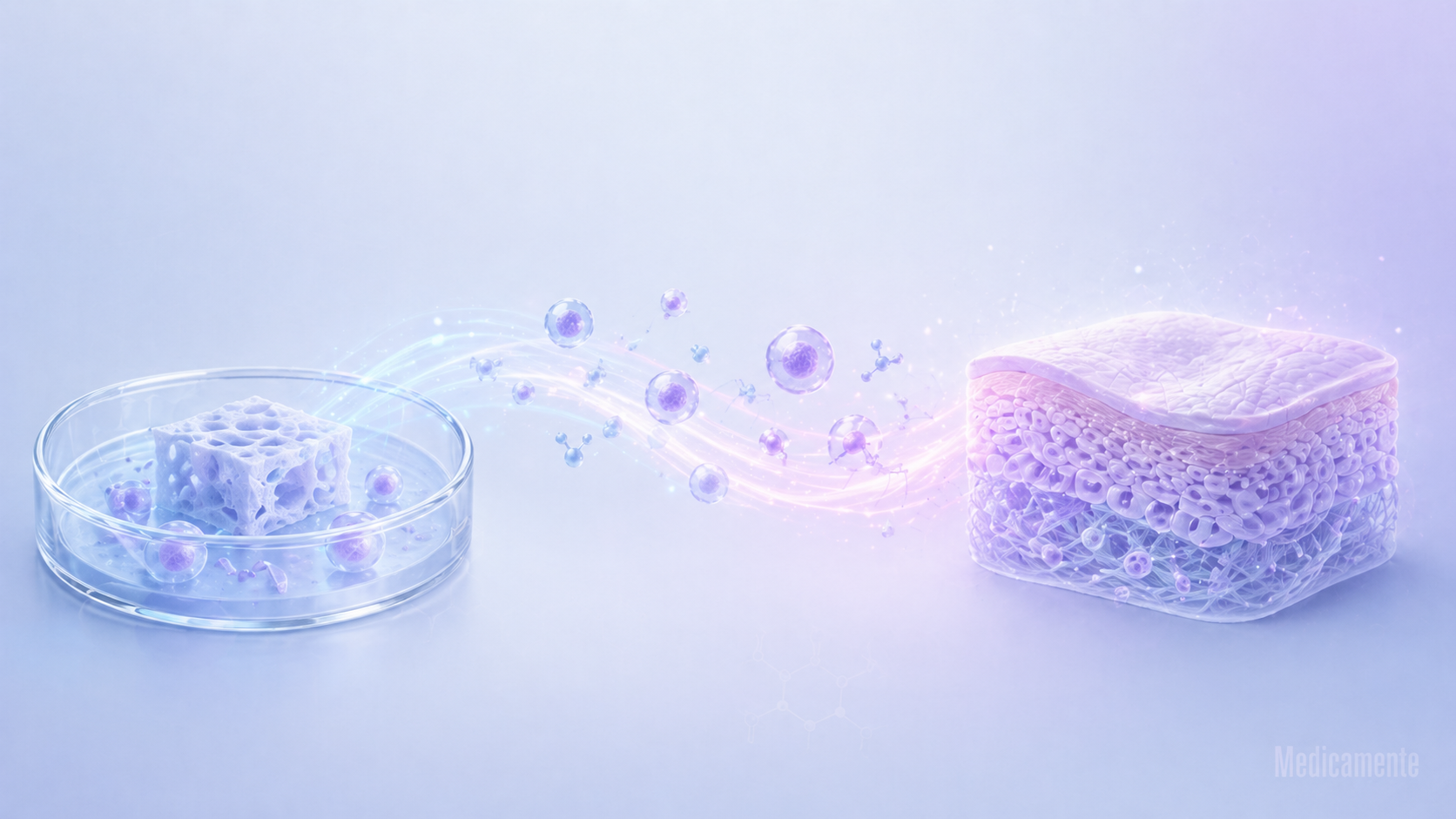
How cells, biomaterials and organoids are changing organ repair
Regenerative medicine has become one of the most ambitious directions in modern biomedicine. Its goal differs from the classical approach, in which disease is treated mainly with drugs, surgery or supportive methods. Regenerative medicine aims to restore damaged tissue, replace lost cellular function or create conditions in which the body can partially rebuild the structure of an organ. At the center of this field are cells, biomaterials, growth factors, genetic modification, tissue engineering and technologies for growing miniature models of organs.
Why this direction is important. Many severe diseases are associated not only with impaired organ function, but also with irreversible loss of specialized cells. In myocardial infarction, cardiomyocytes die; in Parkinson’s disease, dopaminergic neurons are damaged; in type 1 diabetes, pancreatic beta cells are destroyed; in burns, the skin is lost; and in chronic liver or kidney disease, tissue architecture is gradually disrupted. Conventional drugs can slow the process, reduce symptoms or lower the risk of complications, but they are far from always able to restore lost cellular mass. This is where technologies that work not only with the symptom, but with the tissue basis of disease itself, become relevant.
Stem cells have become one of the key tools. They have the capacity for self-renewal and differentiation into specialized cell types. In clinical practice, hematopoietic stem cell transplantation has long been used for certain diseases of the blood and immune system. Newer directions go further: researchers are trying to obtain heart cells, nervous system cells, retinal cells, pancreatic cells, liver cells and other tissue types from stem cells. Induced pluripotent stem cells, or iPS cells, are especially important. They are produced by reprogramming mature cells into a state close to embryonic stem cells. This opens the possibility of creating cellular products genetically related to a specific patient or selected from special cell banks.
One of the most notable developments in recent years has been the progress of iPS-cell therapies. Such technologies show how reprogrammed cells can gradually move from laboratory research toward regulated clinical medicine. They do not mean immediate mass use or universal tissue repair, but they mark an important stage in the transition from experimental cell biology to therapies that can be evaluated according to medical, regulatory and manufacturing standards.
Growing tissues is not limited to cell transplantation. Cells need an environment in which they can survive, attach, receive signals, form structure and interact with neighboring cells. For this reason, tissue engineering has become the second major direction. It combines cells, biomaterials and biophysical conditions. A biomaterial can act as a temporary scaffold that guides tissue growth, keeps cells in the required area and is gradually replaced by the body’s own structures. This approach is especially important for skin, cartilage, bone tissue, blood vessels, heart valves and other structures where mechanical properties are almost as important as cellular composition.
Organoids have become a separate breakthrough tool. An organoid is a three-dimensional structure grown from stem cells or tissue-specific cells that reproduces part of the cellular composition and functions of an organ. It is not a full organ in miniature, but a model that imitates selected features of tissue: architecture, cellular diversity, drug response or elements of development. Organoids are important because they allow researchers to study human biological processes in a system that is more complex than a flat cell culture, but more controlled than the whole organism.
The clinical significance of organoids is already extending beyond fundamental science. They are used to model diseases, test drugs, study the individual response of tumors to therapy, investigate hereditary disorders and assess drug toxicity. For example, tumor organoids can be grown from a patient’s material and used to study sensitivity to different drug combinations. Intestinal, liver, brain, kidney and lung organoids help investigate disease mechanisms that are difficult to study directly in the human body. This is especially important when animal models poorly reflect human biology.
However, organoids still have serious limitations. They often lack a complete vascular network, mature immune system, complex innervation and mechanical load characteristic of a real organ. Tissue in the body does not exist in isolation: it receives blood, oxygen, hormonal signals, neural regulation and immune surveillance. Therefore, an organoid may model one aspect of disease well, but not the entire clinical reality. Modern research is attempting to overcome these limitations through vascularized organoids, organs-on-chips, co-culture of different cell types and bioreactors.
Particular attention is being paid to the creation of vascular networks. Without blood supply, it is impossible to grow a large viable tissue because cells deep inside the construct do not receive enough oxygen and nutrients. Research on laboratory models of human skin and other tissues shows how individual vascular cells can form complex microvascular networks that mature over time and respond to inflammatory signals. Such studies are important not because they already allow entire organs to be replaced, but because they show a path toward more physiological tissue models.
Another direction is 3D bioprinting. In this technology, cells and biomaterials are deposited layer by layer to create a structure with defined geometry. Bioprinting is especially interesting for tissues where spatial organization is important: cartilage, skin, vascular structures, bone defects and tumor models. Printing full organs for transplantation remains a complex task. A real organ contains many cell types, blood vessels, nerves, extracellular matrix, ducts and mechanical gradients. But bioprinting is already helping create experimental models, test drugs and develop individualized implantable constructs.
The regulatory side of regenerative medicine requires particular strictness. Cell and tissue products differ from ordinary chemical drugs. Their properties depend on the source of cells, culture method, genetic stability, purity, maturity, risk of tumor transformation, immune compatibility and manufacturing control. Regulators are developing special pathways for regenerative medical therapies in serious conditions, but accelerated development does not mean lowering requirements for evidence of safety and efficacy. In this field, careful evaluation is especially important because the interventions may have long-term and partly irreversible consequences.
The main risk in this area is premature clinical application. Because patients are highly interested in restorative technologies, offers of unproven “stem cell” procedures without sufficient scientific basis can appear. This is dangerous. The administration of poorly characterized cells may lead to inflammation, infection, immune reactions, formation of unwanted tissues, worsening of the underlying disease or absence of benefit despite significant risks. Therefore, regenerative medicine must develop through controlled clinical trials, standardized manufacturing and transparent patient information.
The future of the field will probably not be one universal method, but a set of specialized technologies. For some diseases, cellular transplants will be used; for others, biomaterial scaffolds; for others, organoids as diagnostic models; and for others, a combination of gene correction and cell therapy. The integration of regenerative medicine with personalized diagnostics looks especially promising. If a patient’s cells can be reprogrammed, the disease studied in the laboratory, drugs tested and then an individualized therapeutic strategy created, medicine gains a new level of precision.
Regenerative medicine does not yet solve the shortage of donor organs and does not allow full organs to be grown routinely for transplantation. But it is already changing the understanding of treatment. An organ is no longer viewed only as a structure that can be replaced by a mechanical device or supported with drugs. It becomes a biological system that can be modeled, partially restored and studied at the cellular level. This field is developing slowly because it requires high safety, long-term follow-up and complex manufacturing. But this caution is precisely what makes it medically meaningful. Regenerative medicine is important not because it promises instant restoration of any organ, but because it is gradually moving tissue repair from experimental biology into regulated clinical practice.
Write a review
Required fields are marked with *
Categories
- Therapy (81)
- News (48)
- GP (23)
- Cardiology (20)
- urology (12)
- Endocrinology (8)
- Ortopedics (4)
- Dermatology (3)
- Ultrasound (1)
- Mobile app (1)
Articles





Archive
- September 2026 (11)
- August 2026 (11)
- July 2026 (11)
- June 2026 (11)
- May 2026 (9)
- April 2026 (8)
- March 2026 (8)
- February 2026 (8)
- January 2026 (8)
- December 2025 (5)
Categories
- Therapy (81)
- News (48)
- GP (23)
- Cardiology (20)
- urology (12)
- Endocrinology (8)
- Ortopedics (4)
- Dermatology (3)
- Ultrasound (1)
- Mobile app (1)


