
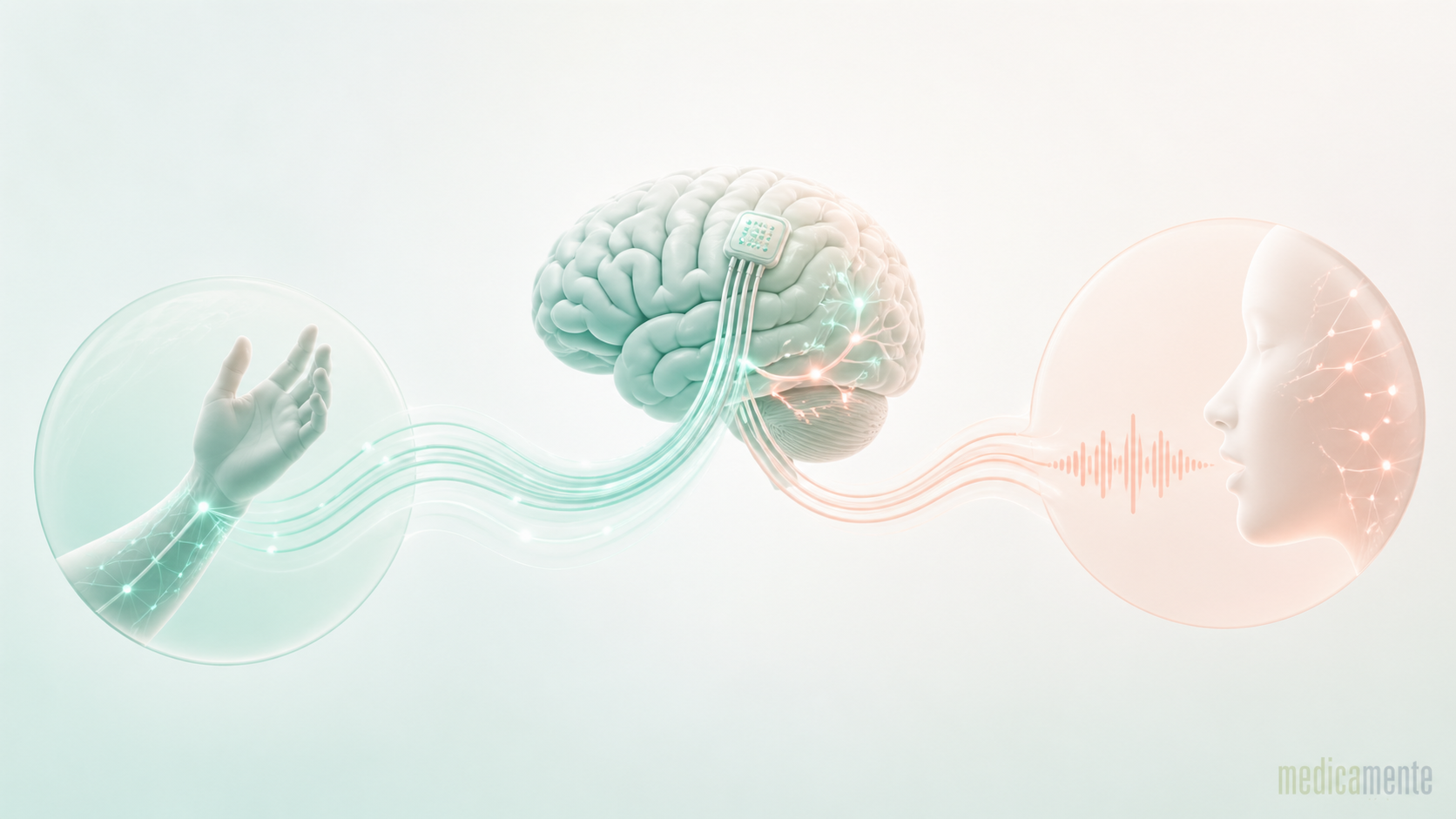
How the brain learns to control the body and communication again
Neurointerfaces have become one of the most notable technologies in modern neurology because they create a direct pathway between the nervous system and an external device. Such an interface can record electrical activity from the brain, spinal cord or peripheral nerves, transform it into a digital signal and use it to control a computer, prosthesis, robotic arm, muscle stimulator or speech synthesis system. In rehabilitation, this is especially important because many patients retain the intention to move or speak, but damage to neural pathways prevents this intention from being carried out in the usual way.
The main idea of a neurointerface is not to “read thoughts” in the everyday sense. The medical task is much more specific: to register patterns of neural activity associated with an attempt to move, speak or choose an action, and to translate them into a useful command. In a person with paralysis, the brain may continue to form a motor intention, but the signal does not reach the muscles because of spinal cord injury, stroke or a neurodegenerative process. A neurointerface attempts to bypass the damaged link and create a new functional circuit.
There are different types of neurointerfaces. Non-invasive systems use electrodes on the surface of the head and record electroencephalographic signals. They are safer and easier to use, but usually have lower spatial resolution. Invasive systems use electrodes placed on the surface of the cortex or inside brain tissue. They provide a more precise signal, but require surgical intervention and long-term safety evaluation. Between these approaches, minimally invasive technologies are developing, such as endovascular electrodes delivered through blood vessels and capable of recording activity without open brain surgery.
In neurorehabilitation, the connection between neurointerfaces and neuroplasticity is especially important. Recovery after stroke or injury is not reduced to mechanical repetition of exercises. The nervous system must reorganize connections, strengthen preserved pathways and form new strategies for movement control. If a patient attempts to perform a movement and the system responds by activating functional electrical stimulation of muscles, robotic assistance or visual feedback, the brain receives confirmation of the link between intention and result. Such a closed loop may enhance learning and support restorative processes.
One of the most promising directions is the restoration of movement after stroke. A neurointerface can be used not only as a way to control a device, but also as a therapeutic system. For example, a patient imagines or attempts to move a hand, the algorithm recognizes the corresponding signal, and then triggers stimulation, virtual movement or mechanical assistance. In this model, the goal is not simply to compensate for a lost skill, but to stimulate the restoration of control. This differs from a prosthesis or ordinary assistive device: the aim is to train the nervous system through coordinated feedback.
In spinal cord injury, neurointerfaces solve a different task. If the brain is able to generate a command but the conducting pathways are damaged, the system can transmit the intention directly to an external device or to a stimulator that activates muscles and spinal networks. For a patient with tetraplegia, even partial restoration of hand grasp can have major significance: the ability to hold an object, use household devices or perform simple actions increases independence. However, such systems require careful patient selection. The level of injury, preservation of neural structures, time since injury, stability of the condition, cognitive ability to learn and readiness for prolonged rehabilitation all matter.
A separate direction is the restoration of communication. For people with amyotrophic lateral sclerosis, severe stroke or paralysis, the ability to express thoughts quickly and naturally may be no less important than restoration of movement. Brain-computer interfaces for speech attempt to decode attempted speech or movement-related signals and translate them into synthesized voice or text. This approach is especially important for patients who are cognitively preserved but cannot speak because of damage to motor pathways. The goal is not simply to produce words, but to restore a more natural form of interaction.
Speech neuroprostheses are developing rapidly because communication has a complex neural structure. Speech involves planning, articulation, breathing, voice production, language networks and motor coordination. When a person attempts to speak, the brain may still generate signals related to intended sounds or words even if muscles cannot execute them. Algorithms can learn to associate these patterns with phonemes, words or text. The more stable and precise the signal, the closer the system can come to real-time communication.
Neurointerfaces can also restore digital communication through typing. Some systems decode attempted finger movements and translate them into characters on a screen. This direction shows that communication recovery does not have to rely only on speech. For some patients, fast and accurate text input may be more practical, especially if voice synthesis is difficult or if language processing models need additional adaptation. The clinical value depends on speed, error rate, fatigue, daily usability and the degree of independence the system gives to the patient.
However, neurointerfaces remain complex medical technologies. Their effectiveness depends on signal quality, electrode stability, algorithm reliability, patient training, implantation safety and the possibility of daily use. A system that works well in the laboratory is not necessarily convenient in real life. A patient needs not a demonstration of a single movement, but a stable tool that can be used repeatedly, without excessive fatigue, technical failures or complicated setup.
Training is an essential part of this field. A neurointerface is not simply installed and used immediately like an ordinary device. The patient learns how to generate stable neural patterns, and the algorithm learns how to interpret them. This mutual adaptation can take time. Rehabilitation specialists, engineers, neurologists, therapists and the patient must work together. The success of the system depends not only on technology, but also on motivation, fatigue management, emotional state, cognitive function and realistic expectations.
Ethical questions are also becoming central. A neurointerface works with neural data, and such data are especially sensitive. It is necessary to understand who has access to signals, how they are stored, whether they can be used to train algorithms, how patient autonomy is protected and who is responsible for erroneous device commands. The more artificial intelligence participates in decoding signals, the more important system transparency becomes. The patient must remain the subject of control, not the object of automatic interpretation.
Safety includes both surgical and digital aspects. In invasive systems, the risks of implantation, infection, inflammation, electrode migration and long-term tissue response must be evaluated. In non-invasive and wearable systems, the risks are lower, but signal instability and misinterpretation remain possible. In systems that control movement, an incorrect command may have physical consequences. Therefore, neurointerfaces must include safeguards, confirmation mechanisms and clear limits on autonomous action.
The future of neurointerfaces will probably be connected with hybrid systems. They will combine neural signal decoding, robotic support, functional electrical stimulation, virtual reality, personalized algorithms and classical rehabilitation. Such an approach may be especially valuable in the chronic phase, when traditional methods provide limited progress but the nervous system still retains some ability to learn. At the same time, neurointerfaces do not eliminate the work of the rehabilitation physician, neurologist, occupational therapist, speech therapist or engineer. On the contrary, they require team-based medicine.
The main significance of neurointerfaces is that they change the goal of rehabilitation. In the past, with severe paralysis, medicine could often only adapt the environment and teach compensatory strategies. Now there is a possibility of partially restoring the connection between intention and action, even when the natural pathway is damaged. This does not mean complete cure of paralysis or stroke, but it creates a new class of restorative technologies. Neurointerfaces show that rehabilitation of the future will be not only physical training, but also precise tuning of interaction between the brain, device and body.
Write a review
Required fields are marked with *
Categories
- Therapy (81)
- News (48)
- GP (23)
- Cardiology (20)
- urology (12)
- Endocrinology (8)
- Ortopedics (4)
- Dermatology (3)
- Ultrasound (1)
- Mobile app (1)
Articles





Archive
- September 2026 (11)
- August 2026 (11)
- July 2026 (11)
- June 2026 (11)
- May 2026 (9)
- April 2026 (8)
- March 2026 (8)
- February 2026 (8)
- January 2026 (8)
- December 2025 (5)
Categories
- Therapy (81)
- News (48)
- GP (23)
- Cardiology (20)
- urology (12)
- Endocrinology (8)
- Ortopedics (4)
- Dermatology (3)
- Ultrasound (1)
- Mobile app (1)


