
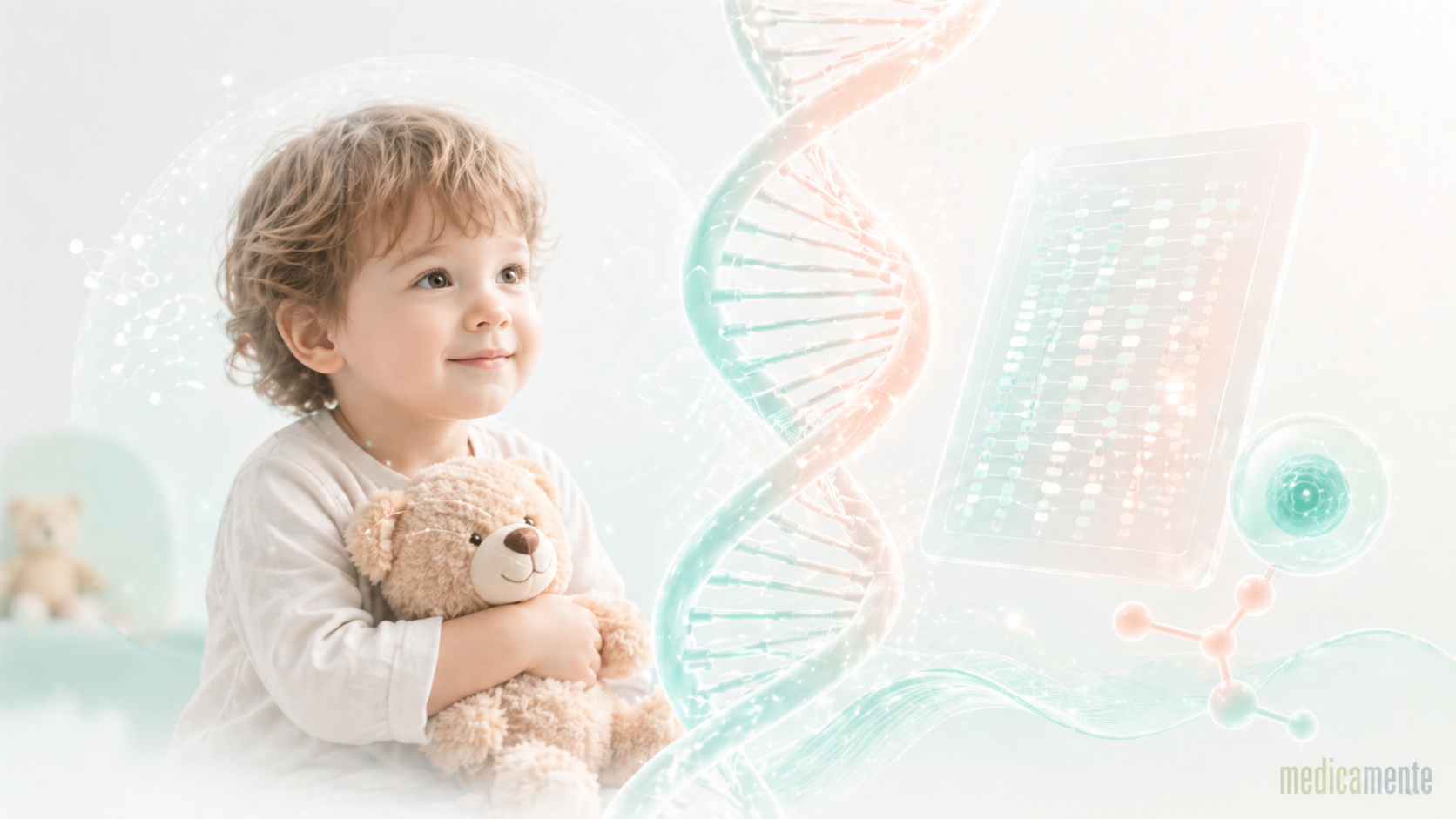
How early sequencing is changing the treatment of rare diseases
Genetic diagnostics in pediatrics is rapidly moving from a highly specialized research field into practical medicine. This is especially visible in newborns and children with severe, rare or unclear diseases, when standard examinations do not provide a precise answer. In such situations, time is critically important. A child may be in an intensive care unit, have seizures, breathing disorders, muscle weakness, developmental delay, congenital malformations, metabolic crises or a combination of symptoms that does not fit one obvious diagnosis. Genetic testing makes it possible to move from describing symptoms to searching for the cause.
Why this is especially important in childhood. Many genetic diseases appear early, but their signs may be nonspecific. The same symptom, for example hypotonia, delayed motor development or epileptic seizures, can occur in dozens of different conditions. Without molecular diagnostics, a child and family often go through a long path: consultations with different specialists, repeated tests, imaging, biopsies, hospitalizations and trial courses of treatment. This period is sometimes called a diagnostic odyssey. The earlier the precise cause is established, the sooner it becomes possible to determine whether targeted treatment exists, which complications should be expected and how the patient should be monitored.
Modern genetic diagnostics uses several levels of analysis. If a specific disease is suspected, testing of a single gene may be used. If the clinical picture points to a group of diseases, targeted gene panels are applied. Broader methods include exome sequencing and whole-genome sequencing. The exome covers protein-coding regions of the genome, where a significant proportion of known pathogenic variants are found. Whole-genome sequencing analyzes both coding and non-coding regions and may also better detect structural changes, copy number variants and some complex rearrangements. The choice of method depends on the clinical situation, availability of technology, urgency and the suspected diagnosis.
Rapid whole-genome sequencing in critically ill newborns occupies a special place. In an intensive care unit, decisions sometimes need to be made within days rather than months. Rapid genetic diagnosis can change treatment: discontinue ineffective interventions, prescribe specific therapy, adjust nutrition, avoid drugs with a risk of toxicity, determine the need for transplantation or clarify prognosis. This is one of the clearest examples of how genetic diagnostics can directly influence clinical decisions rather than remain only an explanatory tool.
Clinical benefit is especially visible in rare diseases. Although each individual rare disease occurs infrequently, together such conditions make up a significant part of severe pediatric pathology. Many of them have a genetic origin. If the diagnosis is established early, the family receives not only the name of the disease, but also a more understandable medical trajectory. The physician can assess the risk of involvement of the heart, kidneys, vision, hearing, nervous system or metabolism. Genetic counseling for parents also becomes possible, including assessment of the risk of disease recurrence in the family and planning of future pregnancies.
A separate direction is genomic newborn screening. Classical newborn screening has long been used to identify selected severe diseases before symptoms appear. It is usually based on biochemical markers from a blood spot. The new idea is to supplement or expand screening using sequencing. Such programs assess whether genomic sequencing can identify a larger number of rare conditions in newborns for which treatment, prevention of complications or early monitoring may be available.
Research results show that this approach is becoming increasingly realistic from a technical and organizational perspective. Large-scale sequencing of newborns is possible, but it raises important questions about which results should truly be returned to families and healthcare systems. The fact that a genetic variant can be found does not automatically mean that it should be reported in screening. The medical value depends on whether the information can lead to a meaningful action for the child.
Expansion of screening requires strict criteria. Not every genetic variant should be searched for in a healthy newborn. It is important that the detected condition be clinically significant, carry a clear risk for the child and imply an action: treatment, prevention of complications, early monitoring or a change in medical management. If a test identifies a variant of uncertain significance or a disease that will appear only in adulthood and has no childhood intervention, the benefit of such knowledge becomes questionable. Therefore, genomic newborn screening is not simply a technical question, but a medical, ethical and organizational task.
The addition of new diseases to newborn screening panels is important because some conditions are often diagnosed only after irreversible damage has already occurred. Early detection can change the timing of monitoring and treatment. At the same time, such decisions usually undergo scientific evaluation and public discussion because screening affects all newborns, not only patients with symptoms. This makes the threshold for evidence and ethical justification especially high.
Interpretation of results is of major importance. Sequencing creates a huge amount of data, but not every detected variant is the cause of disease. A variant may be pathogenic, likely pathogenic, benign, likely benign or of uncertain significance. Correct interpretation requires clinical data, family history, the child’s phenotype, variant databases, functional data and the experience of medical geneticists. Sometimes the diagnosis requires testing the parents to understand whether a variant was inherited or arose de novo. Sometimes the result must be reinterpreted after several years because scientific knowledge about genes and variants changes.
Ethical questions in pediatric genetics are especially important. A child cannot independently decide about testing, so responsibility lies with parents and physicians. It is necessary to explain which results will be analyzed, which incidental findings may appear, how data will be stored and who will have access to them. Genomic testing may reveal information important not only for the child, but also for parents or other relatives. For example, a variant may indicate a hereditary disease risk in the family. This requires careful genetic counseling and respect for confidentiality.
Genetic diagnostics is also changing the development of individualized therapy. The more accurately diagnostics identifies the molecular cause of disease, the more often the question arises of treatment designed for a very small group of patients or even for one specific genetic mechanism. This is particularly relevant for ultra-rare diseases, where traditional randomized trials are difficult or impossible because the number of patients is extremely small. Such situations require new regulatory, ethical and clinical approaches while maintaining the need for evidence and safety.
However, a genetic diagnosis does not always mean that treatment exists. This is one of the most important points for honest communication with a family. In some cases, the result immediately changes management. In others, it helps predict disease course, avoid unnecessary procedures and choose monitoring. Sometimes the diagnosis remains severe and treatment options are limited. But even in such situations, identifying the precise cause may reduce uncertainty, direct the family to specialized physicians, allow participation in registries or studies and provide information about reproductive risks.
The future of pediatric genetics will be connected with an earlier, faster and more integrated approach. Genetic testing will gradually become part of the standard pathway in severe neonatal conditions, unexplained developmental delay, epileptic encephalopathies, congenital anomalies, suspected inherited metabolic diseases and rare syndromes. At the same time, success will depend not only on the cost of sequencing, but also on the availability of specialists, quality of interpretation, speed of laboratory processes, ethical standards and the ability of the healthcare system to act on results.
The main significance of genetic diagnostics in pediatrics is that it changes the structure of clinical thinking itself. The physician is no longer limited to describing a set of symptoms. It becomes possible to search for the molecular cause, predict risks, select monitoring and, in some cases, choose causal therapy. For the child, this may mean a shorter path to diagnosis and more precise medical care. For the family, it means less uncertainty and a clearer understanding of the disease they are facing. Genetic diagnostics does not replace clinical experience, but becomes one of its most important extensions in the era of precision medicine.
Write a review
Required fields are marked with *
Categories
- Therapy (81)
- News (48)
- GP (23)
- Cardiology (20)
- urology (12)
- Endocrinology (8)
- Ortopedics (4)
- Dermatology (3)
- Ultrasound (1)
- Mobile app (1)
Articles





Archive
- September 2026 (11)
- August 2026 (11)
- July 2026 (11)
- June 2026 (11)
- May 2026 (9)
- April 2026 (8)
- March 2026 (8)
- February 2026 (8)
- January 2026 (8)
- December 2025 (5)
Categories
- Therapy (81)
- News (48)
- GP (23)
- Cardiology (20)
- urology (12)
- Endocrinology (8)
- Ortopedics (4)
- Dermatology (3)
- Ultrasound (1)
- Mobile app (1)


