
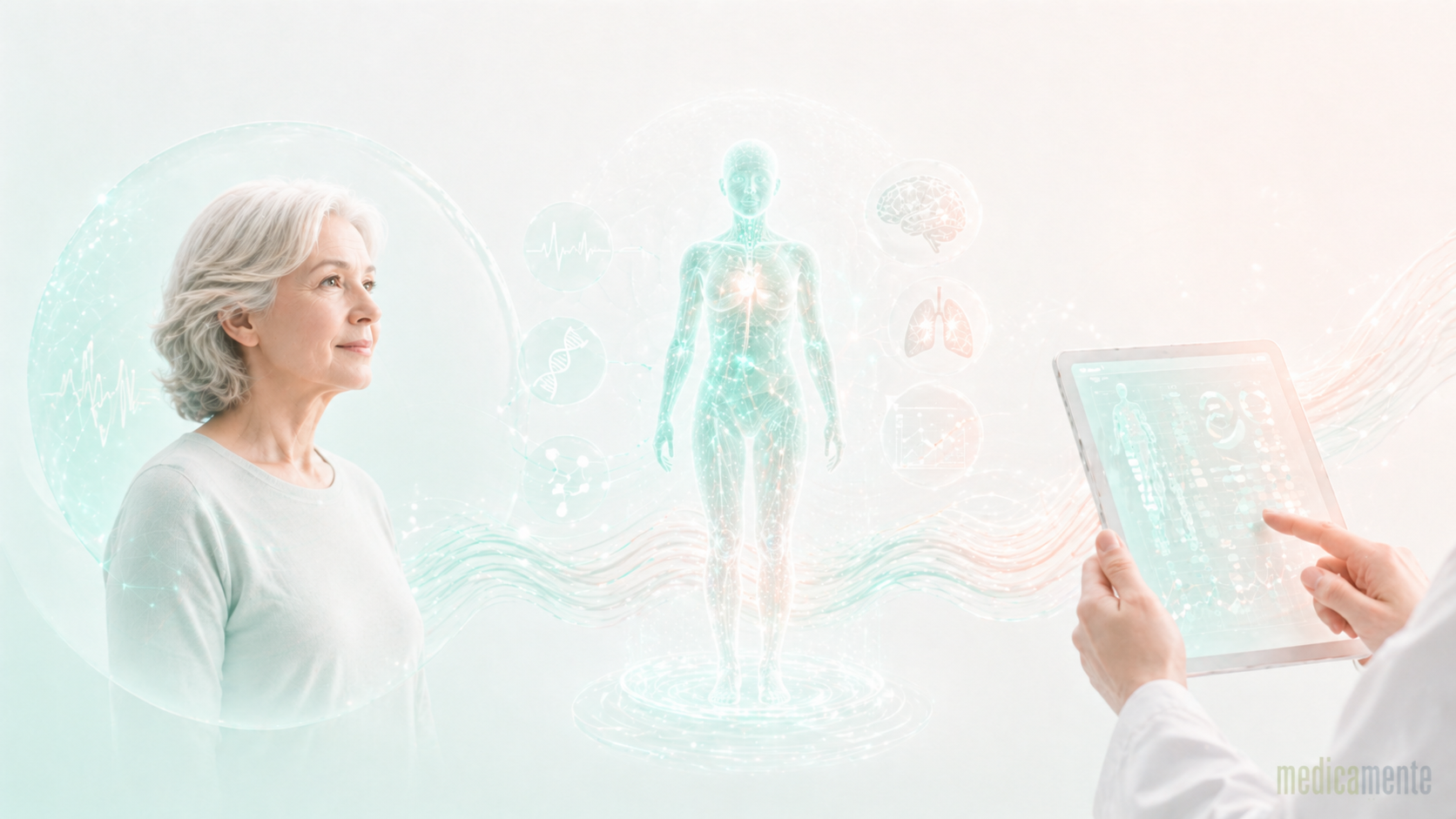
How virtual models help predict treatment outcomes
Digital twins of patients have become one of the most notable ideas in modern personalized medicine. In engineering, a digital twin means a virtual model of a physical object that is updated using data and helps predict its behavior. In medicine, this principle is transferred to the human body, an organ, a tumor, cardiac rhythm, drug response or clinical trajectory. The main goal is not to create an impressive visualization, but to build a model that helps the physician evaluate different scenarios in advance and choose a more informed strategy.
What is a digital twin of a patient. In a medical context, it is a dynamic computer model that can combine data from different sources: medical history, laboratory values, imaging results, genetic information, wearable device data, drug therapy, physiological parameters and information about disease course. Unlike an ordinary electronic health record, a digital twin does not simply store facts. It attempts to model how the patient’s condition may change over time and how different interventions may influence it.
An important difference between a digital twin and a standard prognostic algorithm is individualization. A classical prediction model often estimates risk based on statistics from a large group of patients. For example, it may show that a person with certain risk factors has a higher-than-average probability of complications. A digital twin aims to create a more specific model of this particular patient or this particular organ. It may take into account heart anatomy, tumor parameters, molecular data, treatment history, drug tolerability and current physiological changes. This makes the technology closer to the idea of a “virtual patient” than to a simple risk score.
One of the most developed areas is cardiology. The heart is well suited to digital modeling because its function follows electrical, mechanical and hemodynamic principles. Models already exist that combine data from MRI, electrocardiography, electrophysiological studies and myocardial anatomy. They make it possible to virtually assess electrical impulse propagation, areas of scar tissue, arrhythmia risk and potential targets for ablation. This is especially valuable in complex rhythm disorders, where the physician must understand not only that an arrhythmia exists, but also which tissue zones support it.
This example shows the practical meaning of a digital twin. In complex arrhythmia, the physician must determine which tissue areas maintain the pathological rhythm and where ablation may provide the greatest benefit with minimal damage to healthy myocardium. If different intervention options can be modeled before the procedure, treatment becomes more precise. This does not mean that the computer replaces the electrophysiologist. On the contrary, the model becomes an additional tool that helps the specialist prepare the procedure more effectively, reduce uncertainty and potentially limit the extent of intervention.
In oncology, digital twins are developing in a different direction. Here, the model must consider not only tumor anatomy, but also its molecular profile, growth rate, microenvironment, immune response, drug sensitivity and toxicity risk. An oncological digital twin can be used for several tasks. First, it may help predict how a tumor will respond to different treatment regimens. Second, it may model the risk of adverse effects if liver, kidney, bone marrow, cardiovascular and pharmacogenetic data are included. Third, it may be updated during treatment using liquid biopsy, imaging, tumor markers and clinical response data.
This approach is especially important because a tumor is not static. Under therapeutic pressure, it can evolve, acquire resistance and change its biological behavior. A digital twin may help view cancer not only as a diagnosis fixed at one moment, but as a dynamic system. This does not mean that all tumor behavior can already be predicted accurately. But the direction itself reflects a broader shift in oncology: treatment decisions increasingly depend on the integration of imaging, molecular testing, laboratory data and clinical dynamics.
Another area is clinical trials. Digital twins can be used to model patient groups, evaluate trial design, predict participant dropout and create external or synthetic comparison groups. Such approaches cannot simply replace control groups in every situation, but they may support the design and interpretation of clinical studies. For example, a model may help estimate what could have happened to a participant if they had received placebo rather than an active drug. This is especially relevant in rare diseases, where traditional large randomized trials may be difficult to conduct.
Digital twins may also help assess whether results from a clinical trial are transferable to another patient population. Trial participants often differ from real-world patients by age, comorbidities, treatment burden, disease severity or social factors. A model can help identify where a treatment effect is likely to remain stable and where uncertainty is higher. This does not eliminate the need for real clinical evidence, but it can improve understanding of how research results apply outside the original study population.
Digital twins are also being discussed in chronic noninfectious diseases. Diabetes, arterial hypertension, chronic heart failure, obesity, chronic kidney disease and chronic lung diseases develop over years and depend on many factors. For such conditions, a model can combine data on nutrition, physical activity, sleep, body weight, glucose, blood pressure, medications and symptoms. In theory, this allows the patient and physician to receive more adaptive feedback than during rare brief appointments. However, such systems must be tested not only for technical accuracy, but also for real improvement in outcomes.
A medical digital twin must not turn into an automatic “advisor” without oversight. The more data are used, the higher the risk of errors, bias and false precision. A model may appear convincing, but it can be wrong because of incomplete data, incorrect assumptions, outdated information or weak validation. A particularly dangerous situation arises when a digital twin produces a precise-looking prediction that has not been clinically tested. Therefore, any model output should be treated as a medical hypothesis, not as a final diagnosis or mandatory decision.
Regulatory and ethical issues are especially important in this area. A digital twin may include images, genomic data, laboratory results, behavioral information, wearable device data and treatment history. This creates high requirements for confidentiality protection. It must be clear where data are stored, who has access to them, whether they can be used for algorithm training, how the patient gives consent and how errors are corrected. The more complete the digital profile becomes, the more important it is to preserve patient autonomy and prevent misuse of sensitive information.
One of the main technical problems is data integration. A real patient does not exist as a perfectly structured table. Their data are distributed between laboratories, medical records, images, physician notes, wearable devices and sometimes home measurements. These sources differ in quality, frequency of updates and format. For a digital twin, it is necessary not only to collect data, but also to understand which data are reliable, which are outdated, which contradict one another and which truly have prognostic value. Without this, the model may become complex but not clinically useful.
The second important question is proof of benefit. A digital twin must demonstrate not only technical accuracy, but also improvement in medical outcomes. It may be interesting as a research tool, but for practical medicine it must be shown that its use leads to better treatment selection, fewer complications, fewer unnecessary procedures, more accurate prognosis or better quality of life. It is especially important to compare the model not with the absence of help, but with real standard clinical practice. Only then can it be understood whether a digital twin adds value to existing medical decision-making.
The future of this technology will probably be multilayered. There will not be one universal digital twin of the entire body that solves every task equally well. More realistic are specialized models: a cardiac digital twin for planning an arrhythmia procedure, a tumor twin for therapy prediction, a metabolic twin for diabetes management, a pharmacological twin for dose assessment or a rehabilitation twin for modeling recovery. Over time, these models may become connected, but clinical reliability will be built step by step.
The main significance of digital twins is that they change the way medical data are used. Data stop being only an archive of past events. They become a basis for modeling future scenarios: how the patient’s condition may change, what may happen if treatment is modified, where complication risk is higher and which pathway may be safer. This field is still between research medicine and early clinical implementation. Its success will depend on data quality, algorithm transparency, regulatory oversight and the ability of physicians to use models not instead of clinical reasoning, but as an extension of it.
Write a review
Required fields are marked with *
Categories
- Therapy (81)
- News (48)
- GP (23)
- Cardiology (20)
- urology (12)
- Endocrinology (8)
- Ortopedics (4)
- Dermatology (3)
- Ultrasound (1)
- Mobile app (1)
Articles





Archive
- September 2026 (11)
- August 2026 (11)
- July 2026 (11)
- June 2026 (11)
- May 2026 (9)
- April 2026 (8)
- March 2026 (8)
- February 2026 (8)
- January 2026 (8)
- December 2025 (5)
Categories
- Therapy (81)
- News (48)
- GP (23)
- Cardiology (20)
- urology (12)
- Endocrinology (8)
- Ortopedics (4)
- Dermatology (3)
- Ultrasound (1)
- Mobile app (1)


