
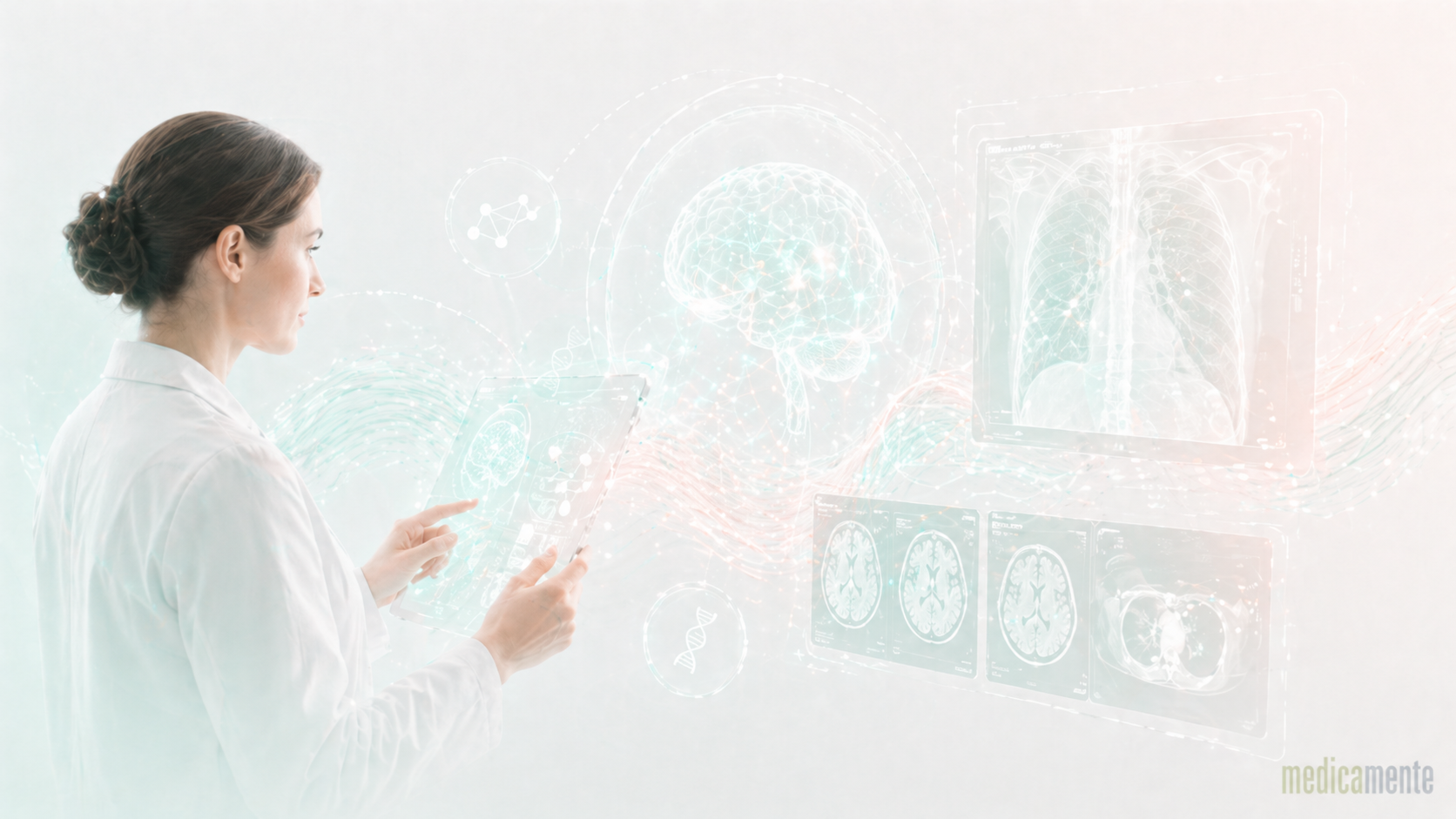
How algorithms are changing medical image diagnostics
Artificial intelligence has become one of the most actively implemented technologies in radiology. This is linked to the very nature of the specialty: radiology works with large volumes of visual data, where it is important to detect pathological changes quickly, compare images over time, assess lesion size and generate structured reports. Machine learning algorithms are well suited to such tasks because they can identify recurring visual patterns, measure parameters and help the physician pay attention to potentially significant areas.
Radiology has become a leading medical field in terms of the number of AI-based devices. This is not accidental. A medical image is already a digital object: CT, MRI, mammography and radiography produce data that can be stored, transmitted, annotated and analyzed. In many radiological tasks, there is also a relatively clear visual target: detecting a nodule, hemorrhage, fracture, thrombus, ischemic focus, tumor lesion or change in tissue density. This does not make diagnosis simple, but it creates conditions in which an algorithm can be trained on a large number of examples.
One of the most mature directions is mammography and breast cancer screening. Screening programs analyze thousands of images every day, and the physician’s task is to find a small number of potentially malignant changes among a large volume of normal examinations. This creates a high cognitive load. Algorithms can be used as a second reader, as a risk-sorting system or as a tool for preliminary marking of suspicious areas. It is important that such systems are evaluated not only by technical accuracy, but also by their impact on cancer detection, recall rates, false-positive results and radiologist workload.
However, the use of artificial intelligence in mammography does not mean automatic abandonment of the physician. Even if an algorithm sorts examinations well by risk, the decision about further evaluation remains clinical. Image quality, breast tissue density, previous studies, medical history, family risk, symptoms and results of other methods must be considered. An algorithm may help the physician identify a suspicious case more quickly, but it should not become the only filter through which the patient passes. Particular caution is needed with systems that promise fully autonomous image reading without radiologist participation.
Another important area is chest CT. Artificial intelligence can help detect pulmonary nodules, signs of pulmonary embolism, pneumothorax, pneumonia, interstitial changes, coronary artery calcification or signs of chronic disease. This trend shows that AI in radiology is beginning to be considered not only as a technical tool for imaging departments, but also as part of the patient pathway in oncology, cardiology and emergency medicine. The image becomes not just a diagnostic snapshot, but an element of a broader clinical decision.
The clinical value of such solutions depends on where exactly they are embedded in the workflow. One option is that the algorithm functions as a triage system and moves urgent cases higher in the queue. This is important when stroke, intracranial hemorrhage, pulmonary embolism or pneumothorax is suspected. Another option is quantitative measurement, for example tumor volume, nodule size, degree of stenosis or lesion dynamics. A third option is assistance in generating a structured report. In each case, the medical risk is different, so validation requirements must also differ.
In acute pathology, time is especially important. If an algorithm detects signs of intracranial hemorrhage or large vessel occlusion faster, the clinical team may begin evaluation and treatment earlier. But in such cases, image recognition alone is not enough. The whole chain matters: scanning quality, data transmission, alert settings, availability of specialists, routing protocols and speed of decision-making. An algorithm that works well by itself may not improve outcomes if it is poorly integrated into the hospital system.
Automatic measurement is a separate topic. A radiologist often compares a patient’s studies over time: whether a lesion has grown, whether a tumor has decreased after therapy, whether tissue density has changed or whether new findings have appeared. Algorithms can perform measurements more consistently than a person, especially when there are many lesions. This is important in oncology, pulmonology and neurology. But automatic measurement must be verifiable. The physician must understand which lesion was measured, where the borders were placed and whether the algorithm confused a vessel, scar, inflammatory area or artifact with a tumor lesion.
Artificial intelligence in radiology is also influencing surgical oncology. Imaging systems can be used not only before treatment, but also during procedures, for example to assess tissue boundaries or support intraoperative decision-making. This shows the expansion of AI radiology beyond the classical reading of scans: algorithms are beginning to be used in operating rooms, where imaging may help the surgeon evaluate tissue in real time. Such applications require especially strict validation because the result may directly influence the extent of surgery.
The main limitation of artificial intelligence in radiology is dependence on the data on which it was trained and tested. If an algorithm was trained on images from one country, one type of equipment, one age group or one clinical scenario, it may perform worse in another hospital. Images depend on scanning protocols, device manufacturer, reconstruction quality, contrast use, patient positioning and local population characteristics. Therefore, an algorithm must undergo external validation and, after implementation, continuous quality monitoring.
Another problem is data bias. If certain patient groups are underrepresented in the training dataset, the model may perform worse for them. This concerns age, sex, ethnic groups, tissue density, comorbidities and rare pathologies. In radiology, such an error may be difficult to notice because the algorithm produces a confident result. Therefore, AI implementation must include analysis not only of overall accuracy, but also of performance in subgroups. Average effectiveness may appear high, while clinically significant errors may be concentrated in specific categories of patients.
Transparency also remains an important issue. Many AI systems function as complex models in which it is difficult to understand exactly why a conclusion was made. A physician may see a heat map or highlighted region, but this does not always explain the algorithm’s logic. For safe use, what matters is not complete understanding of every mathematical operation, but the ability to verify the result: see the original image, understand the suspected pathological area, assess the probability of error, compare with previous studies and reject the system’s conclusion if necessary. Artificial intelligence should strengthen clinical reasoning, not create an opaque automatic verdict.
Regulatory assessment of such systems is complicated by the fact that algorithms can be updated. Unlike a traditional device, software can change after entering the market. This requires a life-cycle approach: pre-implementation testing, post-implementation monitoring, control of updates and transparent information for users. The rapid appearance of new algorithms must not outpace assessment of their safety and effectiveness. In medicine, technological speed is valuable only when accompanied by evidence and control.
The future of AI in radiology will probably not be one universal algorithm, but many specialized systems. Some will triage urgent studies, others will support screening, others will measure tumors, others will predict risk, and still others will support interventional procedures. Gradually, such systems may connect with electronic health records, laboratory data, genomic information and digital twins of patients. Then a radiological image will become not an isolated scan, but part of a comprehensive model of disease.
The main significance of artificial intelligence in radiology is that it changes the organization of the diagnostic process. It can reduce routine workload, accelerate the handling of urgent cases, improve measurement reproducibility and help physicians work with the growing volume of examinations. But the medical value of AI is determined not by the number of implemented algorithms, but by proven improvement in diagnostics, safety and patient pathways. Radiology of the future will probably be hybrid: algorithms will perform part of the technical and analytical work, while the physician will retain clinical interpretation, responsibility and the ability to see the patient more broadly than a single image.
Write a review
Required fields are marked with *
Categories
- Therapy (81)
- News (48)
- GP (23)
- Cardiology (20)
- urology (12)
- Endocrinology (8)
- Ortopedics (4)
- Dermatology (3)
- Ultrasound (1)
- Mobile app (1)
Articles





Archive
- September 2026 (11)
- August 2026 (11)
- July 2026 (11)
- June 2026 (11)
- May 2026 (9)
- April 2026 (8)
- March 2026 (8)
- February 2026 (8)
- January 2026 (8)
- December 2025 (5)
Categories
- Therapy (81)
- News (48)
- GP (23)
- Cardiology (20)
- urology (12)
- Endocrinology (8)
- Ortopedics (4)
- Dermatology (3)
- Ultrasound (1)
- Mobile app (1)


