
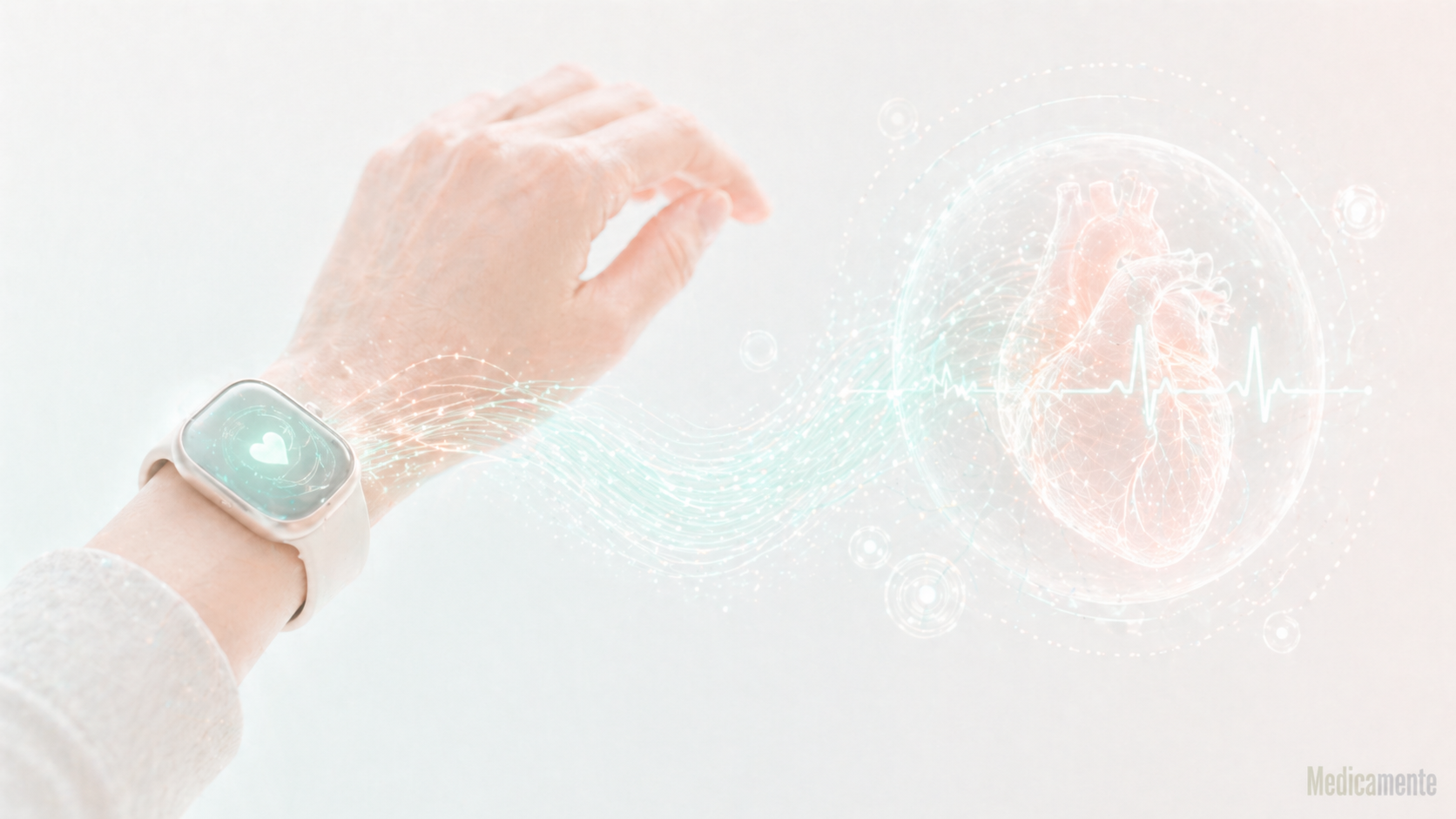
How smart watches and sensors are changing heart monitoring
Wearable devices have changed the understanding of cardiac monitoring. In the past, assessment of heart rhythm was most often linked to a medical office, electrocardiograph, Holter monitoring or inpatient observation. This approach remains the foundation of diagnosis, but it has an obvious limitation: the heart does not always show a rhythm disturbance at the exact moment of examination. Many arrhythmias occur episodically, last only a short time, are not accompanied by pronounced symptoms and may disappear before the patient reaches a physician. This is why the idea of long-term heart monitoring in real life has become especially important.
Modern wearable devices include smart watches, wristbands, patches, rings, portable electrocardiographs and sensor systems that can record heart rate, pulse wave, activity level, sleep, rhythm variability and single-lead electrocardiograms. Their medical value depends on what exactly is measured, how reliable the sensor is, whether the system has undergone regulatory assessment and how the result is used in the clinical pathway. A device that helps a person track activity is not the same as a medical diagnostic device. However, some wearable technologies have already received authorization as medical devices for specific tasks.
The main area of application is detection of atrial fibrillation. This is one of the most common rhythm disorders in adults and an important risk factor for stroke. The problem is that atrial fibrillation may be asymptomatic or occur in episodes. The patient may not feel palpitations, and a standard ECG in the physician’s office may be normal. Wearable devices make it possible to record suspicious episodes over weeks and months, increasing the likelihood of detecting intermittent arrhythmia.
There are two main technical approaches. The first is photoplethysmography. It evaluates changes in tissue blood filling using an optical sensor and detects rhythm irregularity through the pulse wave. This method is convenient for continuous or frequent passive monitoring, but it is not a full electrocardiogram. The second approach is single-lead ECG, when the user places a finger on an electrode on a watch or portable device and receives a short recording of the heart’s electrical activity. Such a recording can help confirm suspicion of arrhythmia, but it usually requires correct measurement technique and medical interpretation.
Clinical studies confirm that wearable devices can increase detection of atrial fibrillation in selected groups of patients. These data are important, but they do not mean that every person needs constant cardiac monitoring through a watch. Arrhythmia screening should take into account age, risk factors, symptoms, hypertension, diabetes, heart failure, previous stroke, valve disease and other conditions. If a wearable device is used in a person with low risk, the probability of a false alarm may exceed the clinical benefit. If the device is used in a high-risk patient or after an intervention, it may become a useful monitoring tool. In medicine, not only the signal matters, but also the probability of disease before testing.
False-positive notifications remain one of the main problems. Irregular pulse may occur not only in atrial fibrillation. It may be caused by extrasystoles, hand movement, poor contact between the sensor and skin, physical activity, tremor, recording artifacts or other rhythms. If a system sends a notification about possible arrhythmia, this is not a final diagnosis. The patient needs medical assessment, ECG confirmation and understanding of the clinical context. Otherwise, a wearable device may lead to anxiety, unnecessary visits, excessive testing and incorrect self-treatment.
It is especially important to emphasize that the decision to prescribe anticoagulants should not be made only on the basis of a watch notification. In atrial fibrillation, stroke prevention may require drugs that affect blood clotting, but they carry a risk of bleeding. The physician evaluates not only the fact of arrhythmia, but also its documented confirmation, episode duration, the patient’s age, comorbidities, stroke risk and bleeding risk. A wearable device may be the starting point of diagnosis, but it does not replace a full cardiological decision.
Wearable devices are also used after arrhythmia treatment. After catheter ablation of atrial fibrillation, a patient may have asymptomatic recurrences that are difficult to detect based only on complaints. Long-term monitoring helps the physician understand whether arrhythmia persists, how frequent episodes are and whether therapy needs adjustment. However, interpretation remains important here as well. More frequent detection of recurrences does not always mean worsening of the condition; sometimes it is simply the result of more intensive monitoring. Therefore, device data must be analyzed together with the clinical picture, not treated as an isolated assessment of treatment success.
A separate direction is heart failure. In patients with this condition, not only rhythm is important, but also signs of deterioration: reduced physical activity, increased pulse rate, sleep disturbance, changes in breathing, weight gain and decreased exercise tolerance. Wearable devices may help identify early signs of decompensation in chronic disease. This reflects a broader trend: wearable technology can record not only a single arrhythmia, but also gradual changes in physiology that may precede clinical worsening.
The potential of wearable devices is strengthened by artificial intelligence. Algorithms can analyze not one recording, but large datasets: heart rate, rhythm, activity, sleep, variability, ECG and changes over time. This makes it possible to use wearable data not only for simple arrhythmia detection, but also for risk assessment. For example, models may evaluate patterns that suggest a higher burden of rhythm disturbances or changes in cardiovascular function. However, the more complex the algorithm, the higher the requirements for validation.
A model may identify statistical relationships, but the physician must understand how applicable these relationships are to a specific patient. If an algorithm was trained on data from active smart watch users, it may perform worse in older people, patients with multiple diseases, people with implanted devices or groups that were underrepresented in the training data. Therefore, clinical validation must include different populations and real-world conditions of use, not only technically high-quality recordings.
Interaction between wearable devices and implanted cardiac systems is also important. In patients with pacemakers, defibrillators or cardiac resynchronization devices, any additional technology must be evaluated in terms of safety and possible interference. Devices with bioimpedance measurements, which use weak electrical currents to estimate body composition or other parameters, are especially discussed. For most users, such functions do not create problems, but in patients with implanted devices, caution and adherence to manufacturer and physician recommendations are required.
Another practical problem is data overload for the medical system. If thousands of patients send pulse recordings, ECG strips and notifications every day, a physician cannot manually analyze every signal. Successful implementation of wearable cardiac monitoring therefore requires not only devices, but also clinical protocols: which notifications are meaningful, who reviews them, when the patient should seek help, how the diagnosis is confirmed, where the data are stored and how they are integrated into the medical record. Without such organization, wearable technologies may create more noise than benefit.
Patient behavior also changes. On one hand, the person gains more control and may notice a problem earlier. On the other hand, constant monitoring of indicators can sometimes increase anxiety. Minor pulse fluctuations, isolated extrasystoles or recording artifacts may be perceived as a dangerous condition. Therefore, medical explanation becomes part of the technology. The patient should understand which signals require urgent care, which should be discussed routinely, and which may be a normal variant or a technical error.
The future of cardiac monitoring will probably be hybrid. Classical ECG, Holter monitoring, implantable loop recorders and medical patches will remain important because they provide more standardized diagnostic data. Smart watches and consumer devices will complement them, especially for long-term observation, early symptom detection and patient engagement. The optimal model does not oppose medical and consumer technologies, but distributes tasks between them: screening, confirmation, treatment and follow-up must have different levels of reliability.
The main significance of wearable devices in cardiology lies in the shift from episodic diagnostics to dynamic monitoring. Cardiovascular diseases often develop and manifest not during a medical visit, but in everyday life: during sleep, exercise, stress, recovery or without noticeable symptoms. Wearable devices allow diagnostics to move closer to the patient’s reality. But their value is determined not by the amount of data collected, but by correct medical interpretation. Future cardiology will use such technologies not as a replacement for the physician, but as an extension of clinical observation, where a digital signal becomes the beginning of a more precise and timely decision.
Write a review
Required fields are marked with *
Categories
- Therapy (81)
- News (48)
- GP (23)
- Cardiology (20)
- urology (12)
- Endocrinology (8)
- Ortopedics (4)
- Dermatology (3)
- Ultrasound (1)
- Mobile app (1)
Articles





Archive
- September 2026 (11)
- August 2026 (11)
- July 2026 (11)
- June 2026 (11)
- May 2026 (9)
- April 2026 (8)
- March 2026 (8)
- February 2026 (8)
- January 2026 (8)
- December 2025 (5)
Categories
- Therapy (81)
- News (48)
- GP (23)
- Cardiology (20)
- urology (12)
- Endocrinology (8)
- Ortopedics (4)
- Dermatology (3)
- Ultrasound (1)
- Mobile app (1)


