
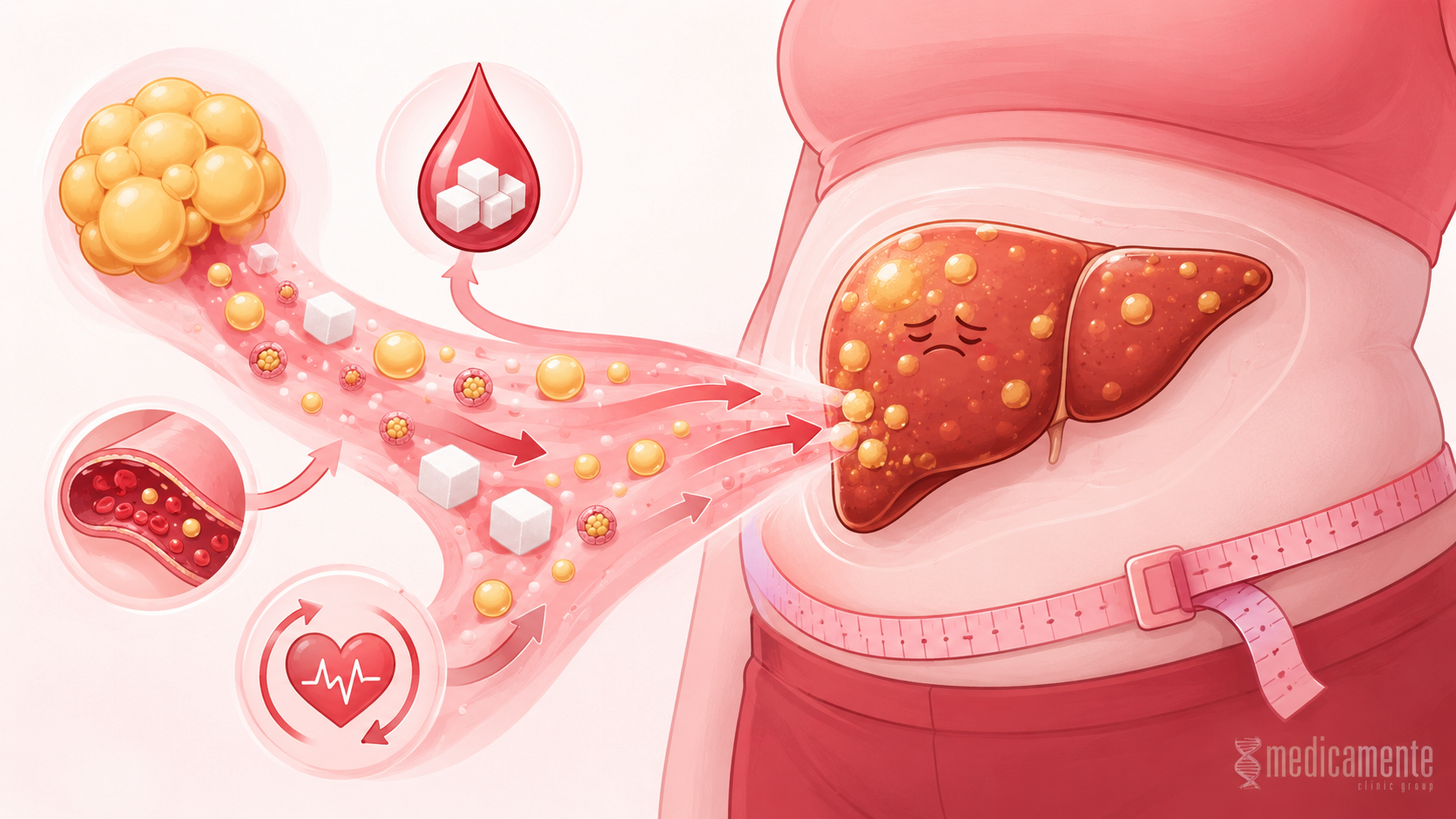
How metabolism, weight and inflammation damage the liver
Fatty liver disease: why it is not only a weight problem
Fatty liver disease is one of the most common liver diseases in modern medicine. It develops when an excessive amount of fat accumulates inside liver cells. At first glance, this may seem like a relatively simple condition: if there is too much fat in the body, part of it is deposited in the liver. In reality, the disease is much more complex. It is related not only to body weight, but also to insulin resistance, impaired glucose metabolism, inflammation, changes in lipid metabolism, intestinal factors, genetic predisposition and lifestyle.
In recent years, even the language used to describe this condition has changed. Previously, the term “non-alcoholic fatty liver disease” was commonly used. Today, the concept of metabolic dysfunction-associated steatotic liver disease is increasingly applied. This approach emphasizes the main point: it is not simply a liver that contains fat, but a disease connected with metabolic dysfunction. This is important because the liver is not an isolated organ, but a central part of the body’s metabolic system.
The liver participates every day in the processing of carbohydrates, fats and proteins. It regulates glucose levels, synthesizes lipoproteins, stores energy reserves, participates in cholesterol metabolism and detoxifies many substances. When insulin resistance, excess visceral fat and chronic low-grade inflammation develop in the body, the liver becomes central to these changes. This is why fatty liver disease often occurs together with type 2 diabetes, obesity, arterial hypertension, dyslipidemia and cardiovascular risks.
How fat accumulates in the liver
Fat accumulation in the liver does not occur in one day. It is a gradual process related to an imbalance between the entry of fatty acids, their synthesis, oxidation and export from the liver. If too many fatty acids enter the liver or the liver begins actively producing fat from excess carbohydrates, liver cells gradually become overloaded with lipids.
Visceral adipose tissue is especially important — fat located around the internal organs. It is metabolically active and releases substances that influence inflammation, insulin sensitivity and fatty acid metabolism. The more pronounced visceral obesity is, the greater the burden on the liver. But it is important to understand that fatty liver disease may also occur in people without pronounced obesity. In some patients, genetic factors, diet, diabetes, physical inactivity, microbiome changes or a combination of several factors play a decisive role.
Insulin resistance is one of the key mechanisms. In this condition, cells respond less effectively to insulin, and the body is forced to produce more of it. Elevated insulin levels influence metabolism, promote fat synthesis in the liver and interfere with normal glucose regulation. As a result, the liver becomes not only an organ that suffers from metabolic disorders, but also a participant in their further development.
From steatosis to inflammation: when the condition becomes more dangerous
Simple accumulation of fat in the liver is called steatosis. In some patients, it may remain relatively stable for a long time and not lead to severe damage. In others, however, an inflammatory form of the disease develops — steatohepatitis. In this case, fat in the liver is accompanied by hepatocyte injury, an inflammatory reaction and activation of fibrosis processes.
The transition from steatosis to steatohepatitis has major clinical significance. It is inflammation and cell injury that create the conditions for connective tissue formation. If this process continues for years, fibrosis may progress. In the early stages, fibrosis may be limited, but with long-term inflammation it becomes more pronounced. Eventually, the disease may lead to cirrhosis — a condition in which normal liver structure is disrupted and the functional reserve of the organ decreases.
The danger is that the patient usually does not feel the moment when simple steatosis changes into inflammation and fibrosis. The disease may not produce specific symptoms. Sometimes a person notices fatigue, heaviness or discomfort in the right upper abdomen, but these signs are nonspecific and do not allow the degree of liver damage to be assessed. Therefore, laboratory tests, ultrasound, elastography and risk factor assessment are much more important than subjective sensations.
Why fatty liver disease is connected with the heart and blood vessels
Fatty liver disease is dangerous not only because it may lead to cirrhosis. It is part of a broader metabolic problem that affects the heart and blood vessels. Patients with fatty liver disease often have elevated blood pressure, abnormal cholesterol and triglyceride levels, insulin resistance, type 2 diabetes and excess visceral fat. All these factors increase the risk of cardiovascular disease.
Therefore, in fatty liver disease, the physician evaluates not only liver enzymes. It is important to look more broadly: glucose level, glycated hemoglobin, lipid profile, blood pressure, body weight, waist circumference, the presence of diabetes, family history and overall cardiovascular risk. Sometimes cardiovascular complications pose a greater immediate risk for the patient than the liver disease itself.
This approach changes the perception of the disease. Fatty liver disease is not a local problem of a single organ. It is a signal that metabolism is working under overload. In this situation, the liver becomes a kind of indicator of metabolic dysfunction. If fat accumulates in the liver and inflammation appears, it often means that disturbances involve the whole body.
Diagnosis: why ordinary liver tests are not enough
Many patients learn about fatty liver disease after an accidental increase in ALT or AST in blood tests or after ultrasound describes signs of steatosis. However, normal liver enzymes do not always exclude the disease. A person may have marked fat accumulation or even fibrosis with only moderate or intermittent changes in ALT and AST. Therefore, diagnosis must be comprehensive.
The physician usually evaluates several areas:
- Laboratory liver markers.
These include ALT, AST, GGT, alkaline phosphatase, bilirubin, albumin, blood clotting markers and other tests when indicated. - Metabolic markers.
Glucose, glycated hemoglobin, insulin resistance, cholesterol, triglycerides, body weight and waist circumference are important. - Instrumental diagnostics.
Ultrasound can detect signs of steatosis, but it does not always accurately determine the degree of inflammation and fibrosis. Elastography helps assess liver tissue stiffness and indirectly judge fibrosis. - Exclusion of other causes of liver damage.
It is important to exclude viral hepatitis, autoimmune liver disease, drug-induced liver injury, hereditary metabolic disorders and significant alcohol-related injury. - Assessment of fibrosis risk.
Laboratory indices, elastography and additional methods are used when necessary. The main task is to determine whether the patient is at risk of progressive liver damage.
In some cases, a liver biopsy may be required. It allows direct assessment of inflammation, cell injury and the degree of fibrosis. However, biopsy is not needed for every patient. The decision is made individually, when non-invasive methods do not provide a clear enough picture or when the result may change treatment strategy.
Treatment: why there is no single universal tablet
Treatment of fatty liver disease begins with understanding its cause. If the disease is associated with metabolic disorders, therapy must target not only the liver, but metabolism as a whole. This includes reducing visceral fat, improving insulin sensitivity, controlling diabetes, correcting lipid abnormalities, normalizing blood pressure and reducing inflammatory burden.
Lifestyle changes remain the foundation of treatment. This is not a formal recommendation, but a biologically meaningful intervention. Even moderate weight loss can reduce the amount of fat in the liver. More substantial weight reduction may decrease inflammation and positively influence fibrosis. However, weight loss should be gradual, sustainable and safe. Severe diets, starvation and uncontrolled regimens may worsen well-being and do not provide reliable long-term results.
Nutrition in fatty liver disease is usually aimed at reducing excess calories, lowering sugar and ultra-processed food intake, limiting sweetened beverages, normalizing the fat composition of the diet and increasing the proportion of foods with high nutritional value. What matters is not a short-term diet, but a sustainable eating pattern that a person can maintain over time.
Physical activity works independently of weight loss. Regular movement improves insulin sensitivity, helps control glucose, reduces visceral fat and supports muscle mass. This is important for the liver because muscles participate in glucose metabolism and energy balance. Even if weight decreases slowly, physical activity may improve the metabolic profile.
Modern drug approaches
Until recently, treatment of fatty liver disease was mainly focused on lifestyle and control of associated conditions. Now the situation is changing. Drugs are appearing that are studied or used for metabolic dysfunction-associated steatohepatitis and fibrosis. Some of them influence bile acid metabolism, lipid metabolism, inflammation, insulin sensitivity or hormonal pathways connected with body weight and metabolism.
Particular interest is focused on drugs used in obesity and type 2 diabetes that may also have a positive effect on the liver. Weight loss, reduction of visceral fat and improved glycemic control can reduce the burden on the liver. However, drug therapy should be prescribed according to medical indications, taking into account the diagnosis, comorbidities, possible contraindications and the goal of treatment.
It is important to understand that even modern drugs do not replace the basic strategy. If excess calorie intake, physical inactivity, uncontrolled diabetes, high triglyceride levels and other risk factors persist, the effect of treatment will be limited. Fatty liver disease requires a systemic approach, where medications may be part of therapy, but do not replace control of the metabolic environment.
When fatty liver disease becomes especially dangerous
Patients with advanced fibrosis, cirrhosis, type 2 diabetes, obesity, high triglyceride levels, arterial hypertension and a combination of several metabolic factors are at the greatest risk. In these people, the likelihood of disease progression is higher. Therefore, they require closer follow-up.
It is especially important to detect fibrosis before cirrhosis develops. In the early stages, elimination of the damaging factor can slow progression and sometimes lead to partial regression of changes. If cirrhosis has already formed, treatment becomes more complex. In that case, it is necessary not only to control the cause of disease, but also to monitor for complications: portal hypertension, ascites, blood clotting disorders, reduced synthetic liver function and risk of liver cancer.
Patients with fatty liver disease often underestimate the condition because it sounds less threatening than viral hepatitis or cirrhosis. But its prevalence is precisely what makes it a serious problem. If the disease affects a large proportion of people with metabolic disorders, even a small percentage of severe cases becomes a significant medical burden.
Main conclusion
Fatty liver disease is not simply “fat in the liver” and not only a consequence of excess weight. It is a manifestation of a complex metabolic disorder in which the liver is at the center of interactions between nutrition, insulin resistance, visceral fat, inflammation, diabetes and cardiovascular risks. The disease may remain unnoticed for a long time, but in some patients it gradually progresses to steatohepatitis, fibrosis, cirrhosis and an increased risk of liver cancer.
The main task of modern medicine is not to wait for symptoms, but to identify patients at risk of progression. This requires laboratory tests, metabolic profile assessment, ultrasound, elastography and exclusion of other causes of liver damage. Treatment must be comprehensive: sustainable nutrition, physical activity, weight control, correction of diabetes and lipid disorders, monitoring of fibrosis and use of drug therapy where it is truly indicated.
The liver is capable of recovery if the damaging factor is removed early enough. Therefore, fatty liver disease is not a reason for panic, but it is also not a condition that should be ignored. It is an important signal of metabolic overload that requires careful diagnosis, consistent monitoring and a long-term approach to health.
Write a review
Required fields are marked with *
Categories
- Therapy (81)
- News (48)
- GP (23)
- Cardiology (20)
- urology (12)
- Endocrinology (8)
- Ortopedics (4)
- Dermatology (3)
- Ultrasound (1)
- Mobile app (1)
Articles





Archive
- September 2026 (11)
- August 2026 (11)
- July 2026 (11)
- June 2026 (11)
- May 2026 (9)
- April 2026 (8)
- March 2026 (8)
- February 2026 (8)
- January 2026 (8)
- December 2025 (5)
Categories
- Therapy (81)
- News (48)
- GP (23)
- Cardiology (20)
- urology (12)
- Endocrinology (8)
- Ortopedics (4)
- Dermatology (3)
- Ultrasound (1)
- Mobile app (1)


