
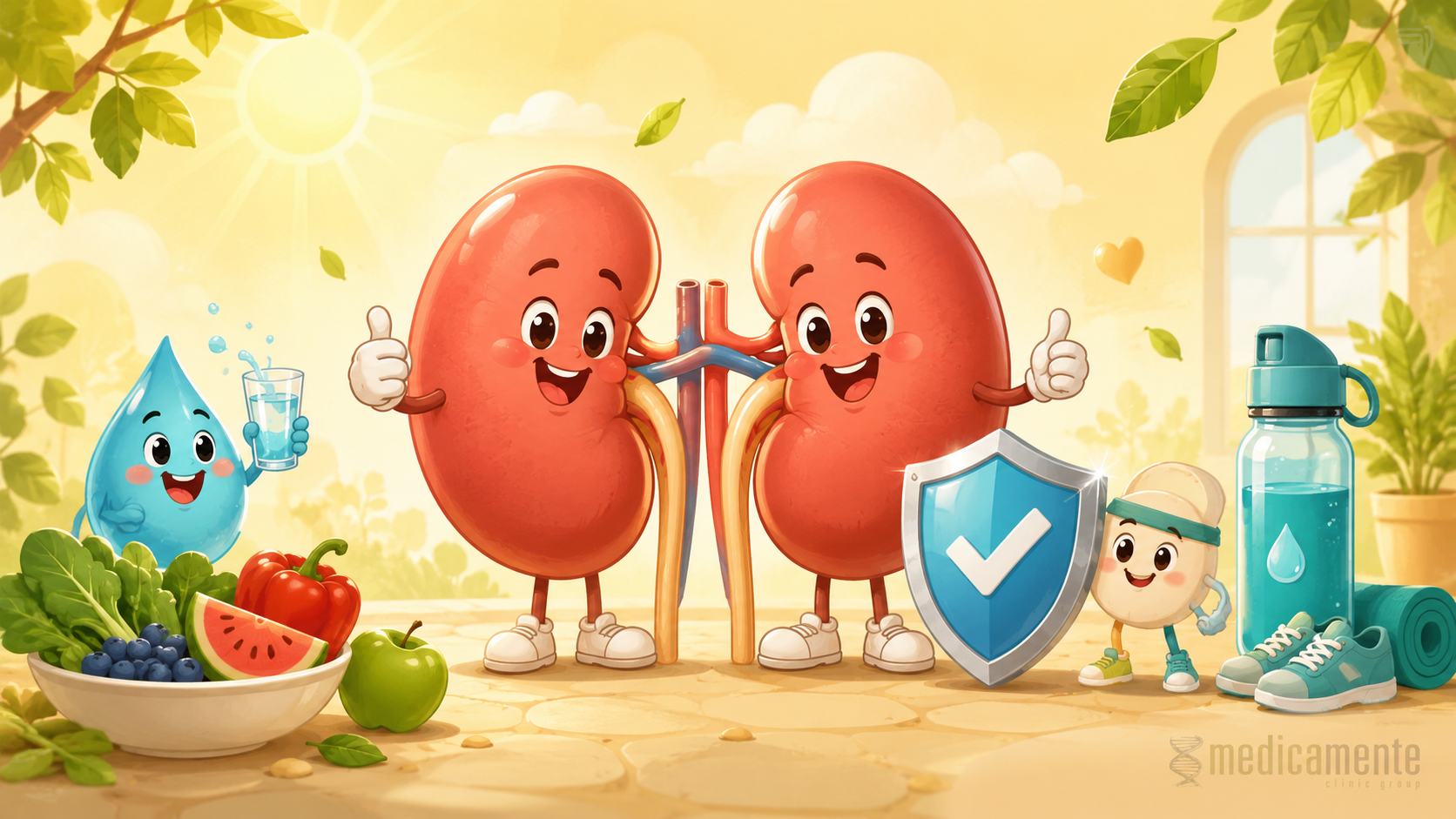
Why kidney health matters before symptoms appear
Kidneys are often remembered only when pain, swelling, changes in urination, or abnormal test results appear. In reality, these organs work continuously and silently every day. They filter the blood, remove waste products, regulate fluid balance, help control blood pressure, maintain the balance of sodium, potassium, calcium, phosphorus, and other electrolytes, and take part in hormonal regulation.
Kidney diseases are especially important because they can remain unnoticed for a long time. A person may feel well, have no pain, and see no visible changes in urine, while kidney function is already gradually declining. Early signs are often detected only through blood and urine tests.
This is why Kidney Health Month is an opportunity to speak not only about severe kidney failure, dialysis, or kidney stones, but also about prevention, risk factors, and early diagnosis. The earlier kidney changes are detected, the more opportunities there are to slow their progression and reduce the risk of complications.
Why the kidneys are connected to blood pressure, diabetes, and the heart
The kidneys are closely connected with the cardiovascular and metabolic systems. High blood pressure can damage the small vessels of the kidneys and reduce their filtering capacity. At the same time, impaired kidney function can make blood pressure more difficult to control. This creates a vicious cycle in which hypertension damages the kidneys, and damaged kidneys contribute to further increases in blood pressure.
Diabetes is another major risk factor. Long-term elevated blood glucose can damage the kidney filters, especially the glomeruli. One of the earliest signs of diabetic kidney disease may be the appearance of albumin in the urine, even when blood creatinine and general well-being remain normal.
The kidneys and the heart also work as a connected system. If the kidneys retain excess fluid and sodium, the workload on the heart increases. If the heart pumps blood less effectively, the kidneys may receive less blood flow. For this reason, kidney disease often increases cardiovascular risk, and heart disease can worsen kidney function.
Which signs may suggest kidney problems
Kidney diseases do not always cause obvious symptoms. Pain in the lower back is not a typical early sign of most chronic kidney diseases. It is more often associated with kidney stones, obstruction of urine flow, or acute inflammatory conditions.
Possible signs of kidney problems may include swelling of the legs or face, persistently elevated blood pressure, changes in the amount of urine, frequent nighttime urination, blood in the urine, foamy urine, weakness, fatigue, nausea, itching, muscle cramps, and reduced exercise tolerance. However, these symptoms are not specific and may occur in many other conditions.
That is why laboratory tests are so important. Blood creatinine, estimated glomerular filtration rate, urinalysis, and albuminuria can reveal kidney changes before symptoms become noticeable.
What modern kidney assessment includes
Modern evaluation of kidney health usually begins with simple tests. A blood test helps assess creatinine and calculate the estimated glomerular filtration rate, or eGFR. This shows how efficiently the kidneys filter the blood.
Urine testing helps detect protein, albumin, blood, white blood cells, bacteria, casts, crystals, and changes in urine concentration or acidity. The albumin-to-creatinine ratio in urine is especially important for people with diabetes, hypertension, cardiovascular disease, or chronic kidney disease risk factors.
Ultrasound can assess kidney size, structure, cysts, stones, urinary tract dilation, and signs of impaired urine flow. In some cases, additional tests may be needed: urine culture, computed tomography, magnetic resonance imaging, immune testing, genetic evaluation, or kidney biopsy.
A comprehensive approach is important because kidney problems can have different mechanisms. In one person, the main issue may be high blood pressure; in another, diabetes; in another, stones, infection, medication-related injury, autoimmune inflammation, or hereditary disease.
What this article series will cover
During Kidney Health Month, it is important to discuss the most common and clinically significant kidney-related topics. The series includes chronic kidney disease, the connection between blood pressure and kidney function, diabetic kidney disease, urinalysis, kidney stones, urinary tract infections, medication-related kidney injury, the relationship between the kidneys and the heart, anemia, vitamin D, and modern kidney diagnostics.
Each of these topics shows one important principle: kidney health depends not only on the kidneys themselves, but also on the whole body. Blood pressure, blood glucose, body weight, hydration, infections, medications, cardiovascular health, and metabolic balance all play a role.
Kidney disease is not always sudden or painful. Very often, it develops gradually and quietly. That is why early testing and risk assessment are central to kidney health. Blood and urine tests can reveal changes long before severe symptoms appear.
Kidney Health Month is a reminder that the kidneys should not be evaluated only when there is pain or an acute problem. They are part of a complex system that supports blood pressure, circulation, metabolism, bones, blood formation, and internal balance. Taking kidney health seriously means looking at the whole organism and identifying risks early.
Write a review
Required fields are marked with *
Categories
- Therapy (81)
- News (48)
- GP (23)
- Cardiology (20)
- urology (12)
- Endocrinology (8)
- Ortopedics (4)
- Dermatology (3)
- Ultrasound (1)
- Mobile app (1)
Articles





Archive
- September 2026 (11)
- August 2026 (11)
- July 2026 (11)
- June 2026 (11)
- May 2026 (9)
- April 2026 (8)
- March 2026 (8)
- February 2026 (8)
- January 2026 (8)
- December 2025 (5)
Categories
- Therapy (81)
- News (48)
- GP (23)
- Cardiology (20)
- urology (12)
- Endocrinology (8)
- Ortopedics (4)
- Dermatology (3)
- Ultrasound (1)
- Mobile app (1)


