
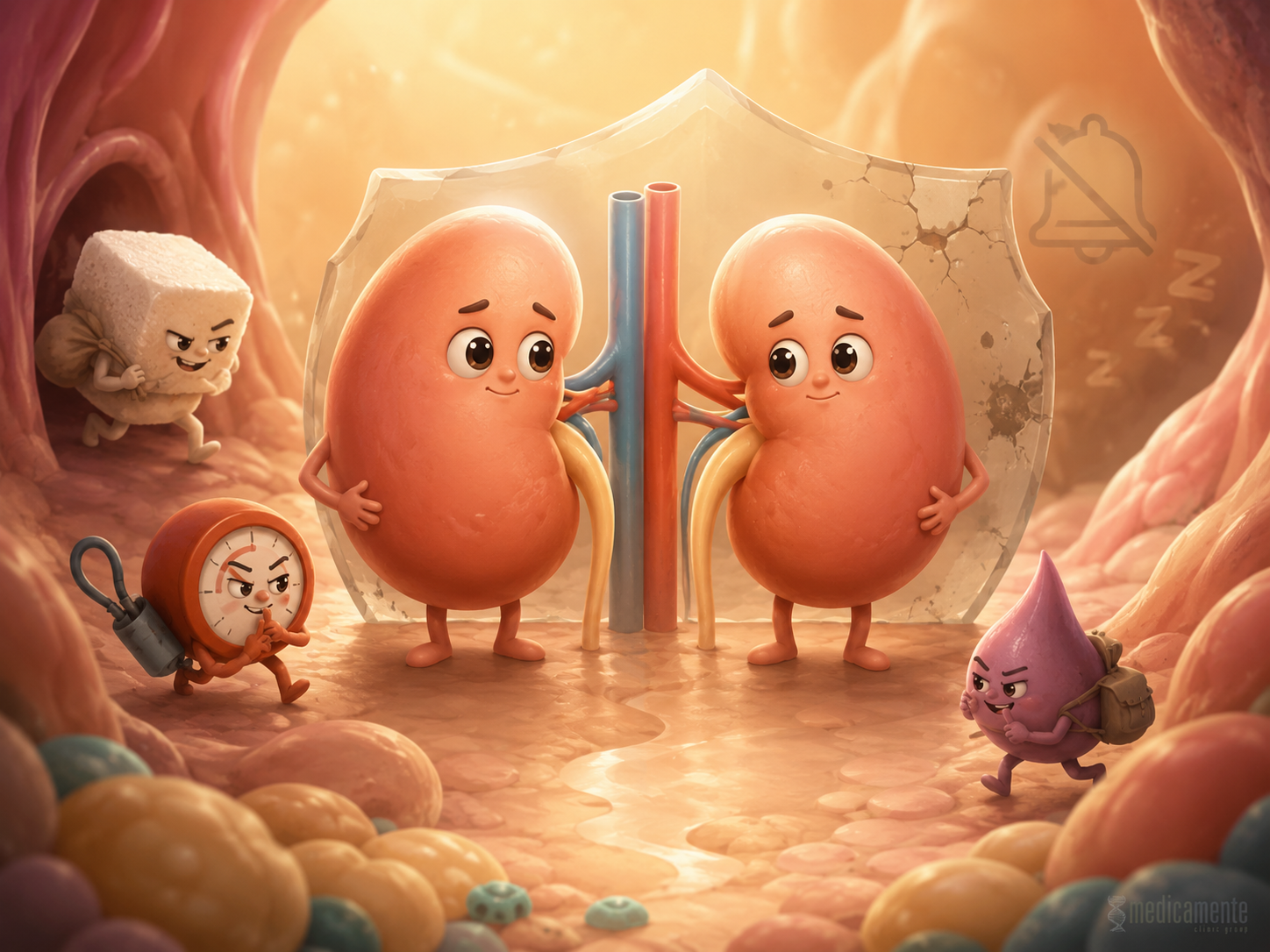
How reduced filtration can remain symptom-free for years
Chronic kidney disease: what this diagnosis means
Chronic kidney disease is a condition in which the structure or function of the kidneys remains impaired over a long period of time. It is not a single accidental abnormal test result, but a persistent process that may continue for months or years. The key feature of chronic kidney disease is that it often develops slowly and may not cause noticeable symptoms for a long time.
The kidneys have a large functional reserve. This means that even when part of the kidney tissue is damaged, they can continue performing their main tasks: filtering blood, removing waste products, regulating fluid volume, and maintaining the balance of sodium, potassium, and other electrolytes. This is why a person may feel well while kidney function is already gradually declining.
Chronic kidney disease is important not only because of the kidneys themselves. It is associated with an increased risk of cardiovascular complications, anemia, mineral metabolism disorders, high blood pressure, and progression to severe kidney failure. Early detection is therefore very important: the earlier kidney changes are found, the more opportunities there are to slow their progression.
Why kidney damage may occur without pain
Many people expect kidney disease to cause lower back pain. In practice, this is often not the case. Most chronic kidney diseases do not cause pain in the early stages. Pain is more typical of acute conditions, such as a kidney stone, obstruction of urine flow, inflammation involving the kidney capsule, or a pronounced infectious process.
In chronic kidney disease, damage often occurs at the level of small blood vessels, glomeruli, and tubules. These structures gradually lose their ability to filter blood properly and retain necessary substances in the body. This process may be silent and develop without sudden symptoms. Therefore, the absence of pain does not rule out a kidney problem.
This is especially important in diabetes and hypertension. Both conditions can damage the small blood vessels of the kidneys for years. A patient may feel no changes, while albumin is already appearing in the urine and the estimated glomerular filtration rate is gradually decreasing. This is why kidney monitoring should be regular in people with chronic metabolic and vascular diseases.
Estimated glomerular filtration rate: the key marker of kidney function
One of the main indicators used to assess the kidneys is the estimated glomerular filtration rate. It shows how effectively the kidneys filter the blood. It is usually calculated based on the level of creatinine in the blood, taking into account age, sex, and other parameters. In laboratory results, this indicator is often marked as eGFR.
Creatinine is a waste product formed in the muscles and removed by the kidneys. If the kidneys filter less effectively, creatinine levels may rise. However, creatinine alone does not always provide the full picture. In older adults, people with low muscle mass, or patients with certain body characteristics, creatinine may appear relatively “normal” even when filtration is already reduced.
This is why doctors assess not only the creatinine value itself, but also the calculated estimated glomerular filtration rate. A reduced eGFR may indicate a decline in the filtering ability of the kidneys. If this reduction persists over time or is combined with other signs of kidney damage, chronic kidney disease may be present.
The stages of chronic kidney disease are largely determined by filtration level. The lower the estimated glomerular filtration rate, the higher the risk of complications and the more careful monitoring becomes. However, signs of kidney damage may also be present even when filtration is relatively preserved, such as albuminuria.
Albuminuria: an early sign of damage to kidney filters
Albuminuria means the presence of albumin in the urine. Albumin is a blood protein that normally should remain in the bloodstream and should not pass through the kidney filter in significant amounts. When the kidney filter is damaged, albumin begins to enter the urine.
This marker is especially important because it may appear before a pronounced decline in filtration. A patient may have normal or nearly normal creatinine, while an elevated albumin level in the urine already indicates damage to kidney structures. This is particularly relevant in diabetes, hypertension, and vascular disease.
The albumin-to-creatinine ratio in urine is often used to assess albuminuria. This test is convenient because it allows albumin loss to be evaluated without collecting urine over 24 hours. If the result is elevated, the doctor usually assesses it again, considers related factors, and decides whether additional testing is needed.
It is important to understand that protein or albumin in the urine is not a diagnosis by itself. It may appear in different conditions: kidney disease, urinary tract infection, physical exertion, fever, temporary inflammation, or other factors. Therefore, the result should always be interpreted together with the clinical picture and repeat testing.
Main causes of chronic kidney disease
Chronic kidney disease can develop for many reasons. In some cases, damage is related to metabolism; in others, to blood pressure, the immune system, infections, hereditary factors, or impaired urine flow.
The most common causes include:
- Diabetes mellitus.
Long-term elevated glucose levels damage small blood vessels and kidney glomeruli. Over time, diabetic kidney disease may develop. - Arterial hypertension.
High blood pressure damages kidney vessels, worsens filtration, and can accelerate the decline in kidney function. - Glomerulonephritis.
This is a group of diseases in which inflammation affects the kidney glomeruli. The causes may be immune-related, infectious, or associated with systemic diseases. - Polycystic kidney disease and hereditary conditions.
Some diseases are genetic and gradually disrupt the structure of the kidneys. - Chronic obstruction of urine flow.
Stones, tumors, prostate enlargement, strictures, and other causes of obstruction can damage the kidneys if they interfere with normal urine drainage. - Recurrent urinary tract infections.
Infections are especially concerning when they affect the kidneys or occur in the setting of obstruction, stones, diabetes, or congenital urinary tract abnormalities. - Medication-related and toxic kidney injury.
Some medications and substances can damage the kidneys, especially during dehydration, pre-existing chronic kidney disease, or a combination of several risk factors. - Autoimmune and systemic diseases.
Some immune system diseases can affect the kidneys as part of a broader inflammatory process.
Sometimes several causes are present at the same time. For example, diabetes may be combined with hypertension, obesity, and atherosclerosis. In such cases, the risk of progression is higher, so it is important to assess the entire risk profile rather than a single factor.
What symptoms may appear as kidney function declines
In the early stages, chronic kidney disease often does not cause noticeable symptoms. As it progresses, signs may appear due to fluid retention, changes in blood composition, impaired hormonal kidney functions, and accumulation of waste products.
Possible symptoms include swelling, high blood pressure, weakness, fatigue, reduced appetite, nausea, itching, nighttime urination, changes in urine volume, muscle cramps, sleep disturbances, and difficulty concentrating. If anemia develops, shortness of breath during physical activity, paleness, palpitations, and marked tiredness may occur.
However, these symptoms are nonspecific. They may be seen in heart, endocrine, gastrointestinal, neurological, and many other conditions. This is why symptoms alone cannot accurately determine the degree of kidney damage. Blood and urine tests are needed.
It is also important that symptom severity does not always match disease severity. Some patients with moderate reduction in kidney function feel unwell, while others may not notice problems even with significant changes. This is why regular monitoring is especially important for people in risk groups.
How chronic kidney disease is confirmed
To diagnose chronic kidney disease, it is important to confirm that the changes are persistent rather than accidental or temporary. For example, creatinine may temporarily rise due to dehydration, acute illness, certain medications, or intense physical activity. Protein in the urine can also appear temporarily. Doctors therefore often order repeat tests and assess trends over time.
Diagnosis usually includes several areas:
- Creatinine and eGFR calculation.
This is the foundation of assessing the filtering function of the kidneys. - Urinalysis.
It helps detect protein, blood, white blood cells, casts, bacteria, and other changes. - Albumin-to-creatinine ratio in urine.
This marker is important for early detection of damage to kidney filters. - Blood electrolytes.
Potassium, sodium, calcium, phosphorus, and bicarbonate help assess the effect of kidney function on the body’s internal balance. - Kidney ultrasound.
It allows assessment of kidney size, structure, cysts, stones, urinary tract dilation, or signs of chronic changes. - Blood pressure and cardiovascular risk assessment.
The kidneys and blood vessels are closely linked, so blood pressure control is an essential part of diagnosis and treatment. - Additional tests when indicated.
If immune, hereditary, or inflammatory kidney disease is suspected, special tests and nephrology consultation may be needed.
In some cases, a kidney biopsy is performed. It is not required for every patient, but it can be necessary when the exact nature of kidney tissue damage must be clarified, for example when glomerulonephritis or a complex immune disorder is suspected.
Why slowing progression is important
Chronic kidney disease can progress at different speeds. In some patients, kidney function remains stable for many years; in others, decline happens more quickly. The rate of progression depends on the cause of the disease, blood pressure level, diabetes, degree of albuminuria, age, body weight, cardiovascular factors, smoking, medication burden, and other conditions.
The main goal of treatment is not only to improve individual test results, but also to slow the loss of kidney function. This involves controlling blood pressure, glucose levels in diabetes, albuminuria, body weight, lipids, salt intake, and factors that can additionally damage the kidneys.
Proper medication use is also important. When kidney function is reduced, some medications require dose adjustment. Some drugs may be undesirable during dehydration or when combined with other medications. Therefore, patients with chronic kidney disease should inform their doctor about their kidney function before new medications are prescribed.
Slowing the progression of chronic kidney disease also lowers the risk of cardiovascular complications. This matters because patients with chronic kidney disease face not only kidney failure, but also a higher risk of heart attack, stroke, heart failure, and vascular complications.
Who especially needs kidney checks
Regular assessment of kidney function is especially important for people in risk groups. First of all, this includes patients with diabetes and hypertension. Even when well-being is normal, these conditions can gradually damage kidney vessels and glomeruli.
Monitoring is also important for people with cardiovascular disease, obesity, metabolic syndrome, recurrent urinary tract infections, kidney stones, autoimmune diseases, a family history of kidney disease, older age, and long-term use of medications that may affect the kidneys.
Initial kidney testing usually does not require complex methods. Often, a blood test with creatinine and eGFR calculation, urinalysis, and albuminuria assessment are enough. If needed, ultrasound and additional tests are added.
Chronic kidney disease is not a condition that always quickly leads to severe kidney failure. In many cases, it can be controlled for a long time. But for this to happen, it is important not to wait for symptoms, but to detect early changes in time. The kidneys can work silently for a long time, which makes blood and urine tests the main way to identify a problem before it begins to noticeably affect well-being.
Write a review
Required fields are marked with *
Categories
- Therapy (81)
- News (48)
- GP (23)
- Cardiology (20)
- urology (12)
- Endocrinology (8)
- Ortopedics (4)
- Dermatology (3)
- Ultrasound (1)
- Mobile app (1)
Articles





Archive
- September 2026 (11)
- August 2026 (11)
- July 2026 (11)
- June 2026 (11)
- May 2026 (9)
- April 2026 (8)
- March 2026 (8)
- February 2026 (8)
- January 2026 (8)
- December 2025 (5)
Categories
- Therapy (81)
- News (48)
- GP (23)
- Cardiology (20)
- urology (12)
- Endocrinology (8)
- Ortopedics (4)
- Dermatology (3)
- Ultrasound (1)
- Mobile app (1)


