
Why high blood pressure damages the body’s filters
Why the kidneys are so important for blood pressure control
Blood pressure depends not only on the work of the heart and the condition of blood vessels. The kidneys play one of the central roles in its regulation. They control fluid volume in the body, sodium excretion, electrolyte balance, and the activity of hormonal systems that affect vascular tone. This means that any persistent kidney dysfunction can influence blood pressure, while long-term high blood pressure can damage kidney tissue.
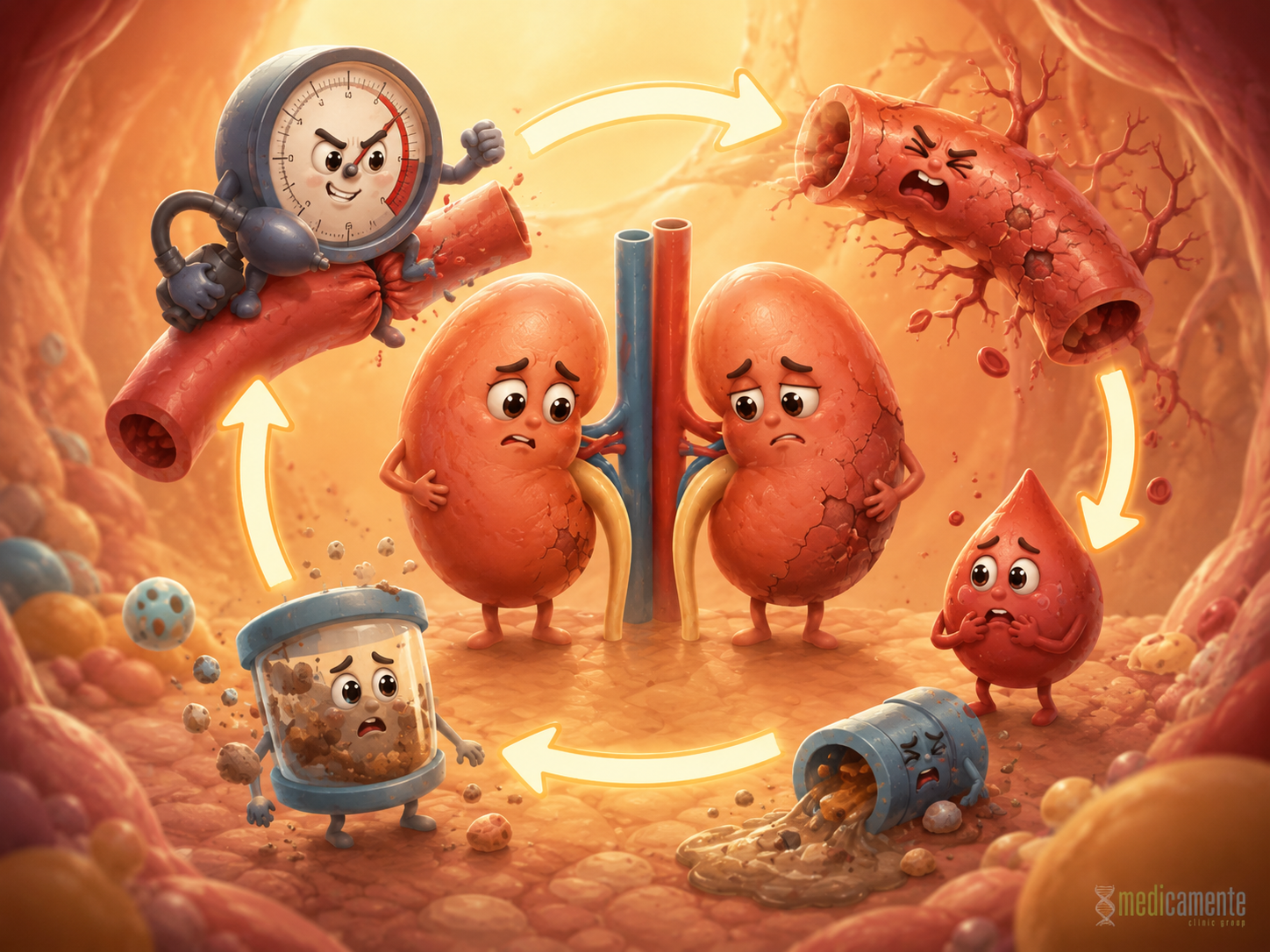
This connection works in both directions. On the one hand, hypertension damages the small blood vessels of the kidneys, worsens blood supply to the glomeruli, and gradually reduces filtration capacity. On the other hand, if the kidneys are already damaged, they regulate fluid volume and hormonal mechanisms less effectively, which can maintain or worsen high blood pressure. This creates a vicious cycle: high blood pressure damages the kidneys, and damaged kidneys contribute to further increases in blood pressure.
The problem may remain unnoticed for a long time. A person may become used to elevated blood pressure or may not measure it regularly. At the same time, reduced kidney function may not cause pain, swelling, or obvious symptoms. For this reason, the combination of hypertension and early kidney changes is often detected only through testing: creatinine, estimated glomerular filtration rate, albumin in the urine, or changes in urinalysis.
How high blood pressure damages kidney vessels
The kidneys contain a very large number of small blood vessels and filtering structures called glomeruli. A large volume of blood passes through them every day. For filtration to remain stable, pressure inside these structures must stay within certain limits. When arterial blood pressure remains elevated for a long time, the kidney vessels experience constant overload.
Over time, the walls of small arteries may thicken, become less elastic, and narrow. This worsens blood flow in kidney tissue. The glomeruli gradually lose their normal structure, and some of them stop filtering blood effectively. In response, the remaining glomeruli may work under increased load. At first, this helps maintain function, but in the long term it accelerates their damage.
This process is known as hypertensive kidney damage. It does not develop over a few days, but over years. This is why a patient may not notice the problem for a long time. At first, tests may show a small amount of albumin in the urine; later, the estimated glomerular filtration rate may decline, creatinine may change, and other signs of chronic kidney disease may appear.
Kidney damage due to hypertension is especially likely if blood pressure has been elevated for many years, treatment is irregular, pressure spikes occur, or there is diabetes, obesity, smoking, high cholesterol, or pre-existing vascular disease. In such situations, the kidneys become part of the overall vascular risk.
Why the kidneys can raise blood pressure
The kidneys not only suffer from hypertension, but also take part in its development. One of the main mechanisms is related to sodium and water regulation. If the kidneys retain too much sodium, the body also retains more fluid. This increases circulating blood volume and can raise blood pressure.
Another important mechanism is the renin-angiotensin-aldosterone system. This hormonal system helps the body regulate blood pressure, vascular tone, and fluid volume. If the kidneys interpret blood flow as insufficient or function under chronic damage, this system may become overactive. As a result, blood vessels constrict, sodium and water are retained, and blood pressure rises.
Normally, these mechanisms protect the body, for example during fluid loss or reduced blood supply. But in chronic disease, they can remain active constantly and become part of the problem. This is why hypertension in patients with kidney disease is often more persistent and requires especially careful control.
Impaired salt excretion also matters. High salt intake can increase fluid retention and blood pressure, especially in people who are salt-sensitive, have chronic kidney disease, are older, have diabetes, or have cardiovascular disease. This is why diet and salt intake can have a real impact on blood pressure control.
Why hypertension and kidney disease often develop together
Hypertension and chronic kidney disease share many risk factors. These include age, obesity, diabetes, atherosclerosis, smoking, high cholesterol, hereditary predisposition, and a sedentary lifestyle. These factors damage blood vessels throughout the body, including the vessels of the kidneys.
The risk is especially high in diabetes. Elevated glucose damages small blood vessels and kidney glomeruli, while hypertension intensifies this damage. Therefore, in patients with diabetes, blood pressure control is just as important as glucose control. Even moderate but long-term elevation of blood pressure can accelerate the development of albuminuria and reduced filtration.
Obesity also increases the workload on the kidneys. Excess visceral fat is associated with insulin resistance, inflammation, sodium retention, higher blood pressure, and changes in vascular function. In this setting, the kidneys may operate under constant metabolic and hemodynamic stress.
Cardiovascular diseases are also closely connected with the kidneys. If the heart pumps blood less effectively, the kidneys may receive less blood flow. In response, hormonal mechanisms are activated that retain fluid and raise blood pressure. This can worsen both heart function and kidney function.
Which tests help detect kidney risk in hypertension
In arterial hypertension, it is important to assess not only blood pressure values, but also the organs that may be affected by them. The kidneys are among the main target organs. Therefore, in long-standing or poorly controlled high blood pressure, kidney function should be checked periodically.
One of the main tests is blood creatinine with calculation of the estimated glomerular filtration rate. This marker helps determine how effectively the kidneys filter blood. If filtration is reduced, it may suggest chronic kidney disease or another impairment of kidney function.
Another important test is urinalysis. It may show protein, blood, white blood cells, casts, and other changes. But albuminuria is especially important for early detection of damage to kidney filters. It is most often assessed using the albumin-to-creatinine ratio in urine.
Albuminuria in hypertension is highly significant. It may appear before a pronounced decline in filtration and indicates damage to blood vessels and glomeruli. In addition, albuminuria is associated not only with kidney risk but also with cardiovascular risk. This means that protein in the urine may be a signal of broader vascular damage.
Additional tests may include blood electrolytes, especially potassium and sodium, blood glucose, glycated hemoglobin, lipid profile, uric acid, and other markers. If secondary hypertension or structural kidney changes are suspected, ultrasound, assessment of renal arteries, or other methods may be needed.
When secondary hypertension should be considered
In most people, high blood pressure is related to a combination of heredity, age, lifestyle, vascular factors, and metabolic factors. But in some patients, hypertension has a specific secondary cause. Kidney disease and renal artery disease are important causes of secondary hypertension.
Secondary hypertension may be suspected when high blood pressure appears at a young age, becomes severe quickly, does not respond well to several medications, is accompanied by sudden worsening of kidney function, significant changes in potassium, sudden deterioration of previously stable blood pressure, or signs of endocrine or vascular disorders.
Kidney-related causes of secondary hypertension may include chronic kidney tissue diseases, narrowing of the renal arteries, certain congenital conditions, polycystic kidney disease, consequences of inflammatory diseases, and other disorders. In such cases, it is important not only to lower blood pressure but also to identify the cause of its persistent elevation.
However, self-diagnosis is not possible here. Even if blood pressure is difficult to control, this does not automatically mean that the cause is the kidneys. The doctor evaluates medical history, blood and urine tests, ultrasound findings, response to treatment, and other signs. If needed, a nephrologist, cardiologist, or endocrinologist may be involved.
Why blood pressure control protects the kidneys
Lowering blood pressure to target levels is one of the main ways to protect the kidneys. When blood pressure becomes stable, the load on vessels and glomeruli decreases, the risk of further damage becomes lower, and the loss of filtration function can slow down. This is especially important in patients who already have chronic kidney disease or albuminuria.
Blood pressure control does not mean medication alone. It includes regular blood pressure measurement, home blood pressure monitoring, weight control, reduced salt intake, physical activity, sleep correction, diabetes management, smoking cessation, and lipid control. All these factors influence vascular risk and kidney health.
Medication therapy is selected individually. In patients with hypertension, chronic kidney disease, and albuminuria, medications that affect the renin-angiotensin system are often used. They can not only lower blood pressure but also reduce albuminuria. However, these medications require monitoring of creatinine and potassium, especially in patients with reduced kidney function.
It is important that hypertension treatment remains consistent. Irregular medication use, self-discontinuation, treatment only when blood pressure is “high,” and lack of monitoring can lead to pressure spikes. For the kidneys, both persistently high blood pressure and frequent fluctuations can be harmful, especially when combined with diabetes, older age, and vascular disease.
The role of salt, fluids, and lifestyle
Salt plays an important role in blood pressure regulation. Excess sodium intake promotes fluid retention and may raise blood pressure. In people with chronic kidney disease, hypertension, heart failure, or older age, salt sensitivity is often higher. Reducing salt intake can therefore help control blood pressure and reduce the burden on the kidneys.
It is important to consider not only the salt added during cooking or at the table, but also hidden salt. It is found in processed meats, cheeses, semi-prepared foods, sauces, salty snacks, fast food, canned foods, and many ready-made products. Sometimes a person believes they eat little salt because they do not add it to meals, while still receiving a large amount of sodium from processed foods.
Physical activity helps reduce blood pressure, improve insulin sensitivity, control body weight, and lower cardiovascular risk. For the kidneys, this is important not as “kidney training,” but through its effect on blood vessels, metabolism, and blood pressure.
Weight control is especially important when hypertension, diabetes, and obesity occur together. Even moderate weight loss can reduce blood pressure, improve metabolic markers, and lower the load on the kidneys. However, changes in diet and physical activity should be sustainable rather than extreme short-term measures.
Why risk cannot be assessed only by well-being
Hypertension often causes no symptoms. A person may not feel high blood pressure and may feel normal even when levels remain persistently elevated. This is why relying only on headache, weakness, or palpitations is not reliable. Blood pressure should be measured, not guessed from symptoms.
The same applies to the kidneys. Reduced filtration and albuminuria may remain unnoticed for a long time. A patient with hypertension may assume there are no complications while early damage is already developing. Blood and urine tests are what allow these changes to be detected.
Particular attention is needed in patients whose hypertension is combined with diabetes, obesity, heart failure, coronary artery disease, previous stroke, smoking, or a family history of kidney disease. In these cases, kidney monitoring should be part of overall care.
The relationship between blood pressure and the kidneys shows an important principle: chronic diseases often do not develop separately, but as an interconnected system. If only blood pressure is controlled and the kidneys are not assessed, early signs of damage may be missed. If the kidneys are treated but blood pressure remains unstable, damage can continue. The most effective approach is therefore simultaneous assessment of blood pressure, kidney function, urine testing, and overall cardiovascular risk.
Write a review
Required fields are marked with *
Categories
- Therapy (81)
- News (48)
- GP (23)
- Cardiology (20)
- urology (12)
- Endocrinology (8)
- Ortopedics (4)
- Dermatology (3)
- Ultrasound (1)
- Mobile app (1)
Articles





Archive
- September 2026 (11)
- August 2026 (11)
- July 2026 (11)
- June 2026 (11)
- May 2026 (9)
- April 2026 (8)
- March 2026 (8)
- February 2026 (8)
- January 2026 (8)
- December 2025 (5)
Categories
- Therapy (81)
- News (48)
- GP (23)
- Cardiology (20)
- urology (12)
- Endocrinology (8)
- Ortopedics (4)
- Dermatology (3)
- Ultrasound (1)
- Mobile app (1)


