
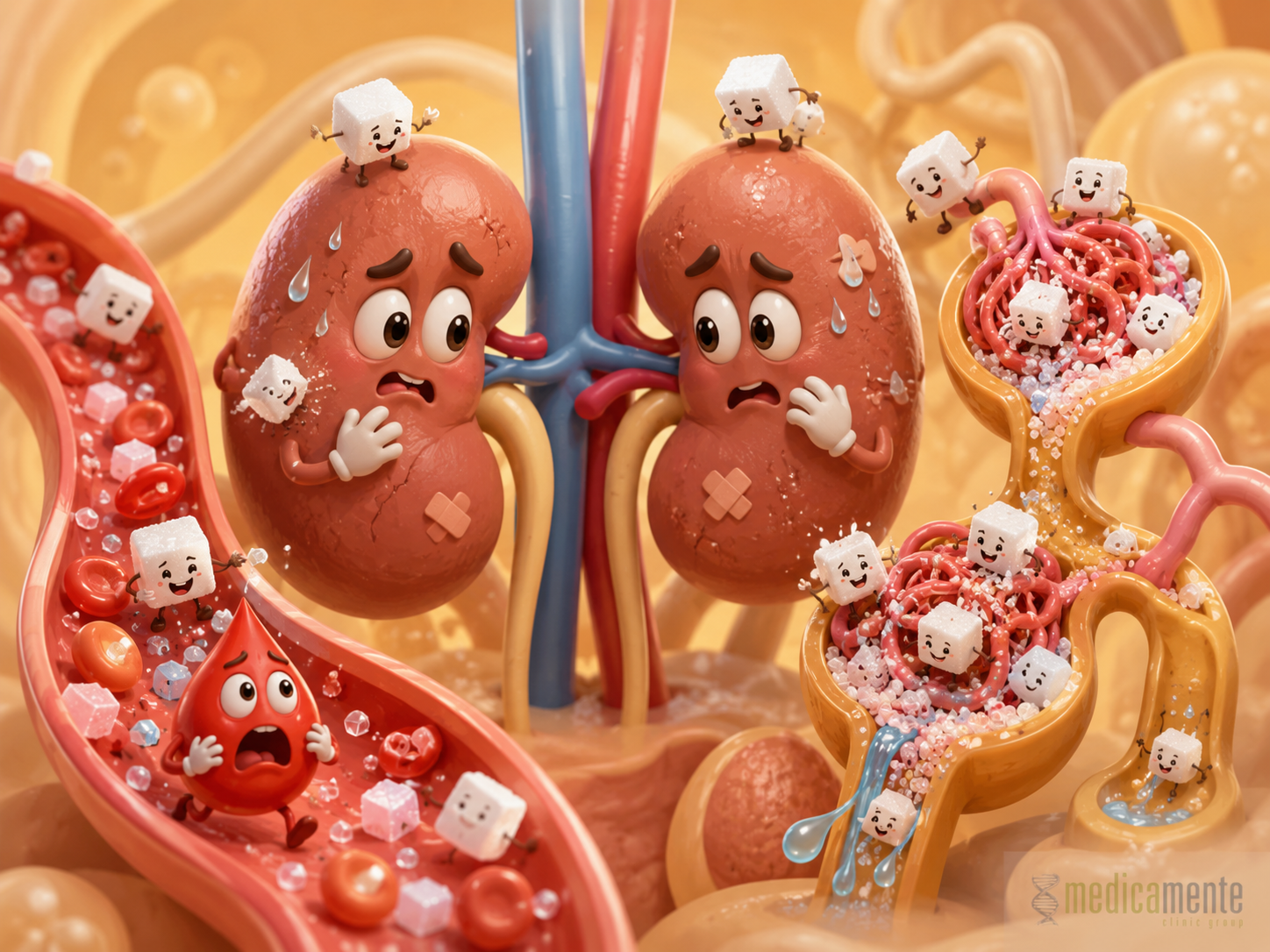
How high blood sugar damages blood vessels and glomeruli
Diabetic kidney disease: why it is one of the main complications of diabetes
Diabetes affects much more than blood glucose levels. Over time, it can damage blood vessels, nerves, the heart, the eyes, and the kidneys. Diabetic kidney disease is one of the most important chronic complications of diabetes because it can gradually reduce kidney filtration and increase cardiovascular risk.
The kidneys contain many small blood vessels and filtering structures called glomeruli. Their role is to filter the blood, remove waste products, and keep necessary substances in the body. In diabetes, these structures are exposed for a long time to elevated glucose, metabolic imbalance, inflammatory signals, high blood pressure, and changes in the vessel wall. Gradually, the kidney filter becomes more vulnerable.
In the early stages, diabetic kidney disease often causes no pain, swelling, or noticeable changes in well-being. A person may feel well, while the first signs are already visible in urine tests. This is why regular kidney monitoring in people with diabetes is as important as glucose control, blood pressure control, eye checks, and cardiovascular risk assessment.
How high blood sugar damages kidney filters
When blood glucose remains elevated for a long time, the function of small blood vessels changes. Vessel walls become more vulnerable, cellular metabolism is disrupted, oxidative stress increases, and chronic inflammation becomes more active. In the kidneys, this is especially important because the glomeruli constantly filter a large volume of blood and are highly sensitive to vascular changes.
One of the early processes is increased pressure inside the glomeruli. At first, the kidneys may even filter too actively while trying to compensate for metabolic disturbances. But this overload gradually damages the filtration barrier. Over time, substances that should normally remain in the blood begin to pass through it, especially albumin.
Albumin is a blood protein. Normally, it almost does not enter the urine. If albumin begins to appear in the urine in increased amounts, this may be an early sign of damage to the kidney filters. Importantly, at this stage blood creatinine and estimated glomerular filtration rate may still remain normal. This is why the feeling that “everything is fine” does not always reflect the true condition of the kidneys.
If the damage continues, some glomeruli gradually lose function. Filtration decreases, creatinine may rise, and signs of chronic kidney disease may appear. This process does not always progress quickly, but without control of diabetes, blood pressure, and other risk factors, it can worsen over time.
Why blood pressure is so important in diabetes
Diabetic kidney disease is rarely related to glucose alone. Blood pressure plays a very important role. In diabetes, blood vessels are already more vulnerable, and elevated blood pressure additionally damages the kidney glomeruli. Therefore, the combination of diabetes and hypertension significantly increases the risk of kidney function decline.
High blood pressure affects the kidneys mechanically and through the blood vessels. It increases the load on small arteries, reduces their elasticity, contributes to thickening of the vessel wall, and disrupts normal filtration. If albuminuria is already present, the risk of progression becomes higher.
Blood pressure control in diabetes is important not only for the kidneys. It lowers the risk of stroke, heart attack, heart failure, retinal damage, and vascular complications. Therefore, in diabetic kidney disease, the doctor evaluates not just one number, but the entire risk profile: glucose, blood pressure, lipids, body weight, albuminuria, estimated glomerular filtration rate, and cardiovascular factors.
It is especially risky when a patient relies only on how they feel. Hypertension may remain unnoticed for a long time, and kidney damage may cause no symptoms. This is why blood pressure should be measured regularly, not only when there is headache or worsening well-being.
Albuminuria: an early marker of kidney damage
One of the main tests in diabetes is the measurement of albumin in the urine. This is usually done using the albumin-to-creatinine ratio in a single urine sample. This method is convenient and can detect even a small increase in albumin.
Albuminuria is important for several reasons. First, it can appear before a pronounced decline in filtration. Second, it reflects damage to the kidney filter. Third, it is associated not only with kidney risk but also with cardiovascular risk. In other words, albumin in the urine may indicate broader damage to the vascular system.
If albuminuria is detected once, it does not always mean persistent diabetic kidney disease. Albumin in the urine may temporarily increase after intense physical activity, during a urinary tract infection, fever, significant blood pressure elevation, diabetes decompensation, or other acute conditions. For this reason, the doctor usually repeats the test and evaluates the trend.
Persistent albuminuria requires attention. It may be a reason to intensify control of blood pressure, glucose, body weight, lipids, and medication therapy. The earlier this sign is detected, the more opportunities there are to slow kidney damage.
Estimated glomerular filtration rate and creatinine
The second important part of diagnosis is assessment of kidney filtration. This is done by measuring blood creatinine and calculating the estimated glomerular filtration rate, or eGFR. This indicator shows how effectively the kidneys filter the blood.
In diabetic kidney disease, different patterns are possible. In one patient, albuminuria may appear early while filtration remains preserved for a long time. In another, filtration may gradually decline even without pronounced albuminuria. This is why both urine and blood tests are important.
Creatinine alone does not always provide the full picture. Its level depends not only on kidney function, but also on muscle mass, age, sex, diet, and other factors. Therefore, doctors focus on the calculated estimated glomerular filtration rate, and in some cases may use additional markers such as cystatin C.
A reduced eGFR helps determine the stage of chronic kidney disease and assess the risk of complications. The lower the filtration, the more carefully medications, blood pressure, electrolytes, anemia, mineral metabolism, and cardiovascular factors need to be monitored.
Why diabetic kidney disease increases cardiovascular risk
The kidneys and blood vessels are closely connected. If albuminuria appears or filtration declines in diabetes, this often indicates not only local kidney damage, but also systemic vascular risk. Such patients have a higher probability of heart failure, heart attack, stroke, and other complications.
Several mechanisms are involved. When kidney function declines, the body regulates fluid volume, blood pressure, electrolytes, and hormonal systems less effectively. Vascular load increases, inflammation may become more active, mineral metabolism changes, and the risk of anemia rises. All of this affects the heart and blood vessels.
Diabetes itself also increases cardiovascular risk. If chronic kidney disease, hypertension, obesity, and dyslipidemia are added, the risk becomes significantly higher. This is why the modern approach to diabetic kidney disease is not limited to “watching the kidneys.” The kidneys, heart, and blood vessels must be protected together.
For this reason, treatment focuses not only on glucose levels, but also on blood pressure, lipid profile, body weight, smoking cessation, physical activity, and the correct selection of medications. This approach reduces overall risk, not just individual laboratory abnormalities.
Which factors accelerate kidney damage in diabetes
Diabetic kidney disease does not develop in the same way in all patients. In some people, changes appear quickly; in others, kidney function remains stable for a long time. The speed of progression depends on many factors.
Risk factors include:
- Long-term elevated glucose levels.
The worse diabetes control is, the greater the burden on blood vessels and kidney glomeruli. - Arterial hypertension.
High blood pressure intensifies damage to the kidney filtration system. - Albuminuria.
The greater the loss of albumin in urine, the higher the risk of progression and cardiovascular complications. - Obesity and insulin resistance.
They increase metabolic stress, inflammation, and vascular dysfunction. - Smoking.
Smoking damages blood vessels and can accelerate the decline in kidney function. - High cholesterol and triglycerides.
Dyslipidemia contributes to vascular damage. - Cardiovascular disease.
Heart and vessel disease worsens overall prognosis and may affect kidney blood flow. - Irregular treatment.
Missed therapy, lack of blood pressure and glucose control, and self-discontinuation of medications increase the risk of progression.
These factors often act together. Therefore, the treatment of diabetic kidney disease requires not a single solution, but a systematic strategy.
Modern approaches to kidney protection
Kidney protection in diabetes begins with regular monitoring. The doctor assesses glucose levels, glycated hemoglobin, blood pressure, albuminuria, creatinine, estimated glomerular filtration rate, lipids, and other indicators. Based on this, the risk is determined and treatment strategy is selected.
Glucose control remains important, but it must be safe and individualized. Excessively high glucose damages blood vessels, but overly aggressive glucose reduction in some patients may increase the risk of hypoglycemia. Therefore, treatment goals depend on age, duration of diabetes, comorbidities, complication risk, and overall condition.
Blood pressure control is equally important. In patients with diabetes and albuminuria, medications that act on the renin-angiotensin system are often used. They can lower blood pressure and reduce albumin loss in the urine. However, when they are used, creatinine and potassium should be monitored, especially if kidney function is already reduced.
In recent years, some medications have become especially important because they can reduce the risk of kidney disease progression in patients with diabetes and chronic kidney disease. Some were initially used for glucose control, but later showed additional protective effects for the kidneys and heart. The decision to prescribe such medications is made by a doctor, taking into account indications, contraindications, kidney function, and associated conditions.
Nutrition, physical activity, weight reduction in obesity, smoking cessation, and salt control also remain important parts of treatment. These measures do not replace medication therapy, but they strengthen its effect and reduce overall metabolic risk.
Why kidneys should be checked regularly in diabetes
Diabetic kidney disease develops gradually, so one normal test does not mean that monitoring is no longer needed. In a person with diabetes, kidney status may change over time. It is influenced by the duration of diabetes, glucose control, blood pressure, age, medications, infections, body weight, and cardiovascular factors.
Regular testing helps detect early changes before symptoms appear. If albuminuria is found at an early stage, kidney protection can be intensified. If the estimated glomerular filtration rate declines, medications can be adjusted in time, and electrolytes, blood pressure, anemia, and other risks can be assessed.
Monitoring is also needed for treatment safety. When kidney function is reduced, some medications require dose adjustment or more cautious use. This applies not only to diabetes medications, but also to painkillers, antibiotics, diuretics, blood pressure medications, and other drugs.
It is important for the patient to understand that kidney checks in diabetes are not an extra formality. They are part of basic medical follow-up. The kidneys can remain silent for a long time, so tests allow problems to be detected before they noticeably affect well-being.
How patients can reduce risk
Reducing the risk of diabetic kidney disease begins with stable control of the main factors. It is important to measure blood pressure regularly, monitor glucose, have blood and urine tests, follow prescribed treatment, and avoid stopping medications independently.
Nutrition should focus not only on sugar, but also on overall vascular risk. Calorie balance, salt intake, fat quality, consumption of ultra-processed foods, weight control, and sustainable eating habits all matter. If kidney function is already reduced, recommendations on protein, salt, potassium, or phosphorus may differ and should be individualized.
Physical activity helps improve insulin sensitivity, control blood pressure, body weight, and lipid profile. Even moderate regular activity can be useful if it matches the patient’s condition and does not cause excessive strain.
It is also important to be careful with self-use of painkillers and supplements. Some medications may be unsafe for the kidneys during dehydration, high blood pressure, reduced filtration, or in combination with other drugs. Therefore, in diabetes and signs of chronic kidney disease, regular and new medications should be discussed with a doctor.
Diabetic kidney disease is not a sudden complication, but a gradual process that can often be detected in the early stages. The main task is not to wait for swelling, pain, or pronounced worsening of well-being. Regular assessment of albuminuria, creatinine, estimated glomerular filtration rate, and blood pressure makes it possible to identify risk in time and protect the kidneys before severe changes develop.
Write a review
Required fields are marked with *
Categories
- Therapy (81)
- News (48)
- GP (23)
- Cardiology (20)
- urology (12)
- Endocrinology (8)
- Ortopedics (4)
- Dermatology (3)
- Ultrasound (1)
- Mobile app (1)
Articles





Archive
- September 2026 (11)
- August 2026 (11)
- July 2026 (11)
- June 2026 (11)
- May 2026 (9)
- April 2026 (8)
- March 2026 (8)
- February 2026 (8)
- January 2026 (8)
- December 2025 (5)
Categories
- Therapy (81)
- News (48)
- GP (23)
- Cardiology (20)
- urology (12)
- Endocrinology (8)
- Ortopedics (4)
- Dermatology (3)
- Ultrasound (1)
- Mobile app (1)


