
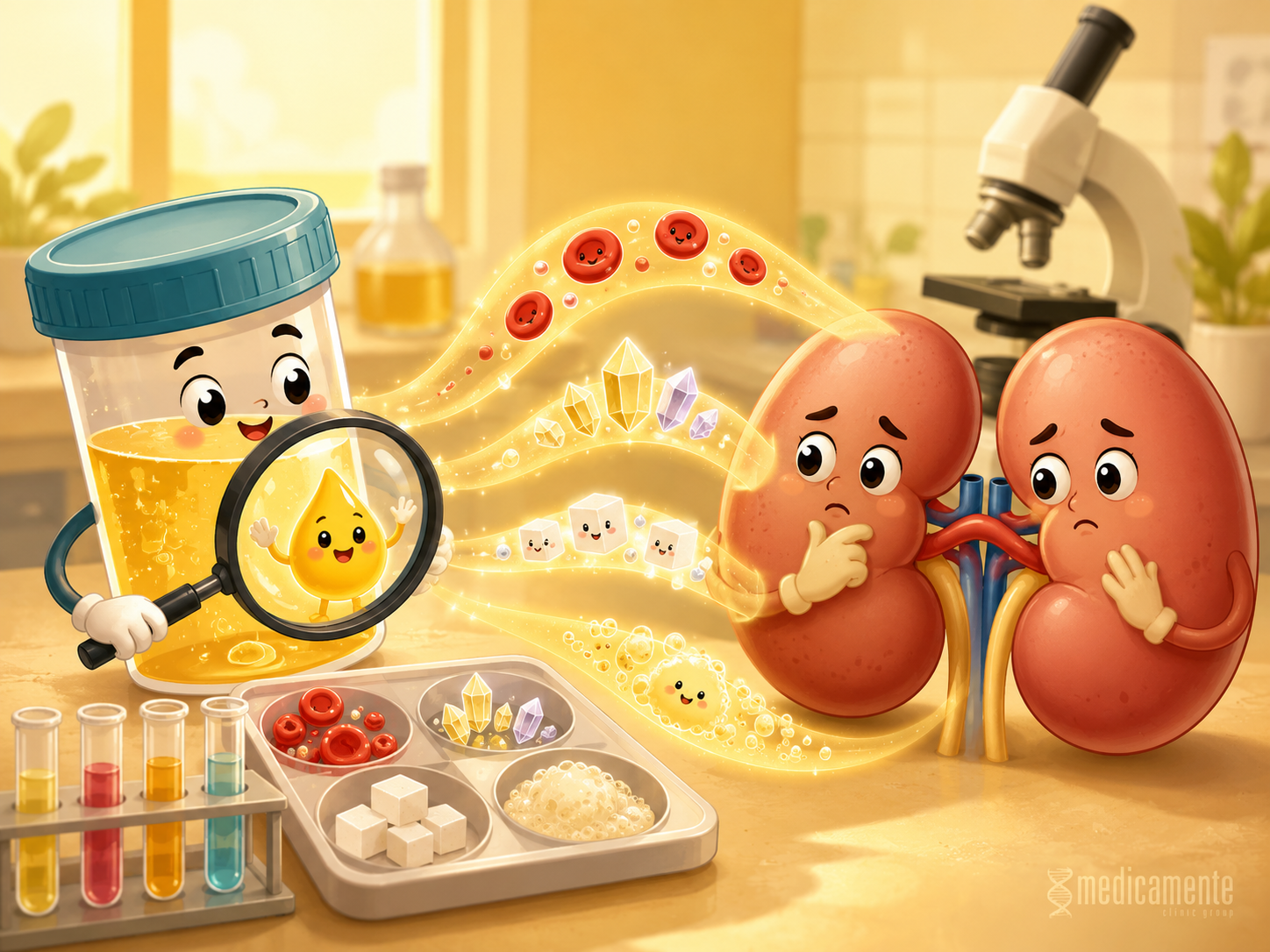
Protein, blood, casts, and other early warning signs
Why urinalysis is important for kidney assessment
Urinalysis is often seen as a simple routine test ordered “just in case.” In reality, it can provide a great deal of information about the kidneys, urinary tract, and metabolism. Urine is formed in the kidneys, passes through the ureters, collects in the bladder, and leaves the body through the urethra. Its composition can therefore reflect changes at different levels of the urinary system.
The kidneys filter the blood, remove waste products, regulate fluid and salt balance, and preserve substances that should remain in the body. If the kidney filter is damaged, protein, red blood cells, or casts may appear in the urine. If there is inflammation in the urinary tract, white blood cells, bacteria, and nitrites may be detected. If metabolism is disturbed, urine density, acidity, crystals, or glucose may change.
The main advantage of urinalysis is its accessibility. It does not replace creatinine, estimated glomerular filtration rate, ultrasound, or special tests, but it often becomes the first signal that the kidneys need attention. This is especially important because many kidney diseases do not cause pain or noticeable symptoms for a long time.
Protein in urine: why this marker matters
Normally, a significant amount of protein should not enter the urine. Blood proteins, especially albumin, should remain inside the bloodstream. If the kidney filtration barrier is damaged, protein can pass through it and be excreted in the urine. Proteinuria, or protein in the urine, is therefore considered an important sign of possible kidney damage.
Protein in the urine may appear in different conditions. It can be associated with diabetic kidney disease, hypertensive kidney damage, glomerulonephritis, autoimmune diseases, infections, intense physical activity, fever, or temporary functional changes. A single abnormal result does not always mean chronic disease, but it does require proper interpretation.
Albuminuria is especially important. Albumin is one of the main blood proteins. Even a small increase in urine albumin can be an early sign of damage to kidney glomeruli, especially in patients with diabetes, hypertension, and cardiovascular disease. For a more accurate assessment, doctors often use not only routine urinalysis, but also the albumin-to-creatinine ratio in urine.
It is important to understand that protein in urine is not always visible. Urine may look normal while the test already shows changes. Sometimes, with pronounced proteinuria, urine may appear foamy, but this sign is nonspecific and is not suitable for self-diagnosis. Laboratory results are much more reliable.
Blood in urine: when the cause must be carefully investigated
The presence of blood in urine is called hematuria. It can be visible, when urine becomes pink, red, or brownish, or microscopic, when red blood cells are found only in laboratory testing. In both cases, it is important to understand the source of blood and the reason for its appearance.
Hematuria can occur in kidney diseases, stones, urinary tract infections, trauma, tumors, prostate disease, blood clotting disorders, or after intense physical activity. Sometimes urine color changes not because of blood, but because of food, medications, or pigments, so laboratory confirmation matters.
For the doctor, not only the presence of red blood cells is important, but also their combination with other findings. If blood in urine is accompanied by protein, casts, and high blood pressure, kidney glomerular disease may be suspected. If white blood cells, bacteria, burning, and frequent urination are present, a urinary tract infection is more likely. If there is sharp pain in the lower back or side, a stone may be one possible cause.
Hematuria should not be ignored, especially if it recurs, persists in repeat tests, or appears without an obvious cause. Even when a person feels well, blood in the urine can be an important diagnostic signal.
White blood cells, bacteria, and nitrites: signs of inflammation
White blood cells in urine most often indicate an inflammatory reaction in the urinary tract. If bacteria, nitrites, cloudy urine, unpleasant odor, frequent urination, pain, or burning are also present, a urinary tract infection may be suspected.
The infection may be located in the bladder, in which case it is often called cystitis. If inflammation moves upward and affects the kidney, pyelonephritis may develop. In this case, high fever, lower back pain, chills, marked weakness, and worsening general condition are more common. This situation requires more careful evaluation.
However, white blood cells in urine do not always mean infection. They may appear due to improper sample collection, inflammation of the external genital area, stones, tubulointerstitial kidney disease, certain medication reactions, or chronic inflammatory processes. The result should therefore be compared with symptoms, urine culture, and other findings.
Bacteria in the test also require cautious interpretation. If urine is collected incorrectly, bacteria from the skin or mucous membranes may enter the sample. When infection is suspected, it is important to collect a midstream urine sample in a clean container. In some cases, urine culture is ordered to identify the pathogen and determine antibiotic sensitivity.
Casts: why they are especially important for the kidneys
Casts are microscopic structures that form inside the kidney tubules. Their presence can provide information about processes occurring within the kidneys. Unlike some other urine findings, casts are more often related to kidney tissue itself rather than only the lower urinary tract.
There are different types of casts. Hyaline casts may sometimes be found in small amounts and do not always indicate serious disease. However, red blood cell casts, white blood cell casts, granular casts, or waxy casts may point to more significant processes: glomerular inflammation, tubular injury, chronic kidney damage, or active inflammation.
For example, the combination of red blood cells, protein, and red blood cell casts may lead a doctor to suspect glomerulonephritis. White blood cell casts may be seen with inflammation of kidney tissue. Granular casts may appear with tubular injury or chronic kidney disease.
Patients cannot see casts themselves; they are detected only through microscopic examination of urine sediment. This is why urinalysis should be interpreted not only by automated indicators, but also with microscopy when needed.
Urine density and the kidney’s ability to concentrate urine
Urine specific gravity shows how concentrated the urine is. This marker depends on fluid intake, sweating, diet, hormonal regulation, and the ability of the kidneys to concentrate or dilute urine.
If a person drinks little or loses fluid, urine usually becomes more concentrated and specific gravity rises. If fluid intake is high, urine becomes more diluted. This is a normal physiological response. But if urine density is persistently low or changes very little, it may suggest impaired concentrating ability of the kidneys or other conditions.
In chronic kidney disease, the kidneys may adapt less effectively to changes in fluid load. A person may urinate more often at night, urine may be less concentrated, and fluid balance may become less flexible. However, no diagnosis is made based on urine density alone. This marker is assessed together with creatinine, filtration rate, electrolytes, and other tests.
Urine density is also useful when evaluating dehydration, some endocrine disorders, and a patient’s condition during acute illness. But it cannot be interpreted separately from context: the same value may mean different things depending on how much fluid the person drank, whether there was fever, physical activity, or use of diuretics.
Glucose and ketones in urine
Glucose appears in urine when blood glucose exceeds the kidney’s ability to return it fully to the bloodstream, or when tubular function is impaired. Most often, glucosuria is associated with diabetes, especially if blood glucose is elevated. However, it may also appear in other conditions.
In diabetes, glucose in the urine may indicate insufficient glucose control, but the main tests for diabetes assessment remain blood glucose and glycated hemoglobin. Urinalysis can add useful information, but it does not replace full diabetes monitoring.
Ketones appear in urine when the body actively uses fats as an energy source. This may happen during prolonged fasting, a low-carbohydrate diet, vomiting, fever, diabetes decompensation, or other conditions. In patients with diabetes, ketones may be especially important, particularly if they occur together with high blood glucose and worsening well-being.
Glucose and ketones in urine do not always directly indicate kidney disease. However, they are important because they show metabolic changes that can affect general health and indirectly increase the burden on the kidneys.
Crystals and salts: do they always mean stones
Crystals of salts may sometimes be found in urine. These may include oxalates, urates, phosphates, and other compounds. Their presence does not always mean kidney stone disease. Crystals may appear due to diet, urine acidity, urine concentration, sample storage temperature, and metabolic factors.
However, if a patient has had kidney stones, pain, repeated episodes of renal colic, or ultrasound changes, crystals may be part of the overall risk assessment. In this situation, the doctor considers urine pH, specific gravity, uric acid, calcium, oxalates, citrates, and other markers when indicated.
It is important to understand that stone prevention is not based on one urine test alone. The type of stone, fluid intake, diet, metabolism, infections, heredity, and urinary tract anatomy all matter. But urinalysis can provide early clues: overly concentrated urine, certain crystals, altered pH, or signs of infection may suggest increased risk.
Urine pH: acidity and metabolism
Urine pH shows its acidity. This marker can change depending on diet, metabolism, infection, medications, and kidney function. Acidic or alkaline urine is not a diagnosis by itself, but it can be a useful part of the overall assessment.
Acidic urine is more common with certain dietary patterns, metabolic conditions, and a tendency toward uric acid stones. Alkaline urine may be seen in some urinary tract infections, especially when bacteria change urine composition, as well as in certain metabolic and tubular disorders.
Urine pH has practical importance in the prevention of some types of stones. For example, uric acid stones form more easily in acidic urine. However, urine pH should not be changed independently using supplements or medications. Incorrect correction may increase the risk of other problems. Such decisions should be made only after proper evaluation.
Why proper sample collection matters
The quality of urinalysis depends strongly on correct sample collection. If the sample is contaminated, the result may show bacteria, white blood cells, mucus, or cells that do not reflect the real condition of the urinary tract. This can lead to unnecessary concerns, repeat testing, or incorrect interpretation.
Usually, morning urine or a properly collected sample is used for routine urinalysis. Hygiene should be performed, a clean container should be used, and the midstream portion should be collected. This means the first part of urine is passed into the toilet, the middle portion is collected in the container, and the final part is not needed for testing.
In women, the test may be distorted during menstruation or if the sample is not collected properly. In men, some changes may be related to inflammation of the prostate or lower urinary tract. If the result is questionable, the doctor may order a repeat test with proper preparation.
It is also important to deliver the sample to the laboratory quickly. With prolonged storage, pH may change, bacteria may multiply, cells may break down, and inaccuracies may appear. Urinalysis seems simple, but the quality of collection truly affects the result.
When urinalysis is not enough
Routine urinalysis is important, but it is not the only diagnostic method. It can show abnormalities, but it does not always explain their cause. If protein, blood, casts, persistent white blood cells, bacteria, or other changes are found, additional testing may be needed.
When protein is found in urine, the albumin-to-creatinine ratio or protein-to-creatinine ratio is often assessed. If infection is suspected, urine culture may be ordered. If kidney function is reduced, creatinine, eGFR, electrolytes, and kidney ultrasound are evaluated. If stones are suspected, ultrasound, CT, or metabolic testing may be used. If glomerulonephritis is suspected, immune tests and nephrology consultation may be needed.
Urinalysis should therefore be seen as part of diagnosis. It helps show the direction: inflammation, filter damage, blood, crystals, impaired concentration, or metabolic changes. But the final interpretation is made only after comparison with other data.
Urinalysis is valuable because it can reveal a problem before pronounced symptoms appear. Protein, albumin, blood, or casts may sometimes be the first signs of kidney disease. White blood cells and bacteria help suggest infection. Specific gravity, pH, glucose, ketones, and crystals provide additional information about metabolism and the urinary system. This is why a simple urine test remains one of the important tools for early detection of kidney and urological disorders.
Write a review
Required fields are marked with *
Categories
- Therapy (81)
- News (48)
- GP (23)
- Cardiology (20)
- urology (12)
- Endocrinology (8)
- Ortopedics (4)
- Dermatology (3)
- Ultrasound (1)
- Mobile app (1)
Articles





Archive
- September 2026 (11)
- August 2026 (11)
- July 2026 (11)
- June 2026 (11)
- May 2026 (9)
- April 2026 (8)
- March 2026 (8)
- February 2026 (8)
- January 2026 (8)
- December 2025 (5)
Categories
- Therapy (81)
- News (48)
- GP (23)
- Cardiology (20)
- urology (12)
- Endocrinology (8)
- Ortopedics (4)
- Dermatology (3)
- Ultrasound (1)
- Mobile app (1)


