
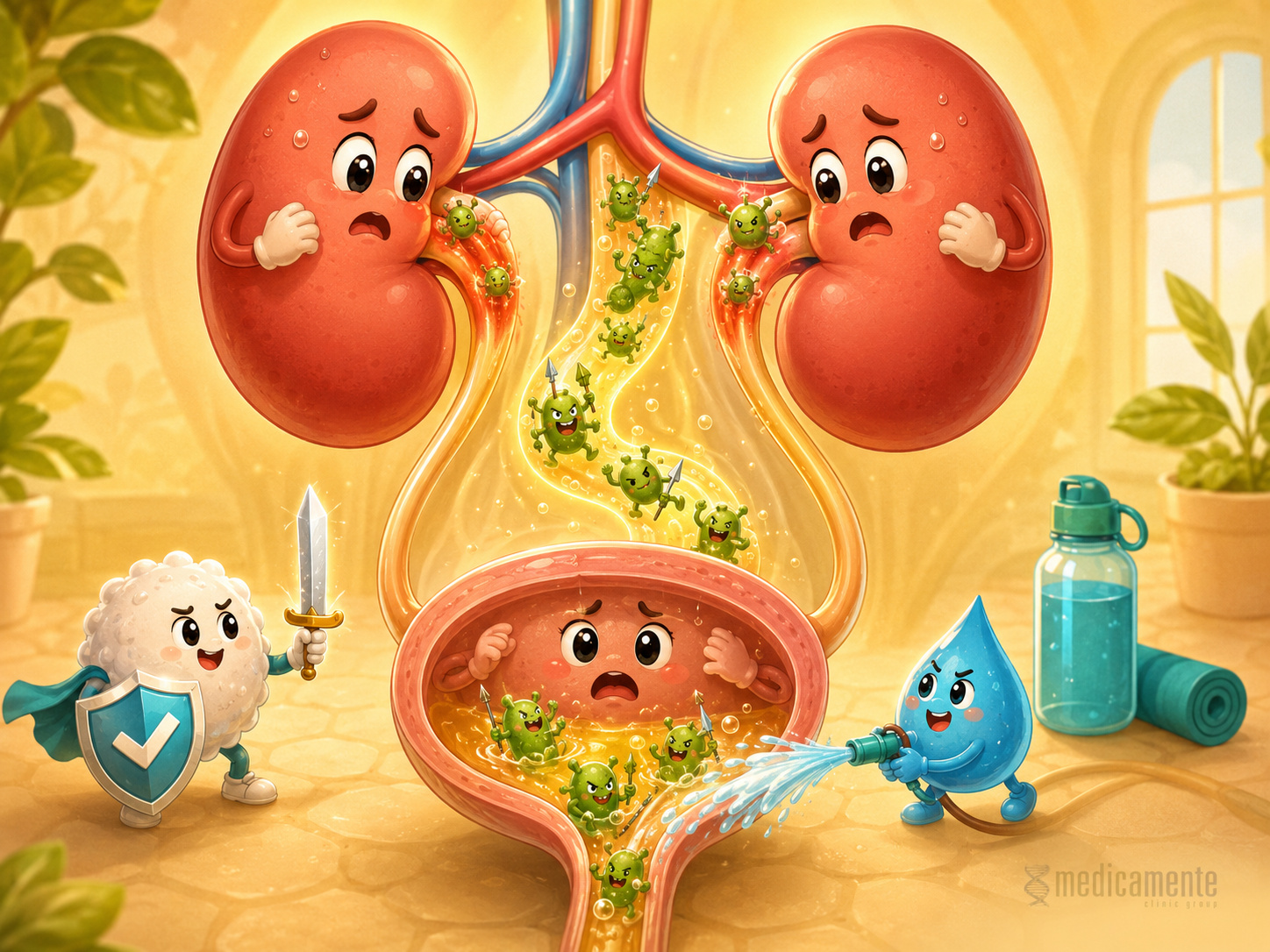
When cystitis becomes a risk for the upper urinary tract
Urinary tract infections: why the level of inflammation matters
Urinary tract infections are a common reason for medical consultation. They can develop at different levels of the urinary system: in the urethra, bladder, ureters, or kidneys. Symptoms, risks, and treatment approach depend on where the inflammation is located.
The most familiar form is cystitis, or inflammation of the bladder. It often causes frequent urination, burning, pain or discomfort in the lower abdomen, a feeling of incomplete bladder emptying, changes in urine odor, or cloudy urine. In uncomplicated cystitis, the general condition is usually only mildly affected, and high fever or pronounced lower back pain is usually absent.
A different situation is pyelonephritis, which is inflammation of the kidney tissue and collecting system. This is an infection of the upper urinary tract. It may be accompanied by high fever, chills, pain in the lower back or side, marked weakness, nausea, and sometimes vomiting. Pyelonephritis requires more careful evaluation because the infection affects the kidney and may lead to complications, especially in patients from risk groups.
It is important to understand that not every urinary tract infection is equally dangerous. However, every infection requires proper assessment because similar symptoms may reflect different conditions, ranging from simple cystitis to kidney inflammation, a stone, impaired urine flow, or a systemic infectious process.
How infection enters the urinary tract
Most urinary tract infections develop through an ascending route. This means bacteria enter the urethra, then may move into the bladder, and under unfavorable conditions may rise further toward the kidneys. The most common causative agents are bacteria from the intestinal flora, which can reach the urinary tract area from nearby tissues.
The urinary system has its own protective mechanisms. Normal urine flow helps mechanically flush bacteria out. The mucous membrane, immune factors, urine acidity, regular bladder emptying, and the absence of obstacles to urine flow all reduce infection risk. When these mechanisms are disrupted, the likelihood of inflammation increases.
For example, if the bladder does not empty completely, bacteria may remain longer and multiply. If there is a stone, urinary tract narrowing, prostate enlargement, congenital abnormality, or impaired urine flow, infection risk is higher. In diabetes, elevated glucose, vascular changes, and impaired immune response can also contribute to more severe or recurrent infections.
Urinary tract infections are more common in women because of anatomical features: the urethra is shorter, so bacteria can more easily reach the bladder. However, urinary tract infections can occur in people of any sex and age, especially when risk factors are present.
Cystitis: when inflammation is limited to the bladder
Cystitis most often causes local symptoms. A patient may feel burning or pain during urination, frequent urges, small amounts of urine, discomfort in the lower abdomen, changes in urine odor, cloudiness, or a small amount of blood. These symptoms may be unpleasant, but in uncomplicated cases the infection is usually limited to the bladder.
Even with typical symptoms, context matters. In some patients, cystitis may truly be an uncomplicated episode. In others, similar complaints may be caused by stones, sexually transmitted infections, inflammatory disorders, tumors, mucosal irritation, medication reactions, or chronic urological conditions.
It is especially important not to consider every urinary discomfort to be ordinary cystitis if symptoms recur frequently, do not improve after treatment, or are accompanied by blood in the urine, lower back pain, fever, or marked worsening of general condition. In such cases, broader diagnostic evaluation is needed.
In cystitis, urinalysis helps confirm inflammation. White blood cells, bacteria, nitrites, and sometimes red blood cells may be found in the urine. In some cases, urine culture is needed, especially with recurrences, atypical presentation, pregnancy, complicated infections, or treatment failure.
Pyelonephritis: when infection rises to the kidney
Pyelonephritis is inflammation that affects the kidney. It usually has a more serious course than cystitis because the infection extends beyond the lower urinary tract and can cause a systemic reaction. Typical signs include high fever, chills, pain in the lower back or side, marked weakness, body aches, nausea, and sometimes vomiting. Urinary symptoms may be present, but they are sometimes less pronounced.
Pyelonephritis is especially dangerous when urine flow is impaired. For example, if a stone blocks the ureter, urine cannot drain normally from the kidney. If infection develops in this setting, pressure in the urinary system rises, bacteria and inflammatory products are retained, and the risk of severe complications increases. This situation requires urgent medical care.
Patients with diabetes, pregnancy, reduced immunity, chronic kidney disease, older age, a single kidney, or congenital urinary tract abnormalities also require special attention. These groups have a higher risk of complicated disease.
It is important that pyelonephritis cannot be reliably distinguished from cystitis based on one symptom alone. Evaluation includes symptoms, temperature, lower back pain, urinalysis, sometimes blood tests, urine culture, and imaging methods. If signs of severe infection are present, the doctor assesses the need for more intensive treatment and monitoring.
Why infections may recur
Recurrent urinary tract infections are a separate problem. If episodes repeat, it is important not only to treat each new infection but also to look for reasons that support inflammation. Recurrent infections may be associated with anatomical features, impaired urine flow, stones, incomplete bladder emptying, hormonal changes, diabetes, changes in microbiota, sexual activity, use of certain hygiene products, or other factors.
In women, recurrent cystitis may be related to anatomical and hormonal features. After menopause, lower estrogen levels can change the condition of the mucous membranes and microbiota, which affects infection risk. In men, recurrent infections usually require a more careful search for the cause, including evaluation of the prostate, residual urine, and possible obstruction.
Stones in the urinary tract can contribute to recurrent infections. They may impair urine flow, irritate the mucosa, and support the presence of bacteria. Some types of stones, especially infection-related stones, can grow in the presence of bacteria that change urine chemistry.
In recurrent infections, uncontrolled repeated use of antibiotics without diagnosis should be avoided. This can lead to bacterial resistance and make future treatment more difficult. In such cases, urine culture, risk factor assessment, and an individualized prevention plan are especially important.
Which factors increase the risk of complicated infection
Not all urinary tract infections are uncomplicated. The risk of complications increases when infection develops in the setting of conditions that interfere with normal urine flow, reduce immune defense, or already impair kidney function.
Risk factors include:
- Pregnancy.
Urinary tract infections during pregnancy require special attention because they may affect the mother’s condition and the course of pregnancy. - Diabetes mellitus.
Diabetes increases the risk of more severe infections and may be associated with impaired kidney function. - Kidney stone disease.
Stones can obstruct urine flow and support inflammation. - Chronic kidney disease.
When kidney function is reduced, infection may be harder to tolerate and medications may require more careful selection. - Impaired urine flow.
Causes may include stones, prostate enlargement, strictures, tumors, or anatomical abnormalities. - Reduced immunity.
Immunosuppressive therapy, cancer, and some chronic conditions can increase complication risk. - Catheters and urological procedures.
Foreign bodies and procedures can make it easier for bacteria to enter the urinary tract. - A single functioning kidney.
In this situation, any inflammation requires especially careful evaluation.
If infection occurs in the presence of these factors, diagnosis and treatment usually need to be more cautious and systematic.
Diagnosis of urinary tract infections
Diagnosis begins with assessment of symptoms and overall condition. The doctor clarifies whether there is burning, frequent urination, lower abdominal pain, fever, chills, lower back pain, blood in urine, nausea, vomiting, pregnancy, diabetes, stones, chronic kidney disease, or repeated episodes.
Urinalysis helps identify signs of inflammation: white blood cells, bacteria, nitrites, sometimes blood and protein. However, the urine sample must be collected correctly. Contamination can lead to false results. Usually, a midstream urine sample in a clean container after hygiene is recommended.
Urine culture is not always required, but it is important in complicated infections, pregnancy, pyelonephritis, recurrences, atypical course, treatment failure, or suspected bacterial resistance. Culture helps identify the pathogen and select an antibiotic based on sensitivity.
Blood tests may be needed when pyelonephritis or systemic infection is suspected. Inflammatory markers, kidney function, electrolytes, and overall condition are assessed. In severe cases, this helps evaluate complication risk.
Ultrasound of the kidneys and urinary tract is ordered if a stone, impaired urine flow, abscess, recurrent infections, pregnancy, chronic kidney disease, or complicated course is suspected. In some cases, computed tomography or other imaging methods may be needed.
Why self-treatment with antibiotics can be a problem
Urinary tract infections are often perceived as something that can be treated independently, especially if similar symptoms have occurred before. However, uncontrolled antibiotic use can create several problems.
First, symptoms may be caused by something other than a bacterial infection. Burning and discomfort may occur with mucosal irritation, inflammatory conditions, sexually transmitted infections, stones, gynecological or urological causes. In this situation, an antibiotic may not help and may delay correct diagnosis.
Second, the wrong choice of medication, dose, or treatment duration may fail to eliminate the infection completely. Symptoms may temporarily decrease, but bacteria may persist and inflammation may return. This is especially dangerous in pyelonephritis or complicated infections.
Third, frequent and unjustified antibiotic use contributes to bacterial resistance. In the future, the infection may become more difficult to treat because commonly used medications no longer work.
Therefore, in recurrent, severe, atypical, or complicated symptoms, it is important not to treat blindly, but to confirm the diagnosis and perform urine culture when needed.
Prevention of recurrent infections
Prevention depends on the cause of recurrence. There is no universal solution for everyone. In some cases, changing certain habits is enough; in others, treatment of associated diseases, correction of hormonal factors, removal of stones, or restoration of urine flow is needed.
General measures may include adequate fluid intake, regular bladder emptying, avoiding prolonged holding of urine, proper intimate hygiene without aggressive products, diabetes control, treatment of constipation, and correction of factors that impair urine flow. In women with recurrent infections, the doctor may assess the relationship between episodes and sexual activity, hormonal status, and mucosal condition.
If infections are related to stones, prevention should include urological evaluation and treatment of kidney stone disease. If the cause is incomplete bladder emptying, it is important to understand why this happens. In men, prostate evaluation may be needed; in some patients, residual urine measurement may be required.
With frequent recurrences, the doctor may suggest additional preventive strategies, but they are selected individually. The main point is not to keep repeating the same treatment without searching for the cause.
Urinary tract infections in older patients
In older adults, urinary tract infections may present differently. Symptoms may sometimes be less typical: instead of pronounced burning or pain, there may be weakness, worsening general condition, reduced appetite, confusion, falls, or worsening of chronic diseases. However, it is important not to confuse infection with asymptomatic bacteria in urine.
Asymptomatic bacteriuria means bacteria are found in the urine, but there are no symptoms or signs of inflammation. In some groups, it does not require antibiotic treatment. Exceptions exist, for example pregnancy or certain situations before urological procedures. Therefore, in older patients, not only the test result but also the clinical picture must be assessed.
Excessive treatment of asymptomatic bacteriuria can lead to bacterial resistance and side effects. On the other hand, a true infection must not be missed, especially if there is fever, pain, worsening kidney function, or signs of systemic inflammation. The balance between treatment and observation should therefore be determined by a doctor.
When infection can be dangerous for the kidneys
Most lower urinary tract infections, when properly treated, do not lead to kidney damage. However, risk increases if infection rises to the kidney, occurs in the setting of impaired urine flow, recurs frequently, has a severe course, or develops in a patient with pre-existing chronic kidney disease.
Pyelonephritis may lead to temporary or more persistent loss of kidney function, especially if it is complicated by obstruction, abscess, sepsis, or repeated episodes. In children, recurrent infections in the presence of vesicoureteral reflux or anatomical abnormalities can lead to kidney scarring. In adults, risk also increases with stones, diabetes, and impaired urine flow.
It is especially important to respond quickly to the combination of infection and obstruction. If urine cannot drain normally, antibiotics may be insufficient without restoring urine flow. This is one reason why side pain, fever, and suspected stone require urgent evaluation.
Urinary tract infections are not only cystitis. They can affect different parts of the urinary system and carry different levels of risk. Mild episodes may resolve without consequences, but recurrent, complicated, or ascending infections require careful diagnosis. Urinalysis, urine culture, risk factor assessment, kidney function monitoring, and imaging when needed help distinguish a simple infection from a situation that may threaten the kidneys.
Write a review
Required fields are marked with *
Categories
- Therapy (81)
- News (48)
- GP (23)
- Cardiology (20)
- urology (12)
- Endocrinology (8)
- Ortopedics (4)
- Dermatology (3)
- Ultrasound (1)
- Mobile app (1)
Articles





Archive
- September 2026 (11)
- August 2026 (11)
- July 2026 (11)
- June 2026 (11)
- May 2026 (9)
- April 2026 (8)
- March 2026 (8)
- February 2026 (8)
- January 2026 (8)
- December 2025 (5)
Categories
- Therapy (81)
- News (48)
- GP (23)
- Cardiology (20)
- urology (12)
- Endocrinology (8)
- Ortopedics (4)
- Dermatology (3)
- Ultrasound (1)
- Mobile app (1)


