
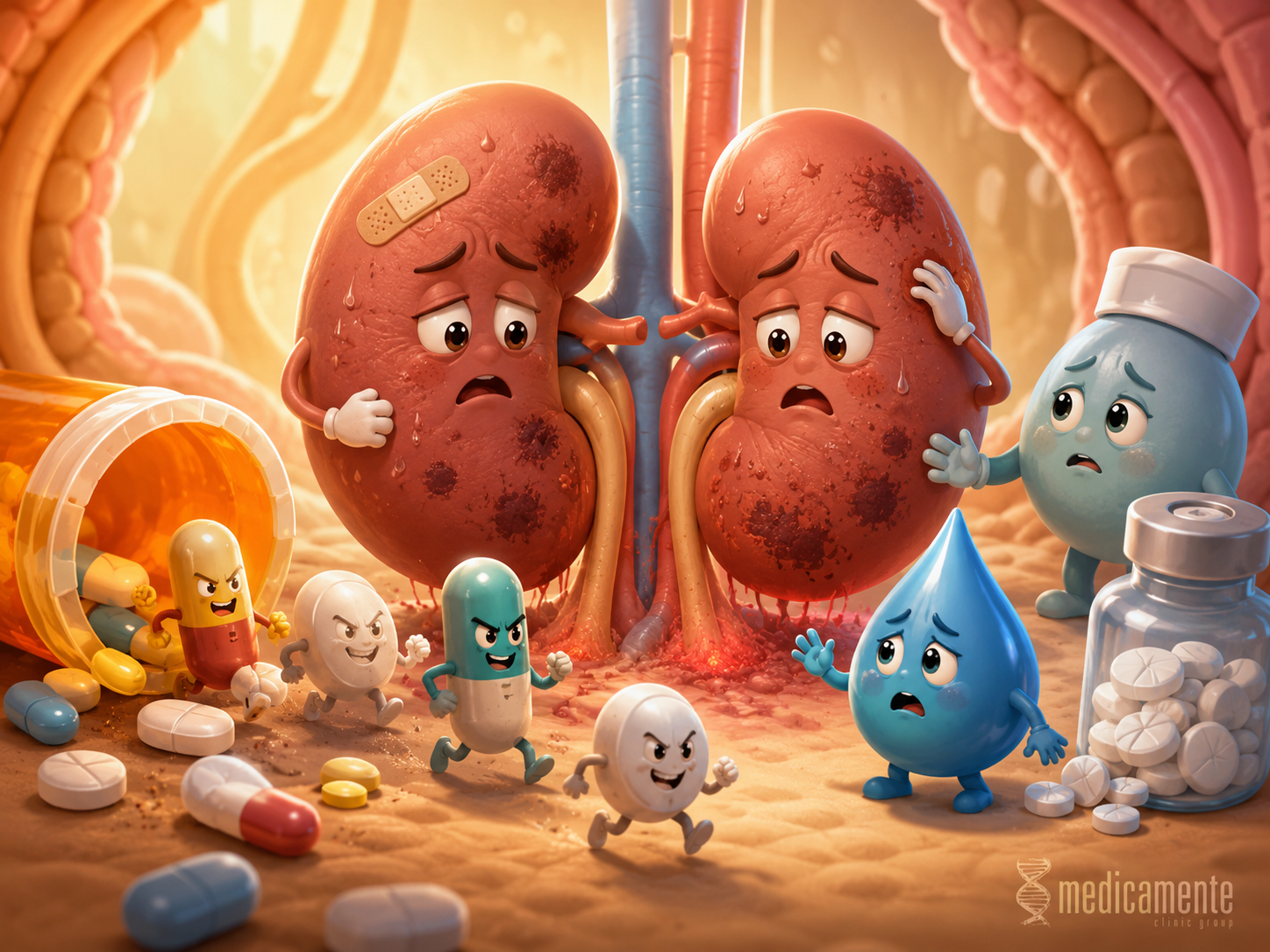
Why some medicines require creatinine monitoring
Why the kidneys are sensitive to medications
The kidneys filter the blood and help remove many substances from the body, including waste products, excess electrolytes, and numerous medications. Because a large volume of blood passes through the kidneys every day, kidney tissue is constantly exposed to substances circulating in the bloodstream.
Many medicines are safe when used correctly. However, some can affect kidney blood flow, irritate kidney tubules, disturb electrolyte balance, or accumulate when filtration is reduced. The risk is not the same for everyone. A medicine that is usually well tolerated in a healthy person may become problematic in someone with dehydration, chronic kidney disease, diabetes, heart failure, older age, or several medications taken together.
Medication-related kidney injury may be acute or gradual. Sometimes kidney function worsens quickly over a few days, for example during dehydration, infection, or the use of several kidney-sensitive medications at once. In other cases, the effect is more subtle and becomes visible only through blood tests.
This is why monitoring matters. Creatinine, estimated glomerular filtration rate, electrolytes, and urinalysis can help detect changes before severe symptoms appear. The goal is not to avoid all medicines, but to use them safely, with proper indications, correct doses, and appropriate monitoring.
How medicines can affect the kidneys
Medication-related kidney injury can happen through different mechanisms. Some drugs reduce blood flow inside the kidneys. Others directly affect kidney tubule cells. Some may cause allergic or inflammatory reactions in kidney tissue. Others can disturb the balance of sodium, potassium, water, or acid-base regulation.
One important mechanism is reduced kidney perfusion. The kidneys need stable blood flow to filter properly. If blood pressure drops, dehydration develops, or certain medications change the tone of kidney blood vessels, filtration may decrease. This can lead to a rise in creatinine.
Another mechanism is direct tubular toxicity. Some medications or their metabolites can injure kidney tubule cells, especially when the drug concentration becomes too high or the patient already has reduced kidney function. In this case, the kidneys may temporarily or sometimes persistently lose part of their filtering ability.
A third mechanism is interstitial nephritis, an inflammatory reaction in the kidney tissue that may occur as a reaction to certain medications. It may be accompanied by fever, rash, changes in urine, eosinophilia, or worsening kidney function, but symptoms are not always clear.
Medications can also cause crystals to form in the urine, disturb electrolyte balance, or worsen pre-existing kidney disease. This is why the same abnormal creatinine result can have different causes and requires clinical interpretation.
Painkillers and the kidneys
Nonsteroidal anti-inflammatory drugs are among the most common medicines that can affect the kidneys. This group includes many widely used painkillers and anti-inflammatory medications. They can reduce the production of prostaglandins, substances that help maintain blood flow in the kidneys, especially when the body is under stress.
In a healthy person who uses such medication occasionally and stays well hydrated, the risk may be low. But the risk increases when there is dehydration, fever, vomiting, diarrhea, heart failure, chronic kidney disease, older age, use of diuretics, or treatment with medications that affect the renin-angiotensin system.
A particularly risky situation is the combination of dehydration, diuretics, blood pressure medications affecting kidney blood flow, and nonsteroidal anti-inflammatory drugs. In this setting, the kidneys may receive less blood flow and filtration can worsen quickly.
Long-term or frequent use of painkillers without medical supervision can also be problematic. Some people take them regularly for joint pain, back pain, headaches, or chronic pain syndromes without checking kidney function. In patients with kidney risk factors, safer pain management should be discussed with a doctor.
Antibiotics and kidney function
Antibiotics are important and often necessary medications, but some of them require caution in patients with reduced kidney function. Certain antibiotics are removed through the kidneys, so their dose may need adjustment when filtration is reduced. If the dose is not adjusted, the drug may accumulate and increase the risk of side effects.
Some antibiotics can directly affect kidney tissue, especially in high doses, prolonged treatment, dehydration, severe infection, or when combined with other kidney-sensitive drugs. The risk depends on the specific antibiotic, dose, duration, kidney function, and the patient’s general condition.
During severe infections, kidney function may worsen not only because of the antibiotic, but also because of the infection itself. Fever, dehydration, low blood pressure, sepsis, and inflammation can all contribute to acute kidney injury. Therefore, if creatinine rises during infection treatment, the cause must be assessed carefully.
Urine culture and antibiotic sensitivity testing can help choose targeted therapy, especially in recurrent urinary tract infections, complicated infections, or suspected bacterial resistance. This reduces the need for unnecessary broad treatment and helps protect both the patient and antibiotic effectiveness.
Contrast agents used in CT and other studies
Some imaging studies use contrast agents to make blood vessels, organs, or tissues more visible. Contrast-enhanced computed tomography can be very useful for diagnosing tumors, vascular problems, inflammation, trauma, and other conditions. However, in patients with reduced kidney function, contrast use requires proper risk assessment.
Before contrast administration, kidney function is often checked using creatinine and estimated glomerular filtration rate. The risk depends on the degree of kidney impairment, dehydration, diabetes, heart failure, acute illness, and other factors. In many cases, contrast can be used safely, but precautions may be needed.
The doctor evaluates whether contrast is necessary, whether another imaging method could provide enough information, and how to reduce risk. Hydration status, medication review, and avoiding unnecessary repeated contrast exposure may be important.
It is also important not to refuse necessary imaging automatically out of fear. Sometimes contrast-enhanced imaging is essential for accurate diagnosis and timely treatment. The decision should balance diagnostic benefit and kidney risk.
Diuretics and fluid balance
Diuretics help the body remove excess sodium and water. They are often used in hypertension, heart failure, edema, and some kidney-related conditions. They can be very useful, but they also require careful balance.
If diuretic effect is too strong, dehydration may develop, blood pressure may fall, and kidney perfusion may decrease. This can lead to a temporary or sometimes significant decline in kidney function. The risk is higher during vomiting, diarrhea, fever, hot weather, low fluid intake, or poor appetite.
Diuretics can also affect electrolytes. Depending on the type of medication, potassium may decrease or increase, sodium may fall, and acid-base balance may change. These changes can cause weakness, cramps, dizziness, heart rhythm disturbances, or other symptoms.
For this reason, patients taking diuretics often need periodic monitoring of creatinine and electrolytes. The dose may need adjustment depending on blood pressure, swelling, kidney function, potassium, sodium, and overall condition.
Blood pressure medications: protection and monitoring
Some blood pressure medications are very important for kidney protection, especially in patients with hypertension, diabetes, chronic kidney disease, and albuminuria. Drugs that affect the renin-angiotensin system can lower blood pressure and reduce albumin loss in the urine.
However, these medications can also cause changes in creatinine and potassium, especially after initiation or dose increase. A small change in creatinine may be expected in some cases and does not automatically mean harm. But significant worsening requires evaluation.
Potassium monitoring is especially important. In some patients, potassium may rise, particularly when kidney function is reduced or when several potassium-increasing medications are used together. High potassium can be dangerous for the heart, so blood tests are part of safe treatment.
This illustrates an important principle: a medication can be kidney-protective and still require monitoring. The need to check creatinine and potassium does not mean the medicine is bad. It means it must be used correctly.
Diabetes medications and reduced kidney function
Diabetes medications differ in how they are processed by the body. Some can be used safely at reduced kidney function, some require dose adjustment, and some may be unsuitable at certain levels of filtration. This is why estimated glomerular filtration rate matters when selecting diabetes therapy.
In patients with diabetes and chronic kidney disease, treatment goals include not only glucose control, but also kidney and cardiovascular protection. Some modern diabetes medications have shown benefits for the kidneys and heart in specific patient groups. However, they are not appropriate for everyone and must be selected according to kidney function, indications, contraindications, and overall risk.
Reduced kidney function also increases the importance of avoiding hypoglycemia. Some medications may remain active longer when filtration declines, which can increase the risk of low blood sugar. Older patients and those with irregular eating patterns are especially vulnerable.
Regular kidney monitoring helps adjust therapy in time and avoid both uncontrolled glucose and medication-related complications.
Supplements, herbs, and “natural” remedies
Many people assume that supplements and herbal products are automatically safe because they are “natural.” This is not always true. Some herbal preparations can contain substances that irritate or damage the kidneys, interact with medications, or affect blood pressure, potassium, fluid balance, or blood clotting.
Another issue is quality control. Supplements may vary in concentration, contain undeclared ingredients, or be combined with other active substances. For a person with chronic kidney disease, diabetes, hypertension, or multiple medications, this can be risky.
High doses of vitamins and minerals can also cause problems. Excessive vitamin C may increase oxalate load in predisposed people, which can matter for kidney stone risk. Uncontrolled magnesium, potassium, phosphorus, or calcium supplements may disturb electrolyte and mineral balance when kidney function is reduced.
Patients often forget to mention supplements to their doctor, but they should be considered part of the medication list. This is especially important before surgery, imaging with contrast, changes in blood pressure therapy, or when kidney tests worsen unexpectedly.
Who is at higher risk
The risk of medication-related kidney injury is higher when the kidneys already have less reserve or when the body is under additional stress.
Risk groups include:
- People with chronic kidney disease.
Reduced filtration makes the kidneys more vulnerable and affects drug elimination. - Older adults.
Kidney reserve may be lower, and several medications are often used at the same time. - Patients with diabetes.
Diabetes can damage kidney vessels and increase the risk of chronic kidney disease. - Patients with heart failure.
Kidney blood flow may depend strongly on fluid balance and blood pressure. - People with dehydration.
Vomiting, diarrhea, fever, low fluid intake, or heat can reduce kidney perfusion. - Patients taking several kidney-sensitive medications.
Drug combinations may increase risk more than each medication separately. - People with liver disease, severe infection, or low blood pressure.
These conditions can impair circulation and affect kidney function. - Patients using painkillers or supplements frequently without supervision.
Long-term unsupervised use can be harmful.
Risk is usually not determined by one factor alone. It increases when several factors occur together.
Which tests help monitor safety
Monitoring depends on the medication and the patient’s risk. The most common tests include blood creatinine, estimated glomerular filtration rate, potassium, sodium, bicarbonate, and sometimes calcium, phosphorus, magnesium, or drug-specific markers.
Urinalysis may be useful if kidney inflammation, protein, blood, or casts are suspected. In some cases, albuminuria is assessed to monitor chronic kidney damage. If infection is involved, urine culture may be needed.
Timing also matters. Some medications require tests before starting, then again after dose changes. Others require periodic monitoring during long-term therapy. During acute illness, dehydration, or hospitalization, kidney function may need closer observation.
Patients with known chronic kidney disease should know that medication doses may depend on eGFR. This applies not only to prescription drugs, but also to some over-the-counter medications.
How to reduce the risk of medication-related kidney injury
Risk reduction begins with knowing kidney function. Creatinine and estimated glomerular filtration rate help determine whether medication doses are appropriate and whether extra monitoring is needed.
It is important to avoid unnecessary self-medication, especially frequent use of painkillers, diuretics, antibiotics, and supplements. A medicine that helped once is not always safe in a different situation, especially during dehydration or acute illness.
Patients should inform doctors about all medications they take, including over-the-counter drugs and supplements. This helps identify risky combinations and prevent interactions.
Hydration and general condition also matter. During vomiting, diarrhea, fever, or poor fluid intake, some medications may become temporarily riskier. Patients with chronic diseases should know when to seek medical advice about medication safety during acute illness.
Medication-related kidney injury is not a reason to fear all treatment. Many medications protect the kidneys, heart, and blood vessels when used properly. The key is correct selection, appropriate dosing, awareness of risk factors, and timely monitoring of kidney function and electrolytes.
Write a review
Required fields are marked with *
Categories
- Therapy (81)
- News (48)
- GP (23)
- Cardiology (20)
- urology (12)
- Endocrinology (8)
- Ortopedics (4)
- Dermatology (3)
- Ultrasound (1)
- Mobile app (1)
Articles





Archive
- September 2026 (11)
- August 2026 (11)
- July 2026 (11)
- June 2026 (11)
- May 2026 (9)
- April 2026 (8)
- March 2026 (8)
- February 2026 (8)
- January 2026 (8)
- December 2025 (5)
Categories
- Therapy (81)
- News (48)
- GP (23)
- Cardiology (20)
- urology (12)
- Endocrinology (8)
- Ortopedics (4)
- Dermatology (3)
- Ultrasound (1)
- Mobile app (1)


