
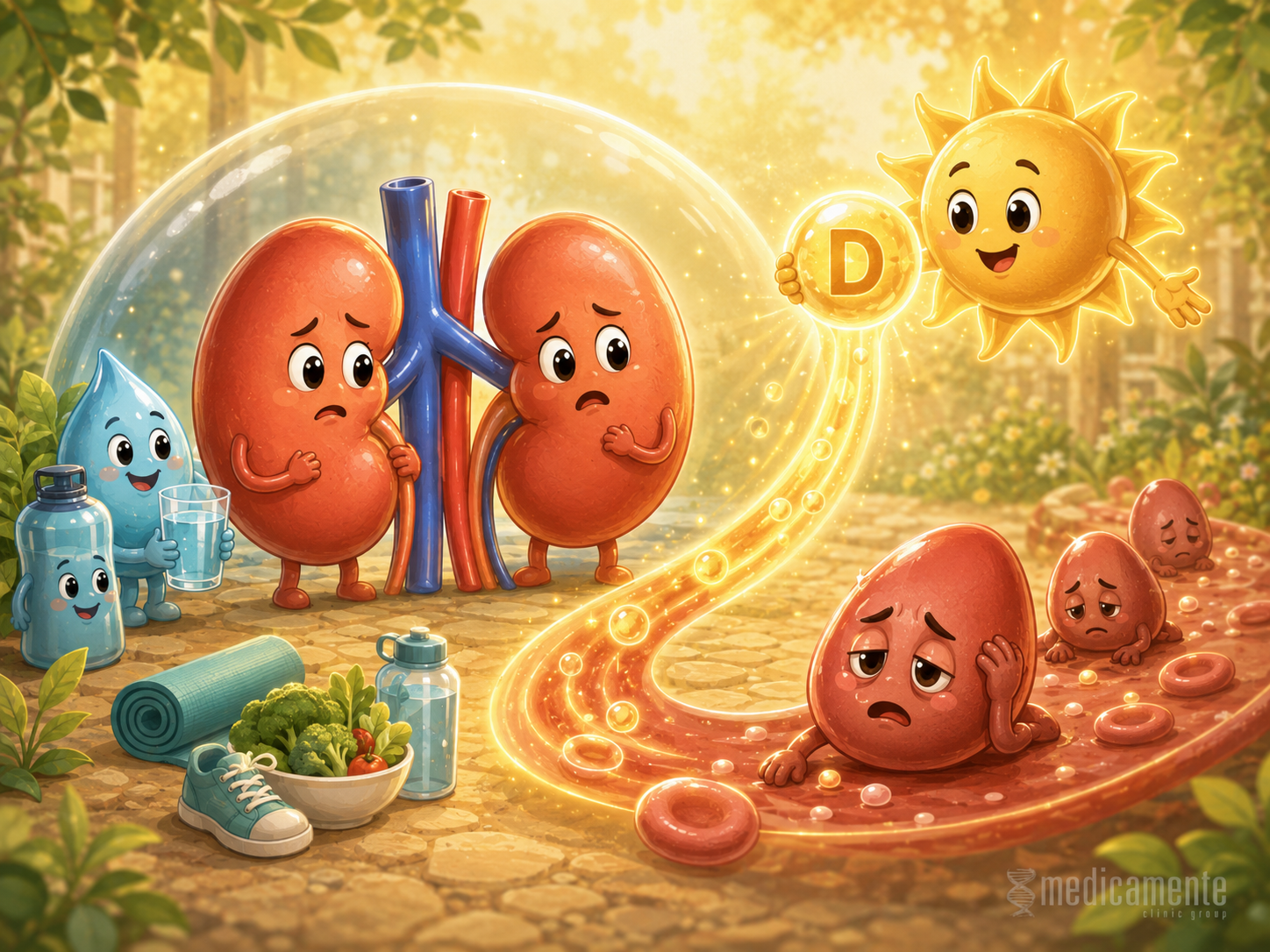
How kidney function is connected to blood, bones, and hormones
Why the kidneys affect more than urine
The kidneys are often seen only as organs that remove fluid and waste products from the body. But their role is much broader. They help regulate blood pressure, fluid and salt balance, acid-base balance, calcium and phosphorus metabolism, vitamin D activation, and the production of hormones that influence red blood cell formation.
This is why chronic kidney disease affects more than filtration. Over time, changes may appear in the blood, bones, blood vessels, muscles, and metabolism. These disturbances are not always noticeable at first. A person may only experience weakness, fatigue, reduced exercise tolerance, or bone and muscle discomfort without connecting these symptoms to kidney function.
Three areas are especially important: anemia, vitamin D, and mineral-bone metabolism. They are closely linked to kidney function and become increasingly significant as estimated glomerular filtration rate declines. This is why, in chronic kidney disease, doctors evaluate not only creatinine and urine tests, but also hemoglobin, iron, phosphorus, calcium, vitamin D, parathyroid hormone, and other markers.
Erythropoietin: how the kidneys help form blood
One of the important hormonal functions of the kidneys is the production of erythropoietin. This hormone stimulates the bone marrow to produce red blood cells. Red blood cells carry oxygen from the lungs to the tissues, and their amount is reflected in the hemoglobin level.
When kidney function declines, erythropoietin production may decrease. The bone marrow receives less stimulation to produce red blood cells, and anemia gradually develops. This is one of the characteristic problems of chronic kidney disease, especially in later stages.
Anemia in chronic kidney disease usually develops gradually. A person may get used to having less energy and may not notice the change immediately. Weakness, fatigue, sleepiness, reduced physical endurance, shortness of breath during exertion, palpitations, dizziness, and pale skin may appear. However, these symptoms are nonspecific and may occur in many other conditions.
It is important to understand that anemia in reduced kidney function is not caused only by erythropoietin deficiency. It may also be influenced by iron deficiency, chronic inflammation, poor nutrition, blood loss, vitamin B12 or folate deficiency, gastrointestinal disease, and medication-related factors. This is why the mechanism of anemia should be understood before treatment is selected.
Why anemia in kidney disease matters
Anemia reduces the blood’s ability to carry oxygen. The body tries to compensate by increasing the work of the heart. The heart has to pump more blood to deliver enough oxygen to the tissues. If anemia is significant or long-lasting, this can increase the burden on the cardiovascular system.
Patients with chronic kidney disease often already have higher cardiovascular risk: hypertension, diabetes, vascular changes, mineral metabolism disorders, and fluid retention. If anemia is added to this, exercise tolerance may decline further, and symptoms of heart failure may become more pronounced.
Anemia also affects quality of life. A person may tolerate everyday activity less well, become tired more quickly, have difficulty concentrating, and feel constantly weak. Sometimes these symptoms are mistakenly attributed only to age, stress, or lack of sleep, although the cause may be reduced hemoglobin associated with chronic kidney disease.
This is why regular complete blood count monitoring is important in chronic kidney disease. If hemoglobin is low, the doctor determines whether anemia is related to kidney function, iron deficiency, inflammation, or another cause. Treatment is selected only after this assessment.
Iron and chronic kidney disease
Iron is necessary for hemoglobin production. Even if erythropoietin is sufficient, the bone marrow cannot effectively produce normal red blood cells without iron. Therefore, iron assessment is an important part of diagnosing anemia in chronic kidney disease.
In chronic kidney disease, both absolute and functional iron deficiency may develop. Absolute deficiency means that iron stores are truly low. This may be related to insufficient intake, blood loss, impaired absorption, or other causes. Functional deficiency means that iron is present in the body, but because of inflammation and metabolic changes, it is less available to the bone marrow.
Assessment usually includes more than serum iron alone. The doctor may evaluate ferritin, transferrin saturation, and other markers. A single marker does not always show the whole picture, because ferritin may rise during inflammation, and serum iron levels can fluctuate.
Treatment of iron deficiency depends on the cause, severity of anemia, stage of chronic kidney disease, and the patient’s condition. In some cases, oral iron is enough; in others, intravenous iron may be needed. The decision is individual, especially if there is inflammation, poor tolerance of tablets, or significant anemia.
Vitamin D: why the kidneys are needed for activation
Vitamin D is often associated only with bones, but its metabolism is more complex. Some vitamin D comes from food, and some is produced in the skin under sunlight. It then goes through several conversion steps in the body. One important step occurs in the kidneys, where the active form of vitamin D is produced.
When kidney function declines, the ability to activate vitamin D may worsen. This affects calcium and phosphorus metabolism, parathyroid gland function, bone health, and blood vessels. Therefore, in chronic kidney disease, the vitamin D problem is not only about intake, but also about how well the kidneys can convert it into its active form.
Low levels of active vitamin D may contribute to lower calcium levels, higher parathyroid hormone, and disturbed mineral metabolism. The body tries to maintain calcium levels in the blood, but it does so through changes in bone tissue and hormonal regulation. Over time, this can lead to kidney-related mineral and bone disorders.
High-dose vitamin D should not be taken independently in chronic kidney disease. Situations differ: one patient may have ordinary vitamin D deficiency, another may have impaired activation, and another may already have abnormal phosphorus, calcium, and parathyroid hormone levels. This is why correction should be based on laboratory results.
Phosphorus, calcium, and parathyroid hormone
The kidneys play an important role in phosphorus excretion. When filtration declines, phosphorus may be removed from the body less effectively. At first, blood tests may remain within normal ranges because of compensatory mechanisms, but as chronic kidney disease progresses, the risk of phosphorus metabolism disturbance increases.
Calcium and phosphorus are closely connected. The body maintains their balance through vitamin D, parathyroid hormone, and the kidneys. Parathyroid hormone is produced by the parathyroid glands and helps regulate calcium and phosphorus levels. With reduced kidney function, this balance may be disturbed: active vitamin D decreases, phosphorus is retained, calcium may fall, and parathyroid hormone may rise.
An increase in parathyroid hormone in chronic kidney disease is called secondary hyperparathyroidism. This is a compensatory response of the body, but over time it can become harmful. Excessive parathyroid hormone activity can affect bone tissue and increase the risk of bone disorders, pain, fractures, and vascular changes.
Mineral disturbances in chronic kidney disease matter not only for bones. Changes in phosphorus, calcium, and parathyroid hormone are linked to vascular stiffness and vascular calcification. This can increase cardiovascular risk, which is already higher in patients with chronic kidney disease.
Kidney-related mineral and bone disorders
In chronic kidney disease, the term mineral and bone disorder is used to describe a complex set of changes involving calcium, phosphorus, vitamin D, parathyroid hormone, bone tissue, and blood vessels. This is not one isolated problem, but a system of interconnected disturbances.
In the early stages of chronic kidney disease, these changes may be minimal or absent. But as kidney function declines, they become more likely. A patient may not feel them immediately, which makes laboratory monitoring important. Changes in blood tests may appear before bone pain, fractures, or significant vascular complications.
Bone tissue in chronic kidney disease may become less stable. Abnormal bone remodeling, excess parathyroid hormone, active vitamin D deficiency, and phosphorus disturbances can affect bone strength. In some cases, the risk of fractures increases even after minor trauma.
But the problem is not limited to bones. Calcium-phosphorus metabolism is linked to blood vessel health. Long-term disturbances may increase the risk of calcification in the vessel wall. Therefore, monitoring mineral metabolism in chronic kidney disease is considered part of protecting not only the bones, but also the cardiovascular system.
Which tests help detect these disturbances
In chronic kidney disease, the doctor may evaluate several groups of markers. The frequency of monitoring depends on the stage of chronic kidney disease, speed of progression, already detected abnormalities, and treatment.
For anemia assessment, the following are usually used:
- Complete blood count.
It shows hemoglobin level, red blood cell count, and other blood parameters. - Iron metabolism markers.
Ferritin, transferrin saturation, and other markers help determine whether iron deficiency is present. - Vitamin B12 and folate.
They may be assessed if other causes of anemia are suspected. - Inflammation markers and other tests when indicated.
They help explain why anemia persists or responds poorly to treatment.
For mineral metabolism assessment, the following may be used:
- Blood calcium and phosphorus.
These markers help assess basic mineral balance. - Parathyroid hormone.
It shows the activity of the parathyroid glands and the body’s response to metabolic disturbance. - Vitamin D.
Vitamin D testing helps determine whether deficiency is present and whether correction is needed. - Alkaline phosphatase and other bone metabolism markers.
They may be used when more significant bone disturbances are suspected. - Creatinine and estimated glomerular filtration rate.
They remain the basis for determining the stage of chronic kidney disease and interpreting other markers.
It is important to assess these tests together. For example, calcium alone, without phosphorus, vitamin D, and parathyroid hormone, does not always explain the situation. In chronic kidney disease, the pattern of markers is what matters.
How anemia in chronic kidney disease is treated
Treatment of anemia depends on its cause and severity. The first step is to confirm that anemia is present and evaluate possible mechanisms. In a patient with chronic kidney disease, anemia may be related to erythropoietin deficiency, iron deficiency, inflammation, blood loss, vitamin deficiencies, or a combination of several causes.
If iron deficiency is detected, it is corrected. The form of iron is selected individually. In some cases, oral iron is suitable; in others, intravenous iron is needed. The goal is not only to raise hemoglobin, but also to create sufficient iron stores for normal blood formation.
In significant anemia related to insufficient erythropoietin production, medications that stimulate red blood cell formation may be used. They are not prescribed to all patients and require monitoring of hemoglobin, blood pressure, iron stores, and overall risk. The goal is not to make hemoglobin as high as possible, but to reach a safe and clinically appropriate level.
Iron supplements or medications to “raise hemoglobin” should not be taken without diagnosis. If anemia is not caused by iron deficiency, such treatment may be ineffective. In addition, excess iron is also undesirable. Therefore, therapy should be based on laboratory results.
How vitamin D and mineral metabolism are corrected
Correction of vitamin D and mineral metabolism in chronic kidney disease depends on the disease stage and specific laboratory findings. A patient may have ordinary vitamin D deficiency, impaired activation, high phosphorus, elevated parathyroid hormone, or a combination of several abnormalities.
The doctor evaluates calcium, phosphorus, vitamin D, and parathyroid hormone levels. If vitamin D deficiency is found, correction may be prescribed. In some cases, standard forms of vitamin D are used; in others, active forms or specific medications affecting parathyroid hormone may be needed. The choice depends on the stage of chronic kidney disease and the laboratory pattern.
If phosphorus is elevated, nutrition with reduced excessive phosphate intake may be discussed. Foods with added phosphates are especially important; they may be found in processed foods, fast food, processed meats, processed cheeses, carbonated drinks, and some ready-made products. However, restrictions should be reasonable, because nutrition in chronic kidney disease must preserve adequate calories and protein quality.
In some cases, medications that bind phosphorus in the intestine are used. They are prescribed when indicated and are taken with food. They should not be used independently because they affect mineral balance and should be selected by a doctor.
Why nutrition in chronic kidney disease must be individualized
Nutrition in chronic kidney disease depends on the stage of the disease, potassium level, phosphorus level, protein in urine, diabetes, blood pressure, body weight, anemia, heart failure, and other factors. Therefore, a universal “kidney diet” is not suitable for everyone.
One patient may need to reduce salt to better control blood pressure and swelling. Another needs to monitor phosphorus. A third needs potassium control. A fourth needs to avoid protein deficiency and loss of muscle mass. In diabetes, carbohydrate metabolism must also be considered, and in heart failure, fluid and sodium are important.
Extremes are especially dangerous. Severe protein restriction without indication may worsen nutrition and lead to loss of muscle mass. Self-imposed potassium restriction may make the diet poor in vegetables and fruits, although not all patients need potassium restriction. Uncontrolled use of mineral supplements may disturb calcium, phosphorus, or magnesium balance.
This is why nutrition in chronic kidney disease should not be a punishment, but part of an individualized plan. It should consider laboratory results, disease stage, and the patient’s real eating habits. The goal is to reduce the burden on the kidneys and vessels while preserving the quality of the diet.
Why early detection of these disturbances matters
Anemia, active vitamin D deficiency, and mineral disturbances develop gradually. They may not be noticeable until they become significant. Regular laboratory monitoring is therefore as important as creatinine and urine testing.
If anemia is detected early, iron status, inflammation, deficiencies, and kidney-related mechanisms can be evaluated. This can help reduce weakness, improve exercise tolerance, and decrease the additional burden on the heart. If calcium, phosphorus, vitamin D, and parathyroid hormone disturbances are detected in time, the risk of bone and vascular complications can be reduced.
Chronic kidney disease is not only a decline in filtration. It is a condition that gradually changes the body’s internal regulation. The kidneys participate in blood formation, hormonal balance, mineral metabolism, and vascular health. Therefore, proper monitoring in chronic kidney disease should include not only creatinine, but also assessment of blood counts, iron, vitamin D, calcium, phosphorus, and parathyroid hormone.
Write a review
Required fields are marked with *
Categories
- Therapy (81)
- News (48)
- GP (23)
- Cardiology (20)
- urology (12)
- Endocrinology (8)
- Ortopedics (4)
- Dermatology (3)
- Ultrasound (1)
- Mobile app (1)
Articles





Archive
- September 2026 (11)
- August 2026 (11)
- July 2026 (11)
- June 2026 (11)
- May 2026 (9)
- April 2026 (8)
- March 2026 (8)
- February 2026 (8)
- January 2026 (8)
- December 2025 (5)
Categories
- Therapy (81)
- News (48)
- GP (23)
- Cardiology (20)
- urology (12)
- Endocrinology (8)
- Ortopedics (4)
- Dermatology (3)
- Ultrasound (1)
- Mobile app (1)


