
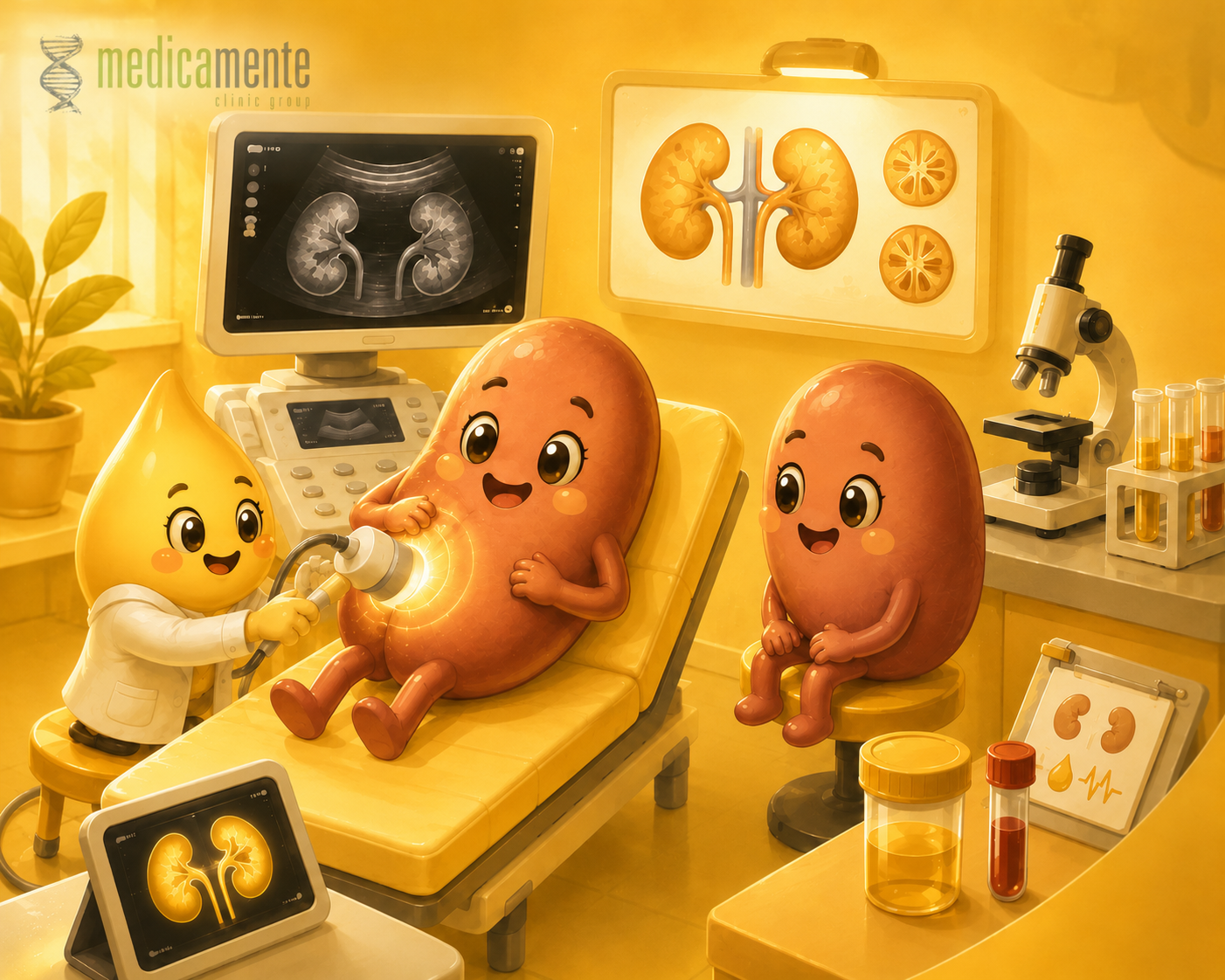
How blood tests, urine tests, and imaging help detect risk
Why kidney diagnostics should be comprehensive
The kidneys perform several tasks at once: they filter blood, remove waste products, regulate fluid volume, blood pressure, electrolytes, acid-base balance, and participate in hormonal regulation. This means their condition cannot be assessed by one test or one symptom alone. Kidney diseases may appear in different ways: reduced filtration, protein in urine, blood in urine, changes in blood pressure, swelling, electrolyte disturbances, stones, infections, or structural changes in kidney tissue.
The main difficulty is that many kidney diseases remain silent for a long time. A person may feel no pain, urine may look normal, and general well-being may remain unchanged. At the same time, early signs of damage may already appear in tests: albuminuria, reduced estimated glomerular filtration rate, microscopic blood in urine, or changes in urine sediment.
Modern kidney diagnostics are based on a combination of several methods. Blood tests show filtration function and internal balance. Urine tests help detect filter damage, inflammation, blood, crystals, and signs of infection. Ultrasound and other imaging methods allow assessment of kidney structure, stones, cysts, tumors, and impaired urine flow. In selected cases, more specialized tests are used, including immune testing, genetic evaluation, or kidney biopsy.
Creatinine and estimated glomerular filtration rate
One of the main markers of kidney function is blood creatinine. Creatinine is produced in muscles and removed from the body by the kidneys. If filtration worsens, its level in the blood may increase. This is why creatinine is often used as a basic laboratory marker of kidney function.
However, creatinine alone does not always show the full picture. Its level depends not only on the kidneys, but also on muscle mass, age, sex, diet, and overall condition. A person with high muscle mass may have higher creatinine, while an older or underweight patient may have relatively low creatinine even when kidney function is already reduced.
This is why estimated glomerular filtration rate, or eGFR, is calculated together with creatinine. This marker shows how effectively the kidneys filter blood. It is calculated using special formulas based on creatinine and individual patient parameters. eGFR helps determine the stage of chronic kidney disease, assess progression risk, and choose safe doses of some medications.
A reduced eGFR does not always mean irreversible disease. Filtration may temporarily worsen during dehydration, severe infection, low blood pressure, use of certain medications, or acute illness. Therefore, the doctor evaluates the dynamics of results, repeat tests, and the combination with other signs, especially urine abnormalities.
Cystatin C: an additional filtration marker
In some situations, cystatin C may be used to assess kidney function. It is a protein produced by the body’s cells and filtered by the kidneys. Its level is less dependent on muscle mass than creatinine, so it can be useful when creatinine does not provide a fully accurate picture.
Cystatin C may be helpful in older patients, people with low muscle mass, significant obesity, unusual body composition, or borderline eGFR results. Sometimes it is used to clarify the stage of chronic kidney disease or assess risk more precisely.
This test does not replace all other methods. It is an additional tool that helps refine the assessment of filtration function. The decision to order it depends on the clinical situation and on how important a more accurate kidney function estimate is.
Urinalysis: a window into the condition of kidney filters
Urinalysis remains one of the most important and accessible diagnostic methods for kidney disease. It can detect protein, blood, white blood cells, bacteria, casts, crystals, changes in urine concentration, and acidity. These markers help determine whether there are signs of inflammation, infection, filter damage, or metabolic disturbance.
Protein in urine may indicate damage to the kidney filter. Albuminuria is especially important — the appearance of albumin in urine. Albumin is a blood protein that normally almost does not pass through the kidney filter. If it appears in urine in increased amounts, this may be an early sign of glomerular damage.
Blood in urine, or hematuria, may be related to stones, infections, inflammation of kidney glomeruli, tumors, trauma, or diseases of the lower urinary tract. It is important to distinguish visible blood in urine from microscopic hematuria, which is detected only in laboratory testing. Repeated or persistent hematuria requires careful evaluation.
White blood cells, bacteria, and nitrites more often suggest urinary tract infection. However, white blood cells may appear not only with bacterial infection, but also with inflammatory diseases, stones, improper sample collection, or kidney tissue involvement. Therefore, urinalysis should always be assessed together with symptoms and, when needed, urine culture.
Casts in urine can be especially important for diagnosing kidney diseases. They form in the kidney tubules and may indicate processes inside kidney tissue. For example, red blood cell casts may be a sign of glomerular disease, while white blood cell casts may suggest inflammation of kidney tissue.
Albumin-to-creatinine ratio in urine
The albumin-to-creatinine ratio in urine is often used for early detection of kidney filter damage. This test helps assess albumin loss without the need to collect urine for 24 hours. It is especially important in diabetes, hypertension, chronic kidney disease, and cardiovascular disease.
Albuminuria may appear earlier than a decrease in estimated glomerular filtration rate. This makes it a valuable early marker. A patient may have normal creatinine and normal eGFR, while elevated albumin in urine already indicates damage to the filtration barrier.
It is important to remember that albuminuria may be temporary. It may increase after intense physical activity, during fever, urinary tract infection, significant blood pressure elevation, diabetes decompensation, or other acute conditions. Therefore, if the result is abnormal, the doctor usually evaluates repeat tests and dynamics.
Persistent albuminuria is important not only for the kidneys. It is associated with increased cardiovascular risk because it reflects damage to the vascular system. This is why this marker helps assess not only kidney risk, but also overall vascular risk.
Electrolytes and acid-base balance
The kidneys regulate sodium, potassium, calcium, phosphorus, magnesium, and acid-base balance. When kidney function declines, these markers may change. Sometimes such changes appear before pronounced symptoms.
Potassium is especially important for the heart and muscles. With reduced kidney function, it may increase, especially if the patient takes certain medications for blood pressure, heart failure, or diabetes. Excessively high potassium can be dangerous for heart rhythm. Very low potassium can also cause weakness, cramps, and rhythm disturbances.
Sodium reflects fluid balance and may change in heart failure, dehydration, diuretic use, endocrine disorders, and kidney disease. Phosphorus and calcium are important for assessing mineral metabolism, bones, and vascular risk. In chronic kidney disease, bicarbonate levels may also change, reflecting acid-base balance.
Therefore, blood tests in kidney diagnostics are not limited to creatinine. Electrolytes help assess medication safety, complication risk, and the effect of kidney function on the whole body.
Kidney ultrasound
Kidney ultrasound is one of the main imaging methods. It is safe, accessible, and allows assessment of kidney size, shape, structure, parenchymal thickness, cysts, stones, dilation of the collecting system, and signs of impaired urine flow.
Kidney size can provide important information. In some chronic diseases, the kidneys become smaller and show signs of scarring. In other conditions, such as polycystic kidney disease, they may be enlarged because of multiple cysts. Difference in kidney size may suggest vascular, congenital, or previous inflammatory changes.
Ultrasound helps detect obstruction — impaired urine flow. If the ureter is blocked by a stone, tumor, enlarged prostate, or another cause, dilation of the urinary tract above the obstruction may appear. This is important because prolonged obstruction can damage the kidney.
Ultrasound may also detect cysts, some tumors, large stones, and structural features. However, not all stones or small changes are clearly visible on ultrasound. Therefore, if symptoms or unclear findings persist, other imaging methods may be needed.
CT, MRI, and other imaging methods
Computed tomography is often used when stones, tumors, trauma, infection complications, or complex structural changes are suspected. In kidney stone disease, CT can accurately determine the size, location, and density of a stone. This is important for choosing treatment strategy.
Contrast-enhanced CT helps assess blood vessels, tumors, inflammatory complications, and certain other conditions. However, when kidney function is reduced, creatinine and eGFR should be assessed before contrast imaging to understand the risk and choose a safe approach.
Magnetic resonance imaging may be used in selected cases when tissue structure, blood vessels, or lesions need clarification, or when CT is undesirable. The choice between ultrasound, CT, and MRI depends on the task: stones, tumors, infection, vascular problems, cysts, and impaired urine flow require different diagnostic approaches.
Sometimes special methods are used to assess kidney vessels, for example when narrowing of the renal arteries is suspected. This condition may be one of the causes of resistant hypertension or worsening kidney function in selected patients.
Urine culture and infection diagnosis
If there are signs of urinary tract infection, urinalysis may show white blood cells, bacteria, and nitrites. But to identify the pathogen and choose treatment, urine culture may be needed. It is especially important in pyelonephritis, pregnancy, recurrent infections, complicated course, treatment failure, or suspected bacterial resistance.
Urine culture shows which bacteria are present and which antibiotics they are sensitive to. This helps avoid blind treatment and reduces the risk of choosing the wrong medication. It is especially important in recurrent infections, where bacteria may be resistant to commonly used antibiotics.
The quality of the result depends on proper urine collection. If the sample is contaminated by bacteria from the skin or mucous membranes, the result may be inaccurate. This is why a midstream urine sample collected into a clean container after hygiene is usually used.
Sometimes bacteria are found in urine without symptoms. This is called asymptomatic bacteriuria. It does not always require treatment, so the doctor evaluates not only the test result, but also symptoms, age, pregnancy, upcoming procedures, and other factors.
Immune testing
Some kidney diseases are related to the immune system. These may include glomerulonephritis, systemic lupus erythematosus, vasculitis, autoimmune kidney involvement, and other conditions. In such cases, routine urinalysis and creatinine may not be enough to understand the cause.
Immune tests may include antibodies, complement components, markers of systemic inflammation, and other indicators. They help determine whether there are signs of an autoimmune process, vessel involvement, or immune inflammation of the glomeruli.
These diseases may be suspected when protein in urine, blood in urine, casts, high blood pressure, swelling, reduced kidney function, and systemic symptoms occur together. Such symptoms may include rash, joint pain, fever, weight loss, or involvement of other organs.
These tests are not ordered for everyone. They are needed when there is suspicion of a specific disease mechanism. Their interpretation is complex, so results are assessed together with the clinical picture and other tests.
Kidney biopsy
Kidney biopsy is a method in which a small piece of kidney tissue is taken for microscopic examination. It allows doctors to see which structures are damaged: glomeruli, tubules, interstitium, or blood vessels. It is one of the most accurate diagnostic methods for certain kidney diseases.
A biopsy may be needed when glomerulonephritis is suspected, kidney function worsens rapidly, proteinuria is significant or unexplained, protein and blood in urine occur together, systemic diseases are present, or the cause of kidney damage remains unclear.
This method is not performed in every patient with chronic kidney disease. If the cause is obvious, for example long-standing diabetes with a typical pattern of diabetic kidney disease, biopsy may not be needed. But if the picture is atypical or treatment depends on the exact diagnosis, biopsy can be very important.
The biopsy result helps choose therapy. Different types of glomerulonephritis may require very different treatment. Therefore, precise tissue diagnosis sometimes determines further management and prognosis.
Genetic testing
Some kidney diseases are hereditary. These include polycystic kidney disease, Alport syndrome, certain tubulopathies, hereditary forms of stone disease, and other rare conditions. Genetic testing may be useful if the disease appears at a young age, there is a family history, the clinical picture is unusual, or kidney changes are combined with hearing, vision, metabolic, or other organ involvement.
A genetic result may help confirm the diagnosis, assess risk for relatives, clarify prognosis, and choose follow-up. However, genetic tests are not ordered for all patients. They are useful when there is a well-founded suspicion of a hereditary mechanism.
It is important to understand that hereditary kidney disease does not always mean rapid progression. Different genetic conditions have different prognoses. Therefore, genetic results should be explained by a specialist so that the patient understands their meaning correctly.
Diagnosis in patients from risk groups
Some people need regular kidney checks even without symptoms. This especially applies to patients with diabetes, hypertension, cardiovascular disease, obesity, metabolic syndrome, recurrent urinary tract infections, kidney stone disease, and a family history of kidney disease.
Basic screening usually includes creatinine with eGFR calculation, urinalysis, and albuminuria assessment. If needed, electrolytes, ultrasound, urine culture, tests for metabolic causes of stones, or other studies may be added.
In patients with diabetes, albuminuria is especially important because it may appear before filtration declines. In patients with hypertension, urinalysis and eGFR help assess target-organ damage. In patients with stones, it is important to understand stone composition, urine volume, calcium, oxalate, uric acid metabolism, and urine pH.
The approach depends on risk. One patient may need only periodic basic monitoring, while another may need expanded diagnostics and follow-up by a nephrologist or urologist.
Why dynamics matter more than one test
A single test result may be abnormal because of temporary factors: dehydration, physical exertion, infection, fever, medications, improper urine collection, or laboratory variation. Therefore, dynamics are very important in kidney diagnostics.
If eGFR declines gradually, this is one type of situation. If creatinine rises sharply over a short period, this may suggest acute kidney injury. If albuminuria appears once after infection or exertion, it may disappear. If it persists in repeat tests, it becomes more significant.
The doctor evaluates not only the numbers, but also how they change over time: stability, progression, relation to treatment, infections, blood pressure, glucose, medications, and general condition. This approach helps distinguish a chronic process from a temporary disturbance.
For this reason, it is important to keep previous test results. Comparing creatinine, eGFR, albuminuria, urinalysis, and blood pressure over months or years often gives more information than one isolated result.
What a modern diagnostic approach looks like
Modern diagnosis of kidney disease does not begin with one complex test, but with proper risk assessment and basic markers. First, it is important to understand whether there are symptoms, risk factors, blood pressure changes, diabetes, infections, stones, family history, medication burden, or signs of systemic disease.
Then blood and urine are usually assessed: creatinine, eGFR, urinalysis, albumin-to-creatinine ratio, electrolytes, and other markers when needed. If structural changes are suspected, ultrasound is used. If stones, tumors, vessels, or complications need more precise evaluation, CT, MRI, or special methods may be used.
If infection is suspected, urine culture is important. If immune disease is suspected, immune testing is used. In unclear or serious kidney involvement, nephrology consultation and sometimes biopsy may be needed. If hereditary disease is suspected, genetic evaluation may be appropriate.
This approach helps avoid unnecessary testing while still detecting significant changes. Kidney diagnostics should be sequential: from simple tests to more complex methods when they are truly needed.
Kidney diseases can often be detected before pronounced symptoms appear. For this, not only creatinine matters, but also estimated glomerular filtration rate, albuminuria, urinalysis, electrolytes, ultrasound, and risk factor assessment. The earlier changes are detected, the more opportunities there are to understand their cause, slow progression, and reduce the risk of complications for the kidneys, heart, and the whole body.
Write a review
Required fields are marked with *
Categories
- Therapy (81)
- News (48)
- GP (23)
- Cardiology (20)
- urology (12)
- Endocrinology (8)
- Ortopedics (4)
- Dermatology (3)
- Ultrasound (1)
- Mobile app (1)
Articles





Archive
- September 2026 (11)
- August 2026 (11)
- July 2026 (11)
- June 2026 (11)
- May 2026 (9)
- April 2026 (8)
- March 2026 (8)
- February 2026 (8)
- January 2026 (8)
- December 2025 (5)
Categories
- Therapy (81)
- News (48)
- GP (23)
- Cardiology (20)
- urology (12)
- Endocrinology (8)
- Ortopedics (4)
- Dermatology (3)
- Ultrasound (1)
- Mobile app (1)


