
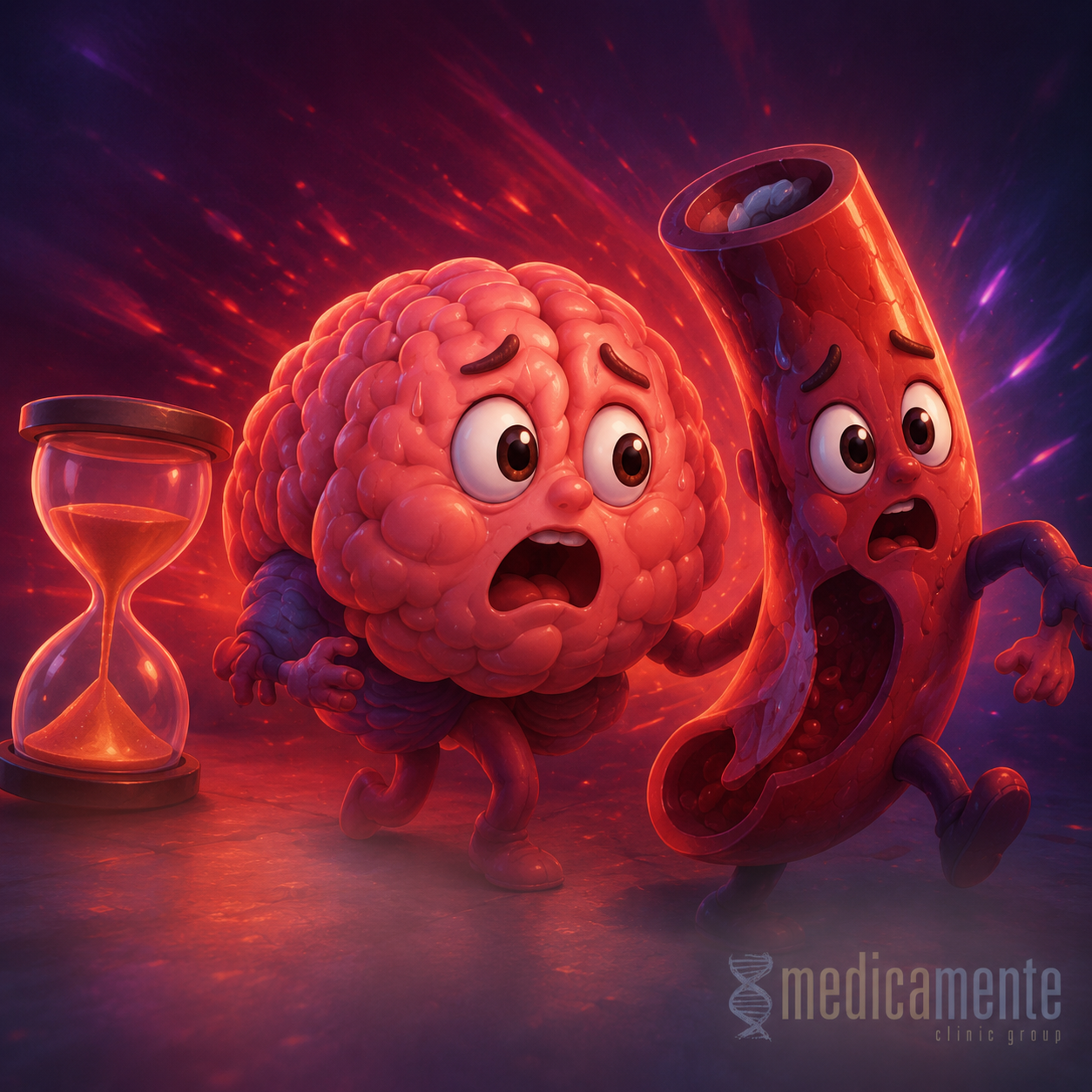
How to recognize impaired blood supply to the brain
Stroke: What Happens in the Brain
The brain constantly needs oxygen and glucose. Its cells are very sensitive to impaired blood supply, so even a short interruption or sharp decrease in blood flow can damage nervous tissue. A stroke occurs when blood supply to part of the brain is disrupted or when bleeding occurs.
There are two main types of stroke. Ischemic stroke develops when a vessel supplying part of the brain is blocked by a clot or embolus. As a result, blood cannot reach a certain area, and brain cells begin to suffer from lack of oxygen. This is the most common type of stroke.
Hemorrhagic stroke develops when a vessel in the brain ruptures and blood leaks into the brain tissue or surrounding spaces. In this case, damage is caused not only by impaired blood supply, but also by pressure from the blood on brain structures, tissue irritation and increased intracranial pressure.
Both types of stroke are dangerous and require urgent care. It is impossible to reliably distinguish ischemic stroke from bleeding based on symptoms alone. Therefore, if stroke is suspected, it is important not to try to treat it at home, but to seek emergency medical help as quickly as possible.
Why the first hours are decisive
Time is critical during a stroke. The longer an area of the brain remains without normal blood supply, the more nerve cells may die. Around the zone of irreversible damage, there may be tissue that is suffering but can still be saved if blood flow is restored in time. This is why early treatment can influence the outcome.
In ischemic stroke, some patients may be eligible for treatment aimed at dissolving the clot or mechanically restoring vessel patency. However, these methods have strict time windows and depend on the type of stroke, symptom onset time, CT or MRI results, patient condition and contraindications.
In hemorrhagic stroke, treatment is different. It is important to quickly detect bleeding, control blood pressure, assess the volume of bleeding, the risk of brain swelling, clotting status and the possible need for neurosurgical intervention.
For patients and relatives, the main message is simple: when stroke symptoms occur, waiting for them to “go away” is dangerous. Even if symptoms weaken or disappear, this may still be a serious warning sign. Rapid medical care helps doctors determine the type of stroke and choose treatment while there is still a chance to influence the prognosis.
Main signs of stroke
The best-known signs of stroke are related to sudden loss of functions controlled by the brain. Symptoms usually appear abruptly. There may be weakness or numbness of the face, arm or leg, especially on one side of the body. A person may notice that one arm does not lift properly, one leg “does not obey,” the corner of the mouth has drooped or the face has become asymmetric.
Speech disturbance is one of the most important signs. A person may speak unclearly, mix up words, fail to understand speech, be unable to find words or produce meaningless phrases. Sometimes relatives notice that speech has become strange, even if the patient does not recognize the problem.
Vision may suddenly worsen in one or both eyes. A person may lose part of the visual field, see double or become disoriented in space. Sometimes they bump into objects on one side or do not notice part of the environment.
Other symptoms may include sudden severe dizziness, loss of balance, unsteady gait, loss of coordination or inability to perform precise movements. Dizziness is especially concerning if it occurs together with speech problems, limb weakness, double vision or marked instability.
FAST: a simple way to remember warning signs
The FAST principle is often used to recognize stroke quickly. It helps remember the main symptoms that should alert people around the patient.
F stands for face. Ask the person to smile. In a stroke, the smile may be asymmetric, one corner of the mouth may droop, or the face may look uneven.
A stands for arms. Ask the person to raise both arms. If one arm drops, does not rise or is clearly weaker than the other, this may be a sign of stroke.
S stands for speech. Ask the person to repeat a simple phrase. Slurred speech, strange words, inability to repeat the phrase or failure to understand the instruction is a warning sign.
T stands for time. If even one of these symptoms is present, emergency medical help should be called immediately. The time when symptoms began should be remembered or written down, because it affects treatment options.
FAST does not include all possible stroke symptoms. For example, it may not detect strokes in the posterior parts of the brain, where dizziness, double vision, coordination problems, unsteady gait, nausea or sudden weakness may dominate. Still, it is a useful simple tool for quick reaction.
Atypical stroke symptoms
Not every stroke looks like classic facial asymmetry and arm weakness. Sometimes symptoms are less obvious, especially when brain areas responsible for coordination, vision, balance or perception are affected.
Sudden severe unsteadiness, inability to walk straight, strong dizziness with poor coordination, double vision, difficulty swallowing, marked drowsiness, confusion or unusual behavior may also be signs of stroke.
Some patients develop a sudden severe headache, especially if it is unusual, very intense and starts abruptly. This can be related to bleeding and requires urgent assessment.
Sometimes symptoms seem “small”: slight hand numbness, speech disturbance lasting a few minutes, brief weakness or vision that suddenly “went blurry.” But even short symptoms may indicate a transient ischemic attack or the beginning of a stroke. They should not be ignored.
Transient ischemic attack
A transient ischemic attack, or TIA, is a short-term disturbance of blood supply to the brain in which symptoms disappear completely. It is sometimes called a “mini-stroke,” but this term can be misleading. TIA does not mean the situation is safe.
TIA symptoms may be the same as stroke symptoms: weakness on one side of the body, speech problems, facial asymmetry, temporary vision loss, numbness or coordination problems. The difference is that they pass, sometimes within minutes or hours.
The main danger of TIA is that it may be a warning of a high risk of a real stroke in the near future. If a vessel was temporarily blocked or blood flow was unstable, the cause may remain: an atherosclerotic plaque, a clot, a rhythm disorder, severe artery narrowing or another condition.
Therefore, disappearance of symptoms is not a reason to relax. After a TIA, urgent medical evaluation is needed to find the cause and reduce the risk of a repeat, potentially more severe event.
Risk factors for stroke
Stroke rarely occurs without risk factors. Some are related to blood vessels, others to the heart, metabolism, blood clotting and lifestyle.
The most important modifiable risk factor is arterial hypertension. Persistently elevated blood pressure damages brain vessels and increases the risk of both ischemic and hemorrhagic stroke. Blood pressure control is one of the most effective methods of prevention.
Atherosclerosis also plays a major role. If plaques form in the carotid arteries, brain vessels or aortic arch, they may narrow vessels or become a source of clots. Elevated LDL cholesterol, smoking, diabetes and inflammation accelerate this process.
Diabetes increases stroke risk through vascular damage, accelerated atherosclerosis, endothelial dysfunction and its association with hypertension, obesity and dyslipidemia. In diabetes, it is especially important to control not only glucose, but also blood pressure, cholesterol and kidney function.
Atrial fibrillation and stroke
One important cardiac cause of stroke is atrial fibrillation. This is a rhythm disorder in which the atria contract irregularly and ineffectively. Because of this, blood flow in parts of the heart may slow down, and clots can form.
If such a clot breaks away, it may travel through the bloodstream to the brain arteries and block a vessel. This is called cardioembolic stroke. It can be severe because the clot often blocks a large artery.
Atrial fibrillation is not always felt. Some people feel palpitations, skipped beats, weakness, shortness of breath or dizziness. In others, the rhythm disorder is found accidentally on ECG, Holter monitoring or during evaluation after a stroke.
Stroke prevention in atrial fibrillation depends on individual risk. Some patients need medications that reduce clot formation. These decisions are made by a doctor, because both stroke risk and bleeding risk must be considered.
How stroke is diagnosed
When stroke is suspected, the first step is urgent assessment and brain imaging. CT or MRI is usually performed. This is necessary to distinguish ischemic stroke from bleeding and determine treatment strategy.
The doctor evaluates the time of symptom onset, neurological status, blood pressure, blood glucose, clotting, medications, associated diseases and severity of deficits. These data help determine whether certain treatments can be used.
In ischemic stroke, assessment of the vessels of the head and neck may be needed. CT angiography, MR angiography, carotid ultrasound or other methods may be used. It is important to identify whether there is a large-vessel occlusion, significant artery narrowing or a source of embolism.
The heart is also evaluated. ECG helps detect rhythm disorders, especially atrial fibrillation. In some cases, Holter monitoring, echocardiography and additional tests are used to search for the source of a clot.
Treatment depends on the type of stroke
Treatment of ischemic and hemorrhagic stroke is fundamentally different. Before brain imaging, it is not safe to make independent decisions about “blood-thinning” medicines or other drugs. What may help in one type of stroke may be dangerous in another.
In ischemic stroke, the main goal is to restore blood flow if possible and safe. Within certain time windows, thrombolytic therapy may be used to dissolve the clot. If a large vessel is blocked, mechanical clot removal may be performed in selected cases.
In hemorrhagic stroke, blood pressure control, assessment of clotting, reversal or correction of certain medications, management of intracranial pressure and possible neurosurgical treatment are important.
After the acute stage, treatment focuses on preventing another stroke, restoring function and controlling risk factors. The approach depends on the cause: atherosclerosis, atrial fibrillation, hypertension, diabetes, small vessel disease, valve disease, clotting disorders or other conditions require different strategies.
Rehabilitation after stroke
Recovery after stroke may take weeks, months and sometimes years. Rehabilitation is aimed at restoring movement, speech, swallowing, coordination, memory, attention, independence and quality of life. The earlier and more correctly it begins, the greater the potential for recovery.
Rehabilitation may include physical therapy, occupational therapy, speech therapy, neuropsychological work, balance training, exercises for the arm and leg, restoration of self-care skills and home adaptation. The program depends on which functions were affected.
Stroke affects not only movement and speech. Patients may have emotional changes, depression, anxiety, irritability, sleep problems, fatigue, reduced concentration and memory difficulties. These symptoms also need attention because they influence recovery.
Family and environment play an important role. Support, a safe home environment, adherence to medication, blood pressure control and regular exercises help reduce the risk of another stroke and improve long-term outcomes.
How to reduce stroke risk
Stroke prevention begins with control of risk factors. Blood pressure comes first. Even moderate but persistent elevation increases the risk of brain vessel damage. Regular measurement and stable control reduce the likelihood of stroke.
The second important factor is cholesterol and atherosclerosis. A lipid profile helps assess the risk of arterial damage. If LDL is elevated and vascular risk is high, lifestyle changes and medication may both be needed.
Diabetes control is also very important. It is necessary to assess not only glucose, but also glycated hemoglobin, blood pressure, kidney function, albuminuria, weight and lipids. Vascular protection in diabetes is a comprehensive approach.
Smoking cessation reduces vessel-wall damage, inflammation and clotting tendency. Physical activity, weight control, reduction of excess salt, moderation of alcohol intake, treatment of sleep apnea and correction of rhythm disorders also help lower risk.
Why waiting is dangerous
It is not safe to observe stroke symptoms at home and wait to see what happens. Even if a person says they feel better, risk remains. Symptoms may temporarily improve and then return or progress. In addition, disappearance of symptoms may indicate TIA, which requires urgent prevention of a repeat event.
Medications should not be given independently, especially drugs that affect clotting, before the type of stroke is known. In bleeding, this may worsen the condition. A person should not try to “walk it off,” drive themselves or postpone evaluation until a routine appointment.
It is very important to remember the time when symptoms began. If the exact time is unknown, it is important to know when the person was last seen without symptoms. This information helps doctors choose possible treatments.
Stroke is a condition in which early recognition can change the outcome. Sudden facial asymmetry, weakness of an arm or leg, speech or vision disturbance, coordination problems, severe dizziness or an unusual sudden headache require immediate medical attention. The faster diagnosis begins, the more opportunities there are to preserve brain function and reduce serious consequences.
Write a review
Required fields are marked with *
Categories
- Therapy (81)
- News (48)
- GP (23)
- Cardiology (20)
- urology (12)
- Endocrinology (8)
- Ortopedics (4)
- Dermatology (3)
- Ultrasound (1)
- Mobile app (1)
Articles





Archive
- September 2026 (11)
- August 2026 (11)
- July 2026 (11)
- June 2026 (11)
- May 2026 (9)
- April 2026 (8)
- March 2026 (8)
- February 2026 (8)
- January 2026 (8)
- December 2025 (5)
Categories
- Therapy (81)
- News (48)
- GP (23)
- Cardiology (20)
- urology (12)
- Endocrinology (8)
- Ortopedics (4)
- Dermatology (3)
- Ultrasound (1)
- Mobile app (1)


