
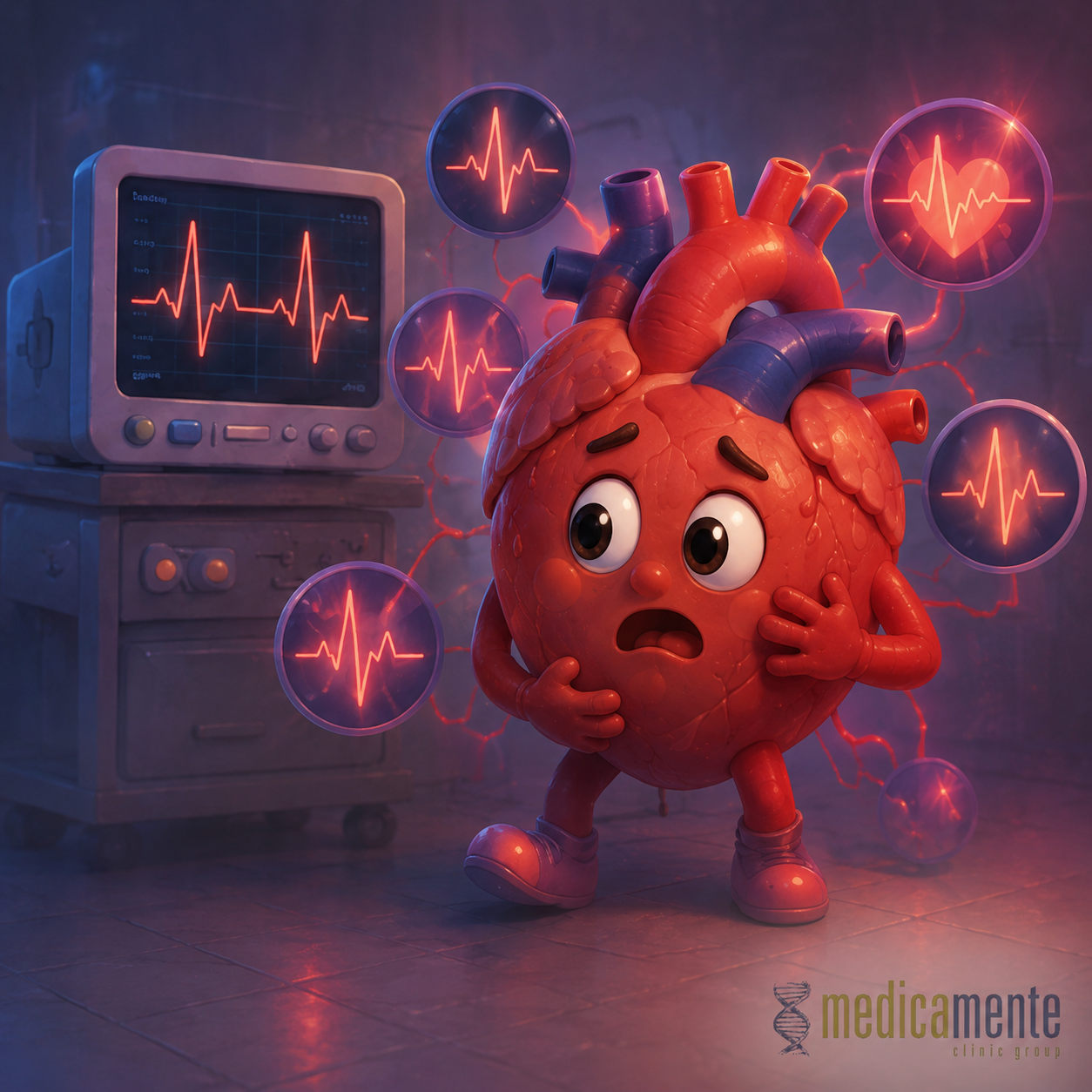
Why skipped beats are not always harmless
Arrhythmias: What They Are
The heart contracts because of electrical impulses. Normally, the impulse begins in the sinus node, the heart’s natural pacemaker, and then spreads through the atria, the atrioventricular node and the ventricles. This allows the heart chambers to contract in a coordinated way and move blood efficiently through the body.
An arrhythmia occurs when impulse formation, electrical conduction or rhythm regularity is disturbed. The heart may beat too fast, too slowly, irregularly or with a sensation of pauses and skipped beats. Sometimes an arrhythmia is strongly felt, sometimes it is found accidentally on ECG, and sometimes it appears only as weakness, shortness of breath or reduced exercise tolerance.
Not all arrhythmias are equally dangerous. Occasional extra beats in a person without structural heart disease have one meaning, while irregular rhythm in atrial fibrillation, severe bradycardia or ventricular tachycardia has another. Therefore, it is important not only to describe the feeling of “heart pounding,” but to understand which rhythm is causing the symptoms.
How arrhythmia may feel
Symptoms can vary. Some patients feel a rapid heartbeat, as if the heart is “racing,” “pounding” or “jumping out.” Others describe skipped beats, pauses, a stopping sensation, thumps in the chest or an irregular rhythm.
Sometimes arrhythmia is accompanied by weakness, dizziness, darkening of vision, shortness of breath, chest discomfort, anxiety, sweating or a feeling of lack of air. More significant rhythm disturbances may cause near-fainting or loss of consciousness.
The intensity of symptoms does not always reflect danger. Some people strongly feel even single extrasystoles that may be relatively benign. Others barely feel atrial fibrillation, which can increase stroke risk and require treatment.
This is why repeated, new, prolonged or unusual palpitations should be evaluated. The main task is to record the rhythm during symptoms or assess it through monitoring.
Why the heart may beat faster
A fast heartbeat does not always mean heart disease. Pulse may rise during physical activity, anxiety, pain, fever, dehydration, anemia, pregnancy, caffeine use, alcohol, nicotine, some medications or stimulants. In these cases, sinus rhythm remains, but the heart works faster because the body needs more blood flow or the nervous system is activated.
However, a fast rhythm may also be an arrhythmia. For example, an episode of supraventricular tachycardia may begin suddenly and end just as suddenly. A person may feel an abrupt start of rapid heartbeat, very fast rhythm, weakness, anxiety, sometimes dizziness or chest discomfort.
Atrial fibrillation may also present with a rapid irregular pulse. The atria contract chaotically, and the ventricles receive irregular impulses. A patient may feel “uneven” heartbeat, skipped beats, shortness of breath or fatigue.
A fast rhythm requires particular attention if it occurs at rest, starts suddenly, is accompanied by chest pain, fainting, severe shortness of breath, low blood pressure or if the person already has heart disease.
Why the heart may beat slower
A slow pulse is not always abnormal. In trained people, especially athletes, the resting heart rate may be lower than average and may be normal if there is no weakness, dizziness, fainting or other symptoms.
However, significant bradycardia may be dangerous if the heart does not provide enough blood flow. Causes may include sinus node dysfunction, impaired conduction between the atria and ventricles, age-related changes in the conduction system, consequences of myocardial infarction, inflammatory disease, electrolyte disturbances or medication effects.
Symptoms of significant slow rhythm may include weakness, fatigue, dizziness, darkening of vision, shortness of breath, confusion, reduced exercise tolerance and fainting. Sometimes a person notices that the pulse is slow but cannot correctly assess how serious it is.
If slow pulse is accompanied by symptoms, especially loss of consciousness or near-fainting, medical evaluation is needed. In some cases, medication adjustment, treatment of the cause or implantation of a pacemaker may be required.
Extrasystoles: why the heart “skips”
Extrasystoles are premature heartbeats. They may arise from the atria or the ventricles. Patients often describe them as a “thump,” “skipped beat,” “pause,” “stopping” or a feeling that the heart stopped for a second and then beat more strongly.
These sensations occur because the premature beat disrupts the usual rhythm. A short compensatory pause may follow, and the next beat may be felt more strongly. This can be unpleasant and anxiety-provoking even when the rhythm disturbance itself is not dangerous.
Extrasystoles may occur in healthy people, especially with stress, poor sleep, caffeine, alcohol, smoking, fatigue, dehydration or after physical exertion. They may also be linked to heart disease, electrolyte disturbances, thyroid disease or some medications.
The significance of extrasystoles depends on their frequency, origin, symptoms and the condition of the heart. If the heart is structurally normal and extrasystoles are infrequent, one approach may be enough. If they are frequent, ventricular, accompanied by fainting, pain or shortness of breath, or if heart disease is present, more detailed evaluation is needed.
Atrial fibrillation
Atrial fibrillation is one of the most common clinically significant arrhythmias. In this condition, the atria contract chaotically and ineffectively, and the pulse often becomes irregular. Heart rate may be high, normal or sometimes even low, depending on impulse conduction and medications.
The main danger of atrial fibrillation is not only unpleasant palpitations. When the atria work irregularly, blood flow in some parts of the heart may slow down, increasing the risk of clot formation. If such a clot enters the brain vessels, an ischemic stroke may occur.
Atrial fibrillation may cause palpitations, skipped beats, shortness of breath, weakness, reduced exercise tolerance, chest discomfort or dizziness. In some patients, however, it is almost asymptomatic and discovered accidentally.
Treatment depends on age, symptoms, heart rate, duration of arrhythmia, heart condition, stroke risk and bleeding risk. A doctor decides whether to control heart rate, try to restore sinus rhythm, prescribe medication to prevent clots or consider other treatment methods.
Supraventricular tachycardias
Supraventricular tachycardias are a group of arrhythmias in which a rapid rhythm originates above the ventricles, often in the atria or near the atrioventricular node. They may appear as sudden episodes of rapid heartbeat.
Patients often describe a very characteristic sensation: the heart suddenly “switches on” to a high rate and later suddenly “switches off.” An episode may last minutes, tens of minutes or longer. It may be accompanied by weakness, anxiety, trembling, shortness of breath, chest pressure or dizziness.
In some people, these episodes are rare and stop on their own. In others, they become frequent, prolonged and significantly reduce quality of life. Although many supraventricular tachycardias are not as dangerous as ventricular rhythm disturbances, they still require diagnosis.
To confirm the diagnosis, it is important to record an ECG during an episode or use Holter monitoring, an event monitor or other methods of longer rhythm recording. In some cases, catheter ablation can be an effective treatment aimed at eliminating the area that maintains the arrhythmia.
Ventricular rhythm disturbances
Ventricular arrhythmias originate in the ventricles. Their significance varies: from isolated ventricular extrasystoles to ventricular tachycardia, which may be dangerous, especially in patients with structural heart disease.
Ventricular tachycardia is a rapid rhythm originating from the ventricles. It may reduce the ability of the heart to pump blood effectively. Symptoms may include strong palpitations, sudden weakness, dizziness, chest pain, shortness of breath, low blood pressure, near-fainting or loss of consciousness.
The risk of ventricular arrhythmias is higher after myocardial infarction, with reduced heart contractility, cardiomyopathies, inflammatory heart disease, severe electrolyte disorders, certain inherited syndromes and some medications.
These arrhythmias require especially careful evaluation. Depending on the cause and risk, treatment may include medication, catheter ablation, treatment of the underlying disease or implanted devices that help prevent sudden dangerous rhythm disturbances.
What can trigger arrhythmias
Arrhythmias may be related to heart disease, but not only to it. Possible causes and triggers include ischemic heart disease, previous heart attack, heart failure, valve disease, inflammation of the heart muscle, cardiomyopathies and congenital features of the conduction system.
Electrolytes are important. Abnormal levels of potassium, magnesium, calcium and sodium can affect the electrical activity of the heart. Such changes may occur with dehydration, vomiting, diarrhea, diuretic use, kidney disease or endocrine disorders.
The thyroid gland also affects rhythm. Increased thyroid function can speed up the pulse and increase the risk of some arrhythmias, including atrial fibrillation. Reduced thyroid function may cause slow pulse and weakness.
Alcohol, caffeine, nicotine, energy drinks, some medications, stimulants, drugs, poor sleep, stress, fever and anemia may also trigger palpitations or rhythm disturbances. This is why arrhythmia diagnosis often includes not only ECG, but also a search for factors that provoke it.
How arrhythmias are diagnosed
The main test for suspected arrhythmia is an electrocardiogram. ECG shows the electrical activity of the heart at the moment of recording. If the arrhythmia is present during the test, ECG can often determine its type.
But many arrhythmias occur in episodes. If the rhythm is normal during a standard ECG, this does not exclude the problem. In such cases, Holter monitoring is used — ECG recording for 24 hours or longer. It helps detect rhythm disorders, assess day and night pulse, connect symptoms with rhythm and count extrasystoles.
If episodes are rare, longer event monitors or devices that the patient activates during symptoms may be used. Sometimes recordings from wearable devices are helpful, but they do not always replace medical ECG and require confirmation.
Additional blood tests may include electrolytes, thyroid function, hemoglobin, kidney function and other indicators. Echocardiography helps assess heart structure, chamber size, valves and contractility, because the significance of arrhythmia strongly depends on the condition of the heart.
When arrhythmia requires urgent care
Some symptoms during rhythm disturbance require immediate evaluation. These include loss of consciousness, near-fainting, severe weakness, chest pain or tightness, sudden shortness of breath, low blood pressure, bluish lips, confusion or a very fast rhythm with worsening condition.
Arrhythmia is also more concerning in a person with known ischemic heart disease, previous heart attack, heart failure, cardiomyopathy or significant valve disease. In such situations, similar symptoms may have a more serious meaning.
If palpitations start suddenly, do not stop and are accompanied by pain, shortness of breath, weakness or dizziness, it is not safe to wait for hours hoping the rhythm will normalize. Medical help should be sought.
Urgency is especially important if the arrhythmia is new, feels unusual, is accompanied by neurological symptoms, severe weakness or impaired consciousness.
Treatment depends on the type
Arrhythmia treatment cannot be chosen correctly without understanding its mechanism. Some rhythm disturbances require only observation and correction of triggers, others need medication, and some require procedures or implanted devices.
In some arrhythmias, the main goal is symptom relief. In others, the goal is to reduce the risk of stroke, heart failure or sudden dangerous events. For example, in atrial fibrillation, it is important not only to control palpitations, but also to assess the need for clot prevention.
Antiarrhythmic drugs may be effective, but they require caution. Some are not suitable for all patients and may have limitations in structural heart disease, kidney dysfunction, electrolyte abnormalities or interactions with other medicines.
Catheter ablation may be used for some types of tachycardia, atrial fibrillation or frequent symptomatic arrhythmias. The method targets an area of the conduction system or heart tissue that triggers or maintains the abnormal rhythm.
Pacemakers and other devices
If the problem is significant slowing of the rhythm or impaired conduction, a pacemaker may be needed. This device helps the heart maintain an adequate rate when the natural conduction system is unreliable.
A pacemaker is not needed for every slow pulse. The decision depends on symptoms, type of block or sinus node dysfunction, length of pauses, connection with fainting and the overall condition of the patient.
If the risk of dangerous ventricular arrhythmias is high, an implantable cardioverter-defibrillator may be considered. This device can recognize life-threatening rhythm disturbances and restore a safer rhythm when needed.
In some patients with heart failure and impaired synchrony of contractions, resynchronization therapy may be used. It helps coordinate ventricular contractions and improve heart function in selected clinical situations.
Lifestyle and prevention of episodes
For some arrhythmias, lifestyle can noticeably affect episode frequency. Poor sleep, stress, alcohol, dehydration, excess caffeine, energy drinks and smoking may provoke palpitations or skipped beats. Triggers vary between individuals.
Regular sleep, moderate physical activity, weight control, treatment of sleep apnea, adequate fluid intake when not restricted, blood pressure control and smoking cessation help reduce the overall load on the cardiovascular system.
In atrial fibrillation, control of blood pressure, weight, diabetes, thyroid disease, alcohol intake and sleep apnea is especially important. These factors may influence episode frequency and treatment effectiveness.
Self-treatment with “heart medicines” or drugs that affect rhythm should be avoided. Some medications may be dangerous if chosen incorrectly, especially if the type of arrhythmia is unknown.
Why symptom tracking is useful
For arrhythmias, the doctor benefits from knowing exactly how symptoms occur. It is useful to note whether palpitations began suddenly or gradually, what the pulse was, whether the rhythm was regular or irregular, how long the episode lasted, what triggered it and how it ended.
Associated symptoms should also be recorded: chest pain, shortness of breath, weakness, dizziness, loss of consciousness, sweating, nausea, fear, low blood pressure. If it is safe to measure pulse and blood pressure during an episode, this may be helpful.
However, the most important thing is to record the rhythm instrumentally. Description helps, but arrhythmia diagnosis is made by ECG or monitoring. Therefore, with repeated episodes, it is important to choose a recording method that can capture the rhythm during symptoms.
Arrhythmias are not one disease, but a large group of rhythm disorders. Some may be relatively benign, while others require active treatment and prevention of complications. Repeated skipped beats, sudden rapid heartbeat, irregular pulse, fainting, shortness of breath or chest pain are symptoms that should not be guessed about. The rhythm should be checked and the cardiovascular system assessed.
Write a review
Required fields are marked with *
Categories
- Therapy (81)
- News (48)
- GP (23)
- Cardiology (20)
- urology (12)
- Endocrinology (8)
- Ortopedics (4)
- Dermatology (3)
- Ultrasound (1)
- Mobile app (1)
Articles





Archive
- September 2026 (11)
- August 2026 (11)
- July 2026 (11)
- June 2026 (11)
- May 2026 (9)
- April 2026 (8)
- March 2026 (8)
- February 2026 (8)
- January 2026 (8)
- December 2025 (5)
Categories
- Therapy (81)
- News (48)
- GP (23)
- Cardiology (20)
- urology (12)
- Endocrinology (8)
- Ortopedics (4)
- Dermatology (3)
- Ultrasound (1)
- Mobile app (1)


