
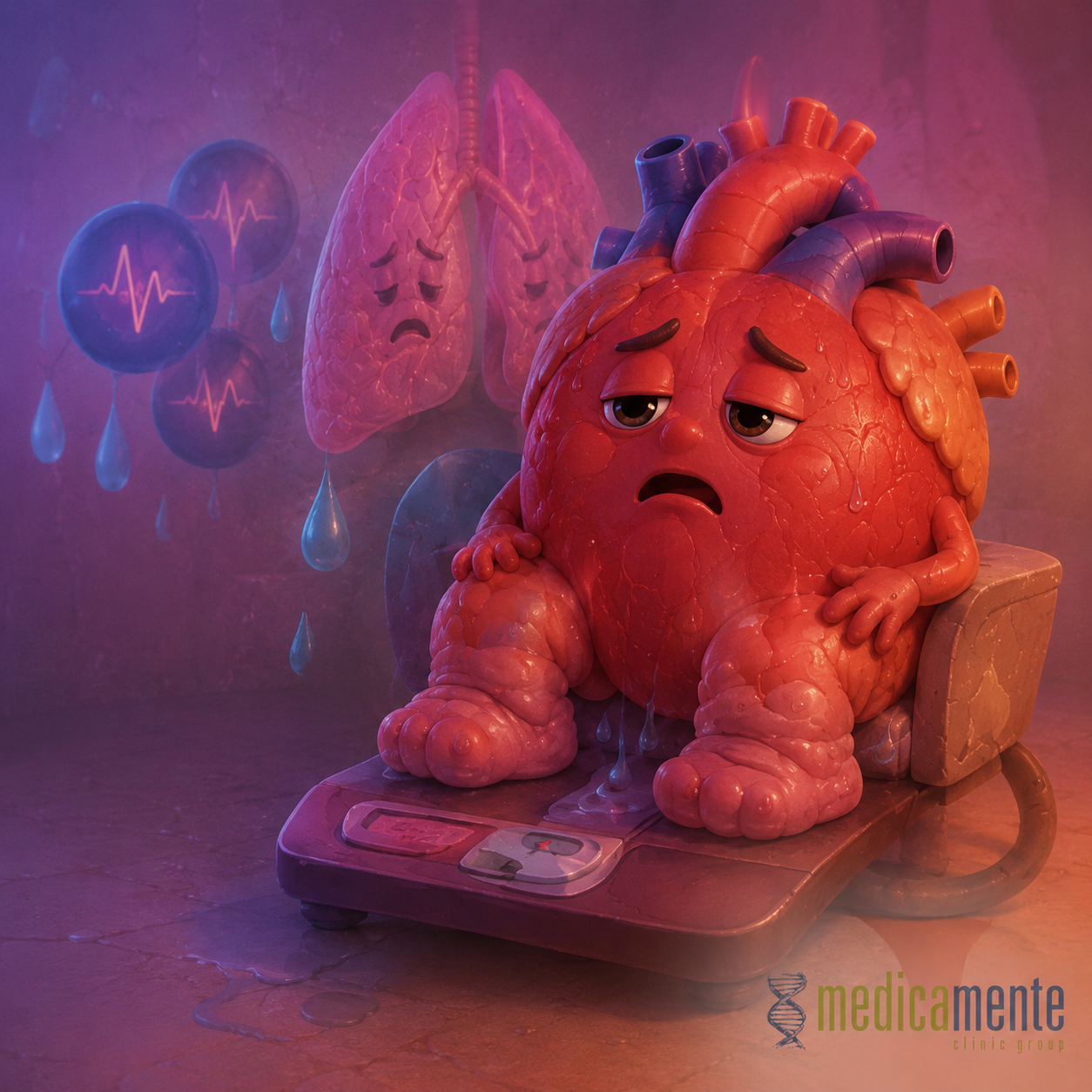
How the heart, vessels and body fluid balance are connected
Heart Failure: What It Means
Heart failure is a condition in which the heart does not perform its pumping function as effectively as the body needs. This does not mean that the heart has stopped working completely. More often, it means that it pumps less efficiently, relaxes poorly, fills poorly or cannot adapt adequately to physical demand.
Organs and tissues depend on a continuous supply of blood, oxygen and nutrients. If the heart works less effectively, the body tries to compensate through several mechanisms: it retains fluid, narrows blood vessels, increases heart rate and activates hormonal systems. At first, these mechanisms help maintain circulation, but over time they may worsen the condition.
Heart failure can develop gradually or appear suddenly. In some patients, symptoms worsen over months or years. In others, deterioration occurs quickly, for example after a heart attack, a severe arrhythmia, a hypertensive crisis, inflammation of the heart muscle or sudden worsening of valve function.
It is important to understand that heart failure is not a single cause, but a syndrome. It can result from different diseases of the heart and vessels. Therefore, when heart failure is detected, it is necessary not only to reduce shortness of breath and swelling, but also to understand why the heart began to work less effectively.
Why heart failure develops
There are many causes of heart failure. One common cause is ischemic heart disease and previous myocardial infarction. If part of the heart muscle was damaged because of impaired blood supply, the heart’s contractile ability may decrease. The larger the area of damage, the higher the risk of heart failure.
Another common cause is long-term arterial hypertension. With high blood pressure, the heart constantly has to work against increased resistance. At first, the heart muscle thickens to cope with the load. Over time, however, it may become less elastic, relax less effectively and later contract more weakly.
Valve diseases can also lead to heart failure. If a valve is narrowed or does not close properly, blood flows through the heart abnormally. This creates pressure or volume overload, enlarges the heart chambers and eventually disrupts their function.
Other causes include rhythm disorders, cardiomyopathies, myocarditis, congenital heart disease, toxic effects of alcohol or some medications, thyroid disease, severe anemia, chronic lung disease, obesity, diabetes and chronic kidney disease. In many patients, several factors are present at the same time.
Why shortness of breath appears
Shortness of breath is one of the most common symptoms of heart failure. It occurs because the heart cannot effectively handle the volume of blood returning from the lungs and the rest of the body. If pressure in the left side of the heart rises, blood drains less effectively from the lung vessels, and fluid may accumulate in lung tissue.
This worsens gas exchange. Breathing becomes more difficult, especially during physical activity. At first, shortness of breath may appear only during fast walking, climbing stairs or active work. Later, it may occur with less effort, during ordinary walking, conversation or even at rest.
A typical sign of heart failure is worsening shortness of breath when lying down. When a person lies down, some fluid shifts toward the chest, and it becomes harder for the heart to handle the blood volume. Some patients therefore feel better sleeping on a high pillow or in a semi-sitting position.
Sometimes nighttime breathlessness occurs: a person wakes up feeling unable to breathe, has to sit up, open a window and breathe sitting for some time. This symptom requires attention, especially if it is combined with swelling, fatigue or known heart disease.
Why swelling appears
Swelling in heart failure is related to fluid retention and increased pressure in the venous system. If the heart pumps blood less effectively, blood may stagnate in the veins, especially in the lower limbs. The liquid part of the blood gradually moves from the vessels into tissues, and swelling appears.
Swelling is most often noticeable in the feet, ankles and lower legs. It may worsen in the evening, after long standing or sitting, and improve after overnight rest. Pressing on the skin may leave a pit. Over time, swelling may become more pronounced and extend higher.
Fluid retention may appear not only as leg swelling. Body weight may increase quickly, the abdomen may feel heavy, abdominal volume may increase because of fluid, appetite may decrease, and there may be a feeling of fullness or discomfort in the right upper abdomen due to liver congestion.
It is important to distinguish cardiac swelling from other causes. Swelling may also occur with vein disease, kidney disease, liver disease, thyroid disorders, lymphatic problems, certain medications or prolonged sitting. Swelling alone does not always mean heart failure, but if it is combined with shortness of breath and reduced exercise tolerance, evaluation is needed.
Fatigue and reduced exercise tolerance
Heart failure does not always begin with severe shortness of breath or major swelling. Sometimes the first sign is reduced stamina. A person notices that ordinary tasks have become harder: climbing stairs, walking, cleaning, shopping, gardening or even talking during activity.
This happens because muscles and organs receive less effective blood supply during exertion. The heart cannot increase output enough, and tissues begin to lack oxygen sooner. Weakness, fatigue, the need to stop more often and a feeling of “no strength” appear.
Sometimes these symptoms are incorrectly attributed to age, stress, excess weight or poor fitness. These factors can indeed affect stamina, but if reduced tolerance develops gradually or becomes clearly worse, cardiac causes should be excluded.
It is especially concerning if fatigue is combined with shortness of breath, swelling, palpitations, nighttime breathlessness, chest pain, previous heart attack, hypertension, diabetes or rhythm disorders.
Systolic and diastolic heart failure
Heart failure may be related to different types of heart dysfunction. In systolic heart failure, the heart contracts less strongly and pumps out less blood. This is often related to heart muscle damage after a heart attack, cardiomyopathy, myocarditis or long-term overload.
In diastolic heart failure, contractility may be relatively preserved, but the heart relaxes poorly and fills less effectively. The heart wall becomes stiffer, pressure inside the chambers rises, and this can cause shortness of breath and congestion, especially during activity. This type is common in people with long-term hypertension, obesity, diabetes, older age and metabolic disorders.
In clinical practice, the left ventricular ejection fraction is often used. It shows what proportion of blood is pumped out of the left ventricle with each contraction. However, heart failure can occur with both reduced and preserved ejection fraction. Therefore, a normal or nearly normal ejection fraction does not always exclude heart failure.
For the patient, the specific name of the type is less important than understanding the cause, severity, risk of complications and treatment approach. Different types of heart failure may require different treatment priorities.
How the heart and kidneys are connected
In heart failure, the kidneys are often involved. If cardiac output decreases or circulation becomes less effective, the kidneys may interpret this as insufficient blood supply. In response, hormonal systems are activated that retain sodium and water.
At first, this may help maintain blood pressure and blood volume. But in chronic heart failure, fluid retention becomes a problem: swelling increases, venous pressure rises, lung congestion appears and the workload on the heart grows.
On the other hand, worsening kidney function can complicate heart failure treatment. Some medications require monitoring of creatinine and potassium. Diuretics help remove excess fluid, but if the effect is too strong, they may cause dehydration, low blood pressure and worsening kidney function.
Therefore, in heart failure it is important to monitor not only the heart, but also the kidneys: creatinine, estimated glomerular filtration rate, electrolytes, especially potassium and sodium, as well as changes in body weight and swelling.
The role of arrhythmias
Rhythm disorders may be both a cause and a consequence of heart failure. If the heart beats too fast, irregularly or too slowly, circulation may become less efficient. Persistent tachycardia itself can weaken the heart muscle.
Atrial fibrillation is especially often associated with heart failure. In this rhythm disorder, the atria contract irregularly, ventricular filling is disturbed, the pulse may be too fast and the risk of clot formation increases. In some patients, atrial fibrillation is the reason for worsening shortness of breath and weakness.
Ventricular arrhythmias in patients with heart failure may be dangerous, especially if heart contractility is reduced. They can increase the risk of fainting and sudden severe rhythm disturbances.
This is why ECG, Holter monitoring and other rhythm evaluation methods are often used in heart failure. Arrhythmia control may be an important part of treatment and complication prevention.
How heart failure is diagnosed
Diagnosis begins with assessment of symptoms, medical history and physical examination. The doctor asks when shortness of breath appeared, what level of activity triggers it, whether there is swelling, nighttime breathlessness, weight gain, palpitations, chest pain, previous heart attack, hypertension, diabetes, valve disease or kidney disease.
During examination, blood pressure, pulse, oxygen saturation, swelling, lung crackles, signs of venous congestion, liver enlargement and other signs of fluid retention or circulatory problems are assessed.
Echocardiography is one of the most important tests. It allows assessment of chamber size, wall thickness, ejection fraction, valve function, pressure in the pulmonary artery and other parameters. It helps identify the likely mechanism of heart failure.
ECG shows rhythm, conduction, signs of previous infarction, chamber overload or other changes. Blood tests may include creatinine, electrolytes, hemoglobin, thyroid function, glucose, lipids and cardiac markers when indicated.
What tests may be needed
When heart failure is suspected, it is important not only to confirm the condition, but also to find the cause. Evaluation may therefore include several directions.
Blood tests help assess kidney function, electrolytes, anemia, inflammation, thyroid function, diabetes and other conditions that may worsen heart function or mimic heart failure symptoms.
Natriuretic peptides may be used as markers of heart strain. Their elevation may support the diagnosis of heart failure, especially when shortness of breath has an unclear cause. But the result must be interpreted with age, kidney function, body weight, heart rhythm and clinical situation in mind.
Chest X-ray may show signs of lung congestion, heart enlargement or other causes of shortness of breath. In some cases, coronary CT angiography, stress tests, cardiac MRI, coronary angiography, valve evaluation or assessment of lung causes of breathlessness may be needed.
The choice of methods depends on the question the doctor is trying to answer: whether ischemic heart disease is present, how the valves function, whether there is arrhythmia, how well the heart contracts, whether fluid congestion is present and which associated conditions affect symptoms.
Treatment of heart failure
Treatment depends on the cause, type of heart failure, ejection fraction, symptoms, kidney function, blood pressure, heart rhythm and associated diseases. The main goals are to reduce symptoms, decrease fluid retention, improve quality of life, slow progression and reduce the risk of hospitalizations and complications.
If excess fluid is present, diuretics are often used. They help reduce swelling and lung congestion, improve breathing and lower body weight by removing excess fluid. But dosing requires caution: too weak an effect will not relieve congestion, while too strong an effect may cause dehydration, low blood pressure and worsening kidney function.
Some medications affect hormonal systems that are activated in heart failure. They help reduce the workload on the heart, protect the heart muscle and improve prognosis in selected groups of patients. Treatment requires monitoring of blood pressure, pulse, creatinine and electrolytes.
If the cause is valve disease, treatment of the valve may be needed. If there is significant coronary artery disease, restoration of blood flow may be discussed. If arrhythmia plays an important role, rhythm treatment is needed. Therefore, heart failure therapy should always be linked to its cause.
Why weight and fluid monitoring matter
In heart failure, body weight may change quickly because of fluid retention. A gain of several kilograms over a short period may mean that fluid is accumulating before severe swelling or shortness of breath appears.
Regular weighing helps detect worsening earlier. It is best to measure weight under similar conditions: in the morning, after using the bathroom, before eating and on the same scale. If weight increases quickly, this may be a reason for medical evaluation or adjustment according to the doctor’s plan.
Control of salt and fluids also matters. Excess salt promotes water retention and can worsen swelling and shortness of breath. Much salt comes not only from the salt shaker, but from ready-made foods, processed meats, cheeses, sauces, semi-prepared products, fast food and snacks.
Fluid restriction is not needed for every patient and depends on the severity of heart failure, sodium level, kidney function and treatment. These recommendations should be individualized.
Physical activity in heart failure
In the past, patients with heart failure were often advised to restrict activity as much as possible. The approach has changed. Complete avoidance of movement can worsen physical fitness, increase weakness, reduce quality of life and contribute to other problems.
Properly selected physical activity can improve exercise tolerance, muscle function, metabolism, mood and everyday independence. But activity must match the patient’s condition and disease stage.
In stable heart failure, regular moderate aerobic activity, walking, breathing exercises, endurance exercises and sometimes low-intensity strength elements may be useful. But with shortness of breath at rest, worsening swelling, chest pain, unstable arrhythmia or recent deterioration, activity should be discussed with a doctor.
Cardiac rehabilitation can help patients return to activity safely, learn to monitor symptoms and choose an appropriate level of exercise.
When heart failure requires urgent care
Some symptoms may indicate decompensation and require urgent assessment. These include a sudden increase in shortness of breath, breathlessness at rest, inability to lie flat because of suffocation, pink frothy sputum, severe weakness, confusion, bluish lips, fainting, chest pain or a sharp drop in blood pressure.
Rapidly increasing swelling, sudden weight gain over several days, a sharp decrease in urination, strong palpitations with worsening condition, severe dizziness or a feeling of breathlessness even without exertion are also concerning.
These symptoms may indicate fluid congestion in the lungs, arrhythmia, myocardial infarction, sudden worsening of pumping function or treatment complications. If the condition is rapidly worsening, waiting for a routine appointment is unsafe.
Prevention of worsening
Heart failure requires long-term follow-up. Even if symptoms improve, blood pressure, pulse, body weight, kidney function, electrolytes, heart rhythm and associated diseases must continue to be monitored.
Prevention of worsening includes regular use of prescribed medications, reduction of excess salt, weight control, smoking cessation, moderate physical activity, vaccination when indicated, and treatment of hypertension, diabetes, ischemic heart disease, arrhythmias and sleep disorders.
It is very important to understand the individual plan: which symptoms are alarming, how often to monitor weight, when to contact a doctor, which tests to repeat, which medications should not be stopped independently and which drugs may worsen fluid retention or kidney function.
Heart failure is a condition in which the heart, vessels, kidneys and fluid balance are closely connected. Shortness of breath, swelling and weakness do not appear randomly; they reflect impaired circulation and compensatory mechanisms. The earlier the cause is identified and the more consistently treatment, salt, weight, blood pressure, rhythm and associated diseases are controlled, the better the chances of reducing symptoms and preventing severe deterioration.
Write a review
Required fields are marked with *
Categories
- Therapy (81)
- News (48)
- GP (23)
- Cardiology (20)
- urology (12)
- Endocrinology (8)
- Ortopedics (4)
- Dermatology (3)
- Ultrasound (1)
- Mobile app (1)
Articles





Archive
- September 2026 (11)
- August 2026 (11)
- July 2026 (11)
- June 2026 (11)
- May 2026 (9)
- April 2026 (8)
- March 2026 (8)
- February 2026 (8)
- January 2026 (8)
- December 2025 (5)
Categories
- Therapy (81)
- News (48)
- GP (23)
- Cardiology (20)
- urology (12)
- Endocrinology (8)
- Ortopedics (4)
- Dermatology (3)
- Ultrasound (1)
- Mobile app (1)


