
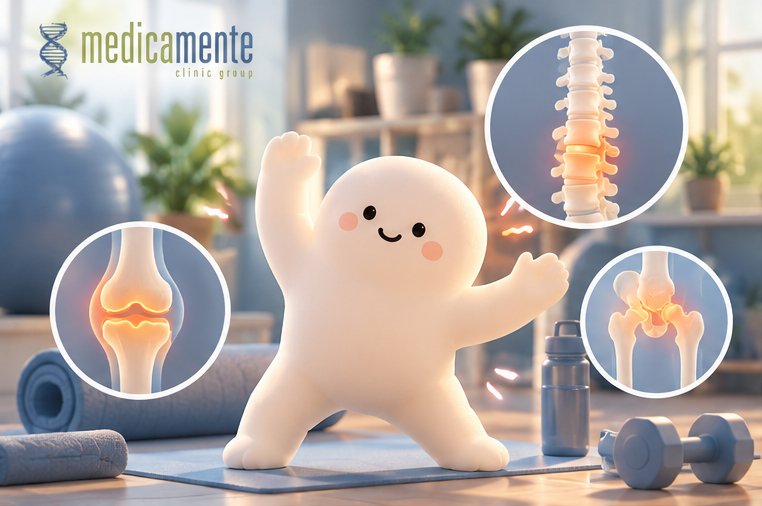
Freedom of Movement: Caring for Your Back and Joints
Movement as Part of Everyday Life
Getting out of bed, turning your head, climbing stairs and carrying groceries all require coordinated work by bones, joints, muscles and the nervous system. While movement remains comfortable, this work is barely noticeable. Pain, stiffness or restricted mobility can change daily life, making work, exercise, leisure and household tasks more difficult.
Our October series focuses on joint and spine health. Its purpose is to explain why common symptoms develop, how their causes are assessed and what prevention can achieve. Musculoskeletal health matters at every age. Office workers, athletes and older adults have different needs, but all benefit from maintaining movement and independence.
How Joints and the Spine Work
Joints connect bones and allow movement in particular directions. Articular cartilage, the joint capsule, ligaments and surrounding muscles help distribute loads and maintain stability. Joint health therefore involves more than cartilage alone. Different tissues, muscle strength, previous injuries and everyday activity all play a role.
The spine provides support, allows movement and protects nerve structures. Vertebrae, intervertebral discs, small joints, ligaments and muscles work together to perform these functions. When pain develops, its source cannot always be identified from its location or how it feels. Assessment considers how symptoms started, how long they have lasted, associated symptoms and examination findings.
Why Pain Needs Careful Assessment
Back pain is often described as nonspecific. This means that an assessment does not identify one particular cause that fully explains the symptoms. It does not make the pain any less real. Its effects on sleep, movement, work and daily life are important when choosing appropriate care.
Different mechanisms must also be considered when joints hurt. Discomfort after unfamiliar activity, the consequences of an injury and an inflammatory condition may require different approaches. Useful information includes when pain occurs, its relationship to movement, swelling, warmth and the duration of morning stiffness. Persistent stiffness together with joint swelling can suggest inflammation, but these symptoms alone do not establish a diagnosis.
Osteoarthritis, Arthritis and Osteoporosis Are Different Conditions
Osteoarthritis affects several structures within a joint and may cause pain, stiffness and reduced function. Describing it only as “worn-out cartilage” oversimplifies the condition. Treatment decisions take account of symptoms, individual abilities and the activities that matter in everyday life.
Arthritis means inflammation of a joint and can have several causes. Osteoporosis involves reduced bone strength and an increased risk of fractures. It often develops without noticeable symptoms until a fracture occurs. An absence of pain therefore does not always mean an absence of disease, and assessing fracture risk has a separate role in preventive care.
Why Assessment Begins with a Conversation and Examination
Specific details matter during a consultation: when pain began, whether there was an injury, which movements are difficult and whether there is numbness, weakness, fever or swelling. Existing conditions, medication and previous episodes are also considered. Examination helps determine what further assessment is needed and which problems require priority attention.
X-rays and MRI scans answer particular diagnostic questions, but they do not replace clinical assessment. Imaging is not automatically needed for everyone with lower back pain. Its usefulness depends on the suspected cause and whether the result would change treatment. Findings on a scan must also be considered alongside symptoms and examination results.
The Role of Physical Activity
Regular activity helps maintain muscle strength, endurance and the ability to perform familiar tasks. A general health target for adults is at least 150 minutes of moderate aerobic activity each week, together with exercises for the major muscle groups on at least two days. Individual activity levels depend on health and physical fitness.
Exercise can also form part of treatment for joint conditions. Activities are selected according to pain, limitations and personal goals. One person may want to walk more confidently, while another hopes to return to work or sport. In osteoarthritis, therapeutic exercise aims to strengthen muscles and improve function. Programmes are adapted to individual abilities and reviewed as necessary.
Everyday Habits and Tolerance of Activity
Caring for the back and joints involves repeated everyday actions. Alternating tasks, arranging a comfortable workspace and increasing physical demands gradually can make activity more manageable. It helps to consider the whole day, including time spent sitting still and opportunities for movement and recovery.
Practical changes are easier to maintain when they address a specific task. Examples include dividing heavy shopping between several bags, preparing gradually for longer walks or adding brief movement breaks to the working day. These adjustments should suit the individual. When pain persists, changes to daily routines complement medical assessment rather than replace it.
When Medical Attention Is Particularly Important
An assessment is appropriate when pain persists, recurs or interferes with sleep, work or movement. Describing changes in ability is as important as describing pain intensity. Difficulty walking a familiar distance, getting dressed, rising from a chair or holding an object provides useful information about function and treatment outcomes.
Emergency assessment is needed when back pain occurs with new bladder or bowel control problems, loss of sensation around the genitals or anus, or severe or worsening weakness in both legs. Pain following a serious injury also requires urgent assessment. Back pain accompanied by fever and feeling generally unwell is another reason to seek prompt medical attention.
What the October Series Will Cover
The following articles will explore lower back and neck pain, posture, disc protrusions and herniations, and the causes of knee pain. Separate articles will address osteoarthritis, inflammatory joint conditions, osteoporosis and the selection of physical activities. The series will conclude with everyday prevention and ways to maintain mobility.
Each topic will address practical questions: what symptoms may mean, which investigations can help and how treatment is chosen. Particular attention will be given to common misconceptions and the limits of interpreting blood tests and scans without clinical context. This approach supports a clearer understanding of medical advice and informed decisions about joint and spine health.
Write a review
Required fields are marked with *
Categories
- Therapy (81)
- News (48)
- GP (23)
- Cardiology (20)
- urology (12)
- Ortopedics (8)
- Endocrinology (8)
- Dermatology (3)
- Ultrasound (1)
- Mobile app (1)
Articles





Archive
- October 2026 (4)
- September 2026 (11)
- August 2026 (11)
- July 2026 (11)
- June 2026 (11)
- May 2026 (9)
- April 2026 (8)
- March 2026 (8)
- February 2026 (8)
- January 2026 (8)
Categories
- Therapy (81)
- News (48)
- GP (23)
- Cardiology (20)
- urology (12)
- Ortopedics (8)
- Endocrinology (8)
- Dermatology (3)
- Ultrasound (1)
- Mobile app (1)


