
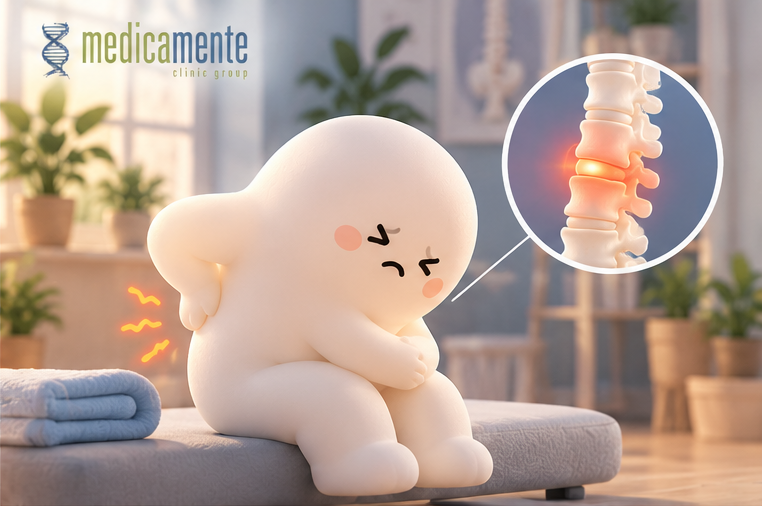
From Overload to Nerve Irritation: Understanding Back Pain
Why the Lower Back Can Hurt
The lower back supports the body during standing, bending, turning and carrying loads. Vertebrae, intervertebral discs, joints, ligaments, muscles and nerves work together to perform these tasks. Pain in this area can develop for different reasons, so the same location does not necessarily mean the same diagnosis.
Symptoms sometimes begin after lifting, an unfamiliar workout or prolonged work in an uncomfortable position. In other cases, there is no identifiable trigger. Pain may range from mild stiffness to severe discomfort that limits movement. Its intensity alone does not establish how much tissue damage has occurred or whether surgery is needed.
What Nonspecific Pain Means
Most episodes of lower back pain are classified as nonspecific. This means that symptoms and examination findings cannot confidently be attributed to one particular disease or injury. The term does not imply that the pain is unimportant or imaginary.
Activity tolerance, muscle tension, physical conditioning, recovery and the nervous system’s processing of pain signals may all contribute. Treatment therefore usually focuses on reducing limitations and gradually restoring activity. Trying to identify one “faulty” structure at all costs does not necessarily lead to more effective care.
When Pain Travels into the Leg
Lower back pain may be accompanied by discomfort in the buttock or leg. Referred pain from structures in the back and pain associated with irritation of a nerve root have different mechanisms. The direction in which pain travels is not enough to establish a diagnosis.
Nerve root involvement may cause shooting or burning pain, tingling, numbness and weakness in particular muscles. Examination can include checking sensation, reflexes and movement. New weakness is particularly important to report, such as difficulty lifting the foot, walking on the heels or pushing off through the toes. New or worsening neurological changes require timely assessment.
Less Common Causes
Some cases have a specific cause, such as a vertebral fracture, inflammatory disease, infection or tumour. Pain from internal organs can also be felt in the lower back. These situations are less common, but identifying them is an important part of the initial assessment.
Relevant information includes injuries, osteoporosis, prolonged systemic corticosteroid use, cancer and reduced immunity. Fever, unexplained weight loss and other accompanying symptoms also matter. An individual warning sign does not confirm serious disease. Conclusions depend on the combination of symptoms, medical history, examination and appropriate investigations.
When Emergency Care Is Needed
Emergency assessment is necessary if back pain occurs with new difficulty passing urine, urinary retention or loss of bladder or bowel control. Loss of sensation around the genitals or anus and severe or worsening weakness in both legs are also warning signs. These symptoms may indicate compression of important nerve structures.
Prompt assessment is needed after a serious injury or when back pain occurs with fever and feeling significantly unwell. Sudden unusual back pain accompanied by chest or abdominal pain, fainting or profound weakness also requires emergency attention. Self-treatment should not delay care in these circumstances.
What the Initial Assessment Involves
Assessment begins with a discussion of when pain started, how it changes, where it spreads and which activities it restricts. Previous episodes, other conditions and medication are considered. It helps to describe whether symptoms interfere with sleeping, walking, sitting, working or household tasks.
Examination may include movement, walking, muscle strength and neurological testing. The findings guide decisions about further investigations. There is no universal blood test panel for lower back pain. Laboratory tests are selected when particular conditions, such as infection or inflammatory disease, are suspected.
Why MRI Is Not Needed for Everyone
For uncomplicated lower back pain, X-rays and MRI are not automatically the first step. Imaging is useful when it answers a specific clinical question and could change treatment. It may be necessary when a fracture, infection or significant nerve involvement is suspected.
Scans frequently show disc and joint changes in people without pain. Terms such as “protrusion”, “degenerative changes” or “herniation” must therefore be interpreted alongside symptoms and examination findings. A finding on a scan does not prove that it causes the pain or that an operation is required.
How Recovery Is Planned
Once serious causes have been excluded, maintaining manageable activity usually forms an important part of care. Prolonged bed rest does not support recovery. Certain demanding activities may need temporary adjustment, while familiar daily movements are continued and gradually increased.
Exercise should reflect individual abilities and goals. No single movement suits everyone. A programme may include walking and exercises for strength, endurance and mobility. New neurological symptoms or a substantial, persistent increase in pain are reasons to review the programme with a healthcare professional.
Medicines and Other Treatments
Pain-relieving medicines may help symptoms, but their suitability depends on contraindications, other conditions and current medication. Anti-inflammatory medicines are not appropriate for everyone. Gastrointestinal, kidney and cardiovascular risks, together with possible interactions, need to be considered.
Massage and other hands-on approaches may be used alongside active rehabilitation. Their purpose is to help symptoms and movement rather than replace functional recovery. Injections and surgery have specific indications. Decisions should reflect the clinical situation, rather than pain intensity or the wording of an MRI report alone.
When Pain Persists or Returns
Persistent pain calls for reassessment of symptoms, the initial diagnosis and the response to treatment. Sleep, emotional wellbeing, work demands and fear of movement may also influence recovery. Considering these factors does not mean dismissing physical symptoms.
Treatment outcomes include more confident walking, better sleep and a return to meaningful activities, as well as reduced pain. A further episode does not necessarily indicate a new spinal injury. An agreed plan helps people adjust activity, recognise when reassessment is needed and gradually restore everyday function.
Write a review
Required fields are marked with *
Categories
- Therapy (81)
- News (48)
- GP (23)
- Cardiology (20)
- urology (12)
- Ortopedics (8)
- Endocrinology (8)
- Dermatology (3)
- Ultrasound (1)
- Mobile app (1)
Articles





Archive
- October 2026 (4)
- September 2026 (11)
- August 2026 (11)
- July 2026 (11)
- June 2026 (11)
- May 2026 (9)
- April 2026 (8)
- March 2026 (8)
- February 2026 (8)
- January 2026 (8)
Categories
- Therapy (81)
- News (48)
- GP (23)
- Cardiology (20)
- urology (12)
- Ortopedics (8)
- Endocrinology (8)
- Dermatology (3)
- Ultrasound (1)
- Mobile app (1)


